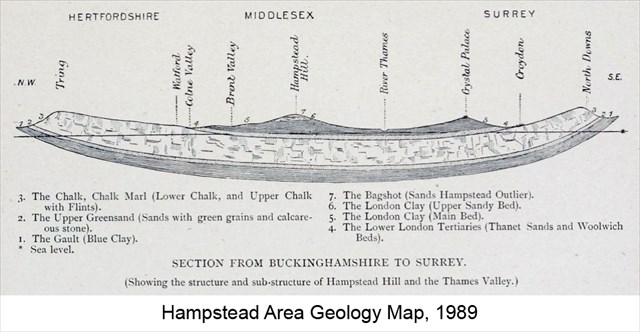
Hampstead Heath is a popular place to go for a walk, but not many people know that the Heath is also interesting geologically. Unlike most of London which rests directly on the layer of London Clay, parts of the Heath are capped with an extra layer of the Bagshot Sands. This even gave the name to a part of the Heath - the Sandy Heath.
The Bagshot Sands, called after the deposit first found in West Surrey, were laid down by a shallow coastal sea. The sand is fine-grained, ranging in color from yellow to deep orange and is rich in iron salts. This results in acidification of the soil, making the area unsuitable for agriculture. The sand has, however, found much use in local roadworks, brick-making, laying of railways and even as a filling for sandbags during the WW1 and WW2. Huge quantities of sand, gravel and clay were removed from the Sandy Heath, especially in the 1860s. The devastation of the area was such that The Illustrated London News wrote in 1871: "The very body of the earth has been cut away to an amazing depth … Holes are scooped out close to the high road thirty or forty feet deep, and big enough to bury the corpses of a nation for half a century … but ugly enough to deter the boldest survivor from approaching so ghastly a spot." Fortunately, the Metropolitan Board of Works aquired the area from Sir Thomas Maryon Wilson in 1871, stopping the destructive exploitation. Today the area is mostly covered in mature oak woodland and only the knolls scattered throughout are a reminder of the devastation inflicted century and a half ago.
At the published coordinates you will find two massive oak trees that pre-date the quarrying, standing on a little hummock and enclosed by a wooden fence. There are also two information boards on the opposite sides of the enclosure that will give you some information about the trees, and importantly for this cache, also about the Bagshot Sands.
In order to log this Earthcache, please send me the answers to following questions via my profile:
1) When was the Bagshot Sand laid down in this area?
2) Which other areas in London are capped by a layer of Bagshot Sand?
3) What makes the sand unsuitable as mortar?
4) What is the cause of the hummocks you can see around you?
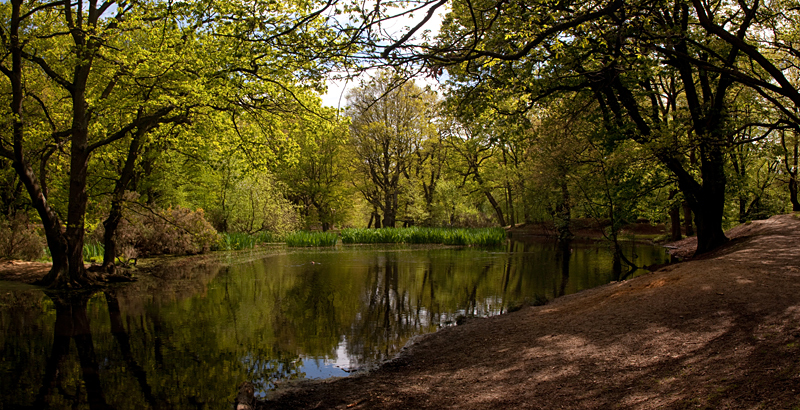
5) Proceed to the nearby Waypoint 2 where you will find one of the Sandy Ponds. Try to explain how these may have formed, bearing in mind the specific characteristics of Bagshot Sands, and describe where does the water come from (eg. spring-fed, stream-fed,...).
You don't need to wait for my response before logging your find. If there are any problems with your answers, I will contact you.
Any photos that you would like to upload with your logs are appreciated, although according to the rules, they are not mandatory.
Congratulations to The Bongtwashes for being the FTF
