Most Drive-In Movie Theaters consist of a large outdoor screen (either a wall painted-white, or a complex steel-truss structure with a complex finish), a projection booth, a concession stand and a large parking area for automobiles. Within this enclosed area, customers can view movies from the privacy and comfort of their cars.

The original Patent Drawings.
The idea originated in the early 1930's in Camden, NJ. and was Patented by Richard M. Hollingshead. His idea began as an experiment in his driveway with a Kodak Projector, mounted on the hood of his car, aimed at a screen that was attached to some trees. He tried different techniques and finally worked-out the parking-arrangement and spacing to allow everyone that attended, an unobstructed view of the screen. Once he had this idea in- place, he was granted a Patent in 1933 and He opened his first Drive-In Theater soon thereafter. This facility only lasted a few years before closing, but the idea caught-on elsewhere to become part of the American Pop-Culture and Landscape to-this-day.

Typical-style of Drive-In Theater Speakers with the Volume Knob.
Sound was originally produced from Speakers in the main screen tower, but the quality wasn't that good and many attempts were made to improve it. In 1941, the RCA corporation found a solution and along-came the in-car speakers with built-in volume controls that most drive-in patrons would come to know. These were better than the original Sound, but still had a very "tinny" sound to them. Later-on, as the technology improved, this system was replaced with Radio Broadcast equipment to allow the sound to be transmitted directly to the vehicles. This was an improved process for sound and also kept damage to the wired Speakers and/or patrons cars that would happen when folks would leave, after a good show of their favorite film, and some people would "forget to remove the speaker" and damage both the speaker and/or their cars in the process (i.e. Windows, or scratches/dents, etc.).
The popularity of the Drive-In's soared after World War II and peaked in the 1950's and 1960's. The theaters would provide cheap, family entertainment including many having a Playground (or other things) for their youngest patrons. For colder-weather, in-car heaters were also offered at many Theaters, much like the Speakers had been.

This type of heater plugged in to 120vAC (not 12V car power)
to warm your car during cold nights at the drive in movie.

An "intermission cartoon" to entice patrons to the Concession Stand.
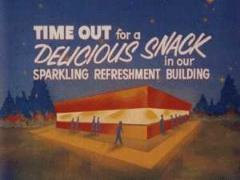
Another Intermission Ad
To this day, food revenue remains extremely important to exhibitors, especially with film rental rates going as high as 80% on opening weekends for some features. In order to promote the concessions, most locations used the now-famous drive-in intermission films, popularized by the Filmack Company, featuring dancing hot dogs and countdown clocks that were supposed to mesmerize the audience members, wet their pallets and open their wallets.
Many Theaters even had "car-hops" like their Drive-In Restaurant counterparts to make the experience even more appealing for their patrons.

A car-hop, taking an order (California)
The Drive-In owners would later allow other-uses for their large amounts of space which could only be used for the Theater after-sunset. This would usually generate more income for the theaters and some of these uses included Flea Markets, Swap Meets, and even Outdoor Church Services.
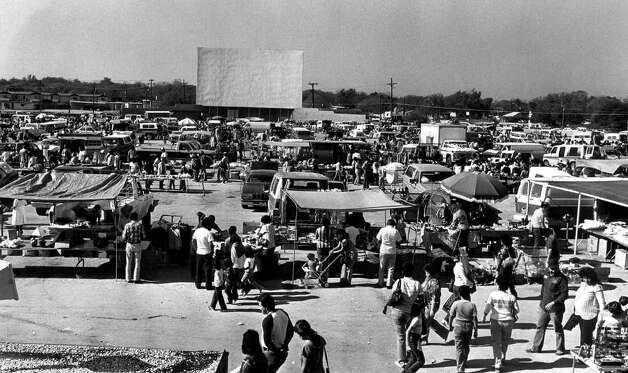
A typical Flea Market at the Mission Drive-In, San Antonio, Texas, 1984
Over time, with the advent of other sources of entertainment, as well as the rising cost of Real Estate and other economic factors, Cinematic Landmarks such as these have been slowly disappearing over the years, leaving less than 500 across the United States currently. Many of those which were closed were later demolished and the real-estate used for other things such as Office or Retail Space, with some being replaced on the exact same land with Mutli-Plex indoor Movie Theaters. Some properties have just been left vacant with nothing remaining there but an empty field. However, a very-select few that were closed have even re- opened to be given a new-life with new patrons looking for a very unique movie-going experience.
Many folks feel that these Gems of Americana are very much an endangered part of the landscape. Most, if not all of them, have very fond memories of their time spent there and would love to be able to revisit their favorite Drive-In Theater once again.
Ontario Cinema History:
The Skyway Drive-In Theatre
County Road 42 - Windsor, ONT
(updated May 24, 2013)
OPEN: 1940's-50's | CLOSED: 1985 | CAPACITY: 700 (est)

Main screen of the Skyway Drive-In (1950s)
The Skyway Drive-In opened in the late 1940's / early 1950's and was a single-screen 'smogger' throughout it's entire lifespan here along County Road 42 and was owned and operated by the Dydzak family.
The family also owned two other local Drive-In theatres: the Windsor Drive-In on Walker Road near Highway 3, and also one in St. Clair Beach. They definitely enjoyed their time as owners and made it a "family affair" to be sure.

The Dydzak Family at the Skyway's Snack Bar (1950)
Like many of the Drive In Theatres that were built, they were trying to attract and keep a family-atmosphere for their customers.
In the summer months, the theatre area would be "fogged" to control the mosquitos and bugs but unfortunately upset a few skunks along the way too. This caused more than just a couple folks to end up leaving the show early and have to deal with an everlasting odor from the upset critters.
 This was the scene at the Skyway drive-in on Aug. 30, 1986
One of the advantages to the theatre being outside was for those folks that smoked being able to enjoy their habit without disrupting or bothering others.
Economics changed as time went on, and many drive-ins closed in the mid-to- late-1980s. The introduction of VCRs meant more people were either staying home to watch movies or going to indoor movie theatres which were getting bigger screens and Dolby sound. This evolution would lead to the decline of "going to the movies" and folks staying-home.
Land values and prices began to go up and the suburbs gradually expanded around it. As the area built up, property taxes also increased until the taxes on the 20+ acres that most the drive ins occupied were more than the net income the theatre generated.
 Skyway Drive-In (1945) showing "Guest Wife" starring Claudette Colbert
After little more than half a century, an era of the Drive-In Theatre ended. Most people that visited Drive In's consider themselves lucky. Most don’t remember what movies they saw but many of them do remember how exciting it was to be outside late at night, loading up at the snack bar and then then trying not to fall asleep while watching the flickering movie screen from the comfy backseat of the car.
One theater goer summed up her feelings. "You just worry sometimes that it will be all gone. We felt so sorry to see those others all go. We really enjoyed this place."
Many folks feel that the Drive-in Theater is a part of an Endangered Americana that is missed by all who treasured the times that they had there due to both the places that are no longer there, as well as those times being shared with the PEOPLE that we shared them with.
IF you have any good-memories or stories of the Skyway Drive-In Theatre, please feel free to share in your logs.
Please BE AWARE OF YOUR SURROUNDINGS and as always, Enjoy the Hunt!