Brief History
Karori Cemetery is New Zealand's second largest burial ground, covering nearly 40 hectares.
It was the final resting place of about 83,000 people.
Today, it is a wealth of Wellington history and a peaceful place to visit.
The cemetery was established in 1891 to replace the overcrowded Bolton Street Cemetery.
The cemetery filled quickly and by the 1950s had nearly reached maximum capacity.
Makara Cemetery became Wellington's principal cemetery in 1965.
The only plots available now at Karori Cemetery are pre-purchased ash or family plots, and children's plots.
Karori Cemetery's crematorium was New Zealand's first crematorium and is the oldest in Australasia, opening in 1909.
It carries out about 450 cremations a year.
Please respect the sites and use the pathways for access.
Note that due to the condition of some of the memorials and monuments in the cemetery, children should be supervised at all times.
Note also the opening times of the cemetery for vehicle access that are published at the entrances.
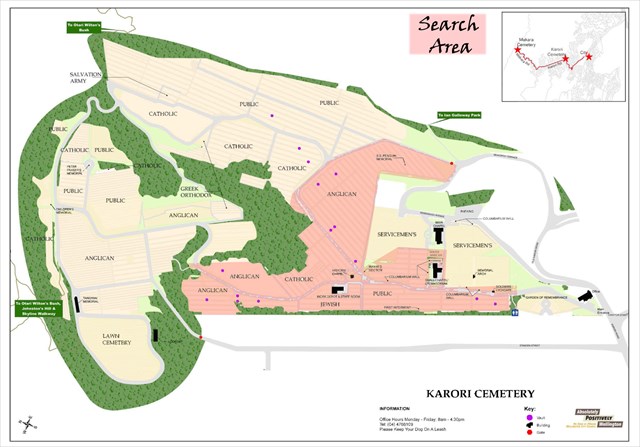
** To locate the cache you will need to locate these gravesites**
The answers to the questions at each grave will help you complete the quest.
You will need to complete the table below with the data gathered and it may pay to print this before setting out.

|
|
C1
|
C2
|
C3
|
C4
|
C5
|
C6
|
C7
|
C8
|
Totals
|
|
|
A
|
B
|
C
|
D
|
E
|
F
|
G
|
H
|
|
|
R1
|
|
|
|
|
|
|
|
|
|
|
|
I
|
J
|
K
|
L
|
M
|
N
|
O
|
P
|
|
|
R2
|
|
|
|
|
|
|
|
|
|
|
|
Q
|
R
|
S
|
T
|
U
|
V
|
W
|
X
|
|
|
R3
|
|
|
|
|
|
|
|
|
|
|
Totals
|
|
|
|
|
|
|
|
|
|
**The map below should help you with your search**

A Number of letters in Wife’s name (born 1852)
B Last digit on John’s bronze plaque
C No of letters in second named twin’s first name
D Number of letters in place where Ernest came from
E No of letters in word preceding “Flagstaff Hill”
F First digit of Gertrude's age when she died.
G Number of letters in vault’s family name
H Number of letters in vault’s family name
I No of letters in George’s youngest daughter’s name
J Date in July 1897
K Number of letters in vault’s family name
L Number of letters in ship’s name (ignore SS)
M Missing digit 10th July 19#8
N What son was Albert?
O No of different female names on marble plaque (SW side of vault)
P No of letters in last word on line “Accidentally killed.....”
Q No of times word “months” is on left side marble plaque
R Number of letters in town where person died
S Number of letters in Christian name
T No of letters in Christian name (after M) for date 1893
U No of letters in last “occupation” mentioned on base
V No of times name “William” appears on the 4 plaques minus two
W No of letters in the only country’s name recorded
X No of letters in the only daughter Christina’s first Christian name
Where R = sum of a row’s data and
C = sum of a column’s data
A = R3 minus R1
B = C4 minus C3
C = C3 minus C2
D = C2 minus C1
W = (R1 +1) minus R2
X = C5 minus C7
Y = C6 minus C8
Z = half of (C1 plus 1)
Checksum for the three Row totals is 146
Chronology of Karori Cemetery
1842 Bolton Street and Mount Street Cemeteries established.
1882 Cemeteries Act passed.
1890 Karori wins a ballot for the site of the new cemetery.
McKenzie brothers agree in principle to accept the council’s offer for their land.
The Council raises loan of £7500 for new cemetery.
1891 McKenzie brothers and council sign sale agreement. Work completed on new road from Polhill Gully to Karori.
August 1891 Frederick William Fish, an infant, is first burial at Karori Cemetery.
Public shelter built in cemetery, later to be named Mortuary Chapel.
February 1892 First regular burials at Karori. Church burials consecrated. Sexton E.A. Nash appointed.
1892 Shelter converted into chapel.
1903 Second public burial section opened.
1909 Crematorium built to a design by John Sydney Swan.
1913 Second Church of England (Anglican) burial section opened.
1918 World War I ends. First organised burials of soldiers in cemetery.
Influenza epidemic claims hundreds of Wellingtonians and cemetery has busiest period of its history,
with 63 people buried on one day in November alone.
1921 Lychgate built in Services Cemetery.
1931 Memorial Arch built in Services Cemetery.
1932 Sealing of main road begins. Other roads and paths progressively sealed over following decades.
1934 A large group of unemployed workers is put to work in the cemetery.
Walking track from Wilton to Karori built through cemetery land. Third public burial section opened.
1937 WCC land near the Standen Street gates set aside for cemetery purposes.
Later used for Wellington’s first lawn cemetery. First columbarium constructed behind crematorium.
Construction of new crematorium mooted. First Greek Orthodox burial section opened.
1944 Mayor of Wellington, Will Appleton, announces the establishment of a lawn cemetery.
1945 Second Catholic burial section opened.
1947 Gray Young, Morton and Young draw up plans for new crematorium chapel, to be built above Services Cemetery.
1948-49 Second columbarium constructed alongside old crematorium chapel.
1951 Lawn cemetery at Standen Street opened.
1953 76 of the victims of the Tangiwai Disaster are buried in cemetery.
1955 Third columbarium built between road and Services Cemetery. Second Greek Orthodox burial section opened.
1957 Tangiwai Memorial opened in cemetery.
1959 New crematorium chapel finished but not opened until 1960.
1960 Rose garden established near main entrance.
1962 Fourth columbarium built alongside main drive near Mortuary Chapel.
March 1965 Makara Cemetery opens for burials.
1966 Garden of Remembrance opened alongside new crematorium.
1972 Decision made to plant trees on cemetery slopes facing Wilton and Northland, after complaints from local residents’ association.
1973 A peak of crematorium use is reached, with up to 14 disposals a day.
1974 Main denominational and Roman Catholic areas closed to new plot purchasers.
1984 Internationally significant stained glass windows in old crematorium chapel restored.
February 1988 50 headstones in Chinese section vandalised.
1991 Cemetery centenary. Rose Garden redesigned and rebuilt.
New gates installed at main entrance and Seaforth and Standen Street entrances.
Open day held and Frederick William Fish’s grave, the first in the cemetery, located and restored.
1990s Fifth and last columbarium built alongside Rosehaugh Avenue crematorium chapel.
1994 Permission given for ash disposal and bronze plaque mounting in Rose Garden.
2001 Certification to ISO 9001 was gained in September 2001
2003 SS Penguin walk opened
Map with red dots amended from part of a WOC orienteering map.
If you have enjoyed this map reading exercise why not find out more about orienteering at
http://wn.orienteering.org.nz/