CITO 2013 - Thales of Miletus Mystery Cache
CITO 2013 - Thales of Miletus
Please note Use of geocaching.com services is subject to the terms and conditions
in our disclaimer.
This cache was planted for the "Cache In Trash Out" event in Athens the 20th of April 2013. The area chosen, the "Environmental Awareness Park Antonis Tritsis", is a park that needs "Caches In" and "Trash Out". The cache is located at the coordinates you will calculate after solving a simple geometry problem using "Thales theorem". But first thing first, few info about Thales of Miletus


Thales of Miletus (pron.: /ˈθeɪliːz/; Greek: Θαλῆς, Thalēs; c. 624 BC – c. 546 BC) was a pre-Socratic Greek philosopher from Miletus in Asia Minor, and one of the Seven Sages of Greece.
Many, most notably Aristotle, regard him as the first philosopher in the Greek tradition.[ According to Bertrand Russell, "Western philosophy begins with Thales."Thales attempted to explain natural phenomena without reference to mythology and was tremendously influential in this respect. In mathematics, Thales used geometry to solve problems such as calculating the height of pyramids and the distance of ships from the shore.
He is credited with the first use of deductive reasoning applied to geometry, by deriving four corollaries to Thales' Theorem. As a result, he has been hailed as the first true mathematician and is the first known individual to whom a mathematical discovery has been attributed. In geometry, Thales' theorem (named after Thales of Miletus) states that if A, B and C are points on a circle where the line AC is a diameter of the circle, then the angle ABC is a right angle.
Thales' theorem is a special case of the inscribed angle theorem, and is mentioned and proved on the 33rd proposition, third book of Euclid's Elements. It is generally attributed to Thales, who is said to have sacrificed an ox in honor of the discovery, but sometimes it is attributed to Pythagoras.
The intercept theorem, also known as "Thales' theorem" (not to be confused with another theorem with that name), is an important theorem in elementary geometry about the ratios of various line segments that are created if two intersecting lines are intercepted by a pair of parallels. It is equivalent to the theorem about ratios in similar triangles. Traditionally it is attributed to Greek mathematician Thales.
Measuring the Width of a River
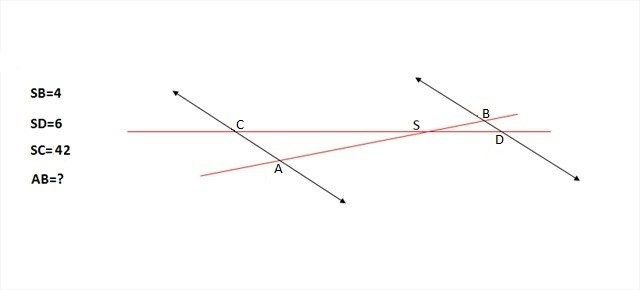
The final coordinates of the cache are: N 38 02.9AB E 023 43.387
To find the final coordinates of the cache you have to think as Thales did in the intercept theorem, finding the AB at the following schema
To be able to solve the puzzle cache, "CITO 2013 BONUS cache" you have to write down the letter that is written on the logbook and on the container and collect also the letters from the rest "Cito 2013..." caches.
More information about Thales of Miletus at: Wikipedia and at, IEP
Additional Hints
(Decrypt)
gur pbagnvare vf -> 0, 1, 1, 2, 3, 5, 8, 13, 21, 34, 55, 89, 144,...
Treasures
You'll collect a digital Treasure from one of these collections when you find and log this geocache:

Loading Treasures