

Starorzecze Pisy w okolicy Jazowej Góry
O miejscu:
Rzeka Pisa wypływa z jeziora Roś i płynie przez wschodnią część Puszczy Piskiej oraz Równinę Kurpiowską, po czym wpada do Narwi jako prawy dopływ w okolicach Nowogrodu. Rzeka ma długość ok. 80 km. Łączy Krainę Wielkich Jezior Mazurskich z Wisłą. Jest typową rzeką nizinną. Ze względu na swoją głębokość (na nurcie ponad 1 m), jest rzeką żeglowną. Na całym odcinku wije się i silnie meandruje, można także zaobserwować charakterystyczne elementy krajobrazu nadrzecznego: łachy piaskowe oraz urzekające starorzecza. Szlak łatwy, nieuciążliwy. Ciekawostką jest, iż jest to jedyna rzeka w tej części Europy, która płynie od początku do końca w kierunku południowym.
Charakterystycznym elementem środowiska w rozwoju każdej rzeki są pozostałości po jej dawnym korycie, czyli tzw. starorzecza. Powstają one w sposób naturalny, jak i dzięki regulacjom prowadzonym na rzekach. Warunki powstania starorzeczy są ściśle powiązane z procesami erozji. Przewaga erozji bocznej nad erozją denną na danym odcinku rzeki powoduje odcięcie meandrów, tworząc zbiorniki zwane starorzeczami. Nieregulowana rzeka płynie po terenie płaskim wieloma odnogami w sposób bardzo kręty, tworząc głębokie pętle – zakola; brzeg wklęsły jest rozmywany, wypukły – namywany (odkładanie rumowiska), wysokie wody skracają sobie drogę – kształtują nowe, prostsze koryta, pozostawiając częściowo, a czasem całkowicie odcięte starorzecze. Istoty wpływ na kształtowanie się starorzeczy mają takie czynniki jak: budowa geologiczna, hydrologiczny rzeki, a także parametry geomorfometryczne i glebowe oraz zagospodarowanie zlewni. Starorzecza, które powstały naturalnie często nie mają stałego połączenia z rzeką i zwane są jeziorami rzecznymi. Są one przeważnie niewielkimi i płytkimi akwenami, dzięki czemu szybko ulegają procesowi sukcesji, zarastają roślinnością i zanikają z powierzchni ziemi.
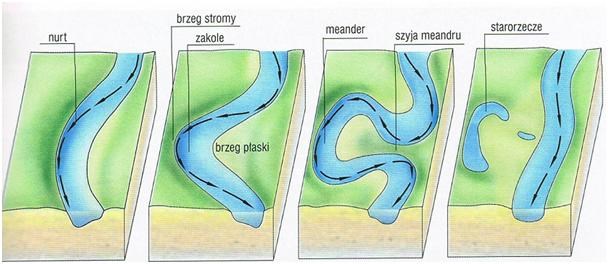
Powstawanie starorzecza
Earthcache:
Żeby zalogować tę skrzynkę musisz odwiedzic to miejsce i wysłac poprawne odpowiedzi na zadane pytania. Brak odpowiedzi będzie powodem usunicia wpisu. Po wysłaniu odpowiedzi na pytania, proszę o logowanie earthcache’a, jeśli odpowiedzi będą błedne, napisze do ciebie. Odpowiedzi mogą być przesyłane w języku polskim lub angielskim. Mile widziane są zdjęcia!!!
Pytania:
1. Podaj wysokość klifu nad rzeką.
2. Jak myslisz czy proces erozji juz się zakończył w tym miejscu? Czy rzeka nadal podmywa piaszczysty klif?
3. Opisz piasek na klifie, jaka ma budowe(czy jest on gruby czy drobny, sypki czy zbity). Jakiego pochodzenia może on być?
About this spot:
The Pisa River flows from Roś Lake, situated in the Municipality of Pisz, through the eastern part of the Piska Primeval Forest and the Kurpie Plain, and discharges into the Narew River as its right tributary near Nowogród. The river is about 80 km long and joins the Great Mazurian Lakes with the Vistula River. It is a typical lowland river whose depth (over 1 m of current) makes it a navigable river which winds and meanders along its entire length. It is also characterized by distinctive elements of riverside landscape: sandbanks and oxbow lakes. The trail is easy and does not require great effort. An interesting point to note is that the Pisa River is the only river in this part of Europe that flows southwards from its beginning to the end.
An oxbow lake is formed when a river creates a meander, due to the river's eroding the bank through hydraulic action, abrasion and corrosion. After a long period of time, the meander becomes very curved, and eventually the neck of the meander will become narrower and the river will cut through the neck at a time of flood, cutting off the meander and forming an oxbow lake. When a river reaches a low-lying plain, often in its final course to the sea or a lake, it meanders widely. In the vicinity of a river bend, deposition occurs on the convex bank (the bank with the smaller radius). In contrast, both lateral erosion and undercutting occur on the cut bank or concave bank (the bank with the greater radius.) Continuous deposition on the convex bank and erosion of the concave bank of a meandering river cause the formation of a very pronounced meander with two concave banks getting closer. The narrow neck of land between the two neighboring concave banks is finally cut through, either by lateral erosion of the two concave banks or by the strong currents of a flood. When this happens, a new straighter river channel is created and an abandoned meander loop, called a cutoff, is formed. When deposition finally seals off the cutoff from the river channel, an oxbow lake is formed. This process can occur over a time scale from a few years to several decades and may sometimes become essentially static.
Earthcache:
To log this earthcache you have to visit this place and send the correct answers to the questions. No response will cause deletion of the log. After sending the response to the questions, please login earthcache'a if the answers are wrong, I’ll let you know. Replies can be sent in English or Polish. Photos are more than welcome!
Questions:
1. Tell me the hight of the cliff by the river?
2. What do you think has the erosion process ended in this place? Is the river still undermining sandy cliff.
3. Describe the sand on a cliff (is it thick or fine, loose or dense). What origin does it have?.