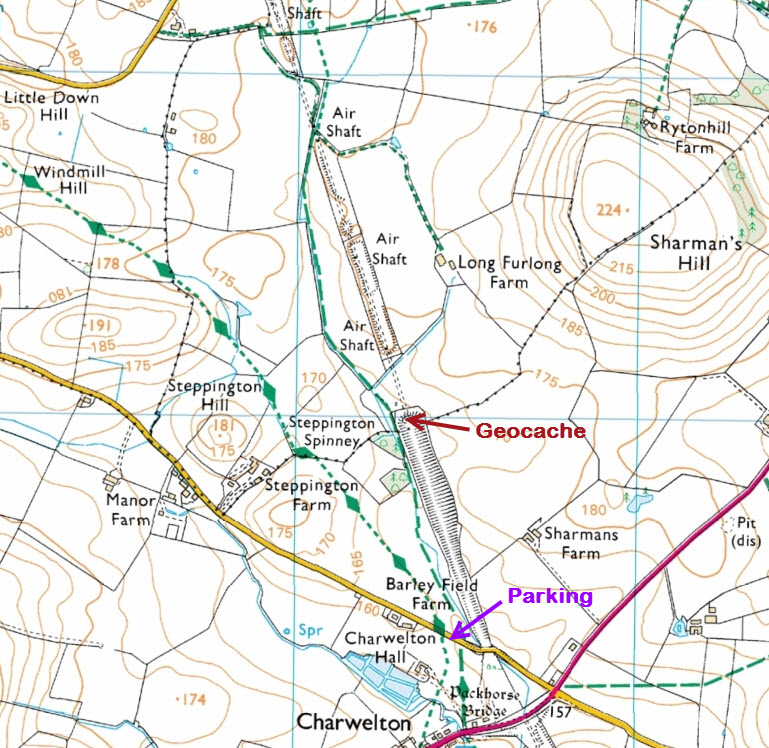
The 2,997-yard structure was cut by T Oliver & Son of Horsham as part of the Great Central's 'London Extension' construction contract No.4. It passes through the upper beds of the lower Lias and the lower beds of the middle Lias. 27 feet wide and 25 feet 6 inches high, Catesby is straight throughout and on a rising gradient of 1:176 to the south, with the summit of this section reached as daylight resumes.
Its creation demanded round 290,000 cubic yards of mining. Work to sink the first shaft began on 18th February 1895 and the last length was keyed in on 22nd May 1897 - a remarkably quick average rate of 110 yards per month. Progress was greatly accelerated by the use of Ruston steam navvies (cranes).
The tunnel was mostly driven from nine construction shafts, each equipped with wooden headgear which was used to lower materials to the men working beneath. None though was permitted within 500 yards of the north portal due to the landowner, Mr Attenborough, wanting to maintain the privacy of his residence which stood close to the workings. As a result, 264 yards through very heavy ground had to be constructed by means of a 12x10ft bottom heading and break-ups. This proved liable to breakages and one part completely collapsed. The surrounding strata was under significant pressure which resulted in a heavy lining of seven rings in the arch and side walls, with six rings in the invert. These were divided into 10-foot lengths.

Cut-and-cover was used for the first 44 yards from the north portal. The length adjoining this had so little ground above it that the two crown bars were laid from a trench on the surface.
The remainder of the tunnel proved relatively light work and was driven full-sized without headings. Here the lining is mostly five rings thick with a four-ring invert, all faced with Staffordshire brindle and built in lime mortar. Around 30 million bricks were swallowed up by the structure.
Very little water ingress was experienced, amounting to around 80 gallons per minute. Chases were built into the back of the brickwork at intervals, leading to pipes built through the side wall at rail level. Water was then discharged into a culvert in the six-foot, accessed via deep catchpits.
Ventilation is provided by five shafts. Four of these are 10 feet in diameter but the northernmost - 1,250 yards from the entrance - is 15 feet wide to provide greater air flow. The landowner did not want his view blighted by rising smoke either! Yet despite this, his accommodation was rewarded with the naming of a bridge after him: the first crossing of the railway north of the tunnel is called Attenborough No.1. The first belch of smoke up the shafts occurred on 25th July 1898 when coal services started running.

Trackworkers were relatively well served with regular refuges provided on both sides and three rest cabins built into the Up sidewall. One is located directly opposite the tablet that marks the "half way" point.
Catesby Tunnel retired from operational service on 3rd September 1966 since which time the permanent way has been removed. Water ingress compounded by a blocked drain just north of the fifth shaft means that, in places, it is flooded to a depth of a foot or more. Calcite makes it presence felt with some extraordinary formations.

You can read more about Catesby Tunnel at warwickshirerailways.com
A simple magnetic micro cache just off the footpath between Catesby and Charwelton. Have Fun!!!