A number is a mathematical object used to count, label, and measure. In mathematics, the definition of number has been extended over the years to include such numbers as 0, negative numbers, rational numbers, irrational numbers, and complex numbers. Mathematical operations are certain procedures that take one or more numbers as input and produce a number as output. Unary operations take a single input number and produce a single output number. For example, the successor operation adds 1 to an integer, thus the successor of 4 is 5. Binary operations take two input numbers and produce a single output number. Examples of binary operations include addition, subtraction, multiplication, division, and exponentiation. The study of numerical operations is called arithmetic. A notational symbol that represents a number is called a numeral. In addition to their use in counting and measuring, numerals are often used for labels (telephone numbers), for ordering (serial numbers), and for codes (e.g., ISBNs). In common usage, the word number can mean the abstract object, the symbol, or the word for the number.
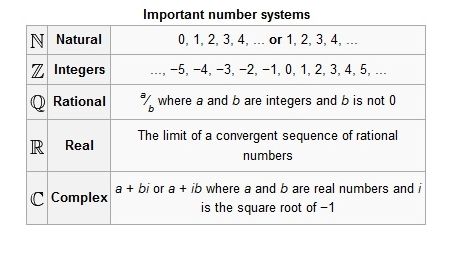
The most familiar numbers are the natural numbers or counting numbers: 1, 2, 3, and so on. Traditionally, the sequence of natural numbers started with 1 (0 was not even considered a number for the Ancient Greeks.) However, in the 19th century, set theorists and other mathematicians started including 0 (cardinality of the empty set, i.e. 0 elements, where 0 is thus the smallest cardinal number) in the set of natural numbers.[citation needed] Today, different mathematicians use the term to describe both sets, including 0 or not. The mathematical symbol for the set of all natural numbers is N, also written N0 or N1 when it is necessary to indicate whether the set should start with 0 or 1, respectively. In the base 10 numeral system, in almost universal use today for mathematical operations, the symbols for natural numbers are written using ten digits: 0, 1, 2, 3, 4, 5, 6, 7, 8, and 9. In this base 10 system, the rightmost digit of a natural number has a place value of 1, and every other digit has a place value ten times that of the place value of the digit to its right. In set theory, which is capable of acting as an axiomatic foundation for modern mathematics, natural numbers can be represented by classes of equivalent sets. For instance, the number 3 can be represented as the class of all sets that have exactly three elements. Alternatively, in Peano Arithmetic, the number 3 is represented as sss0, where s is the "successor" function (i.e., 3 is the third successor of 0). Many different representations are possible; all that is needed to formally represent 3 is to inscribe a certain symbol or pattern of symbols three times.
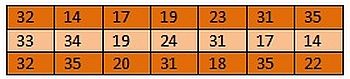
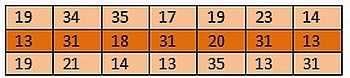
The cache can be found at South starting with 33 and East starting with 018.
Well done Terunkies on being FTF.