Credit River - RMS Empress of Ireland Traditional Cache
Credit River - RMS Empress of Ireland
-
Difficulty:
-

-
Terrain:
-

Size:  (micro)
Please note Use of geocaching.com services is subject to the terms and conditions
in our disclaimer.
Credit River - Shipwreck Series
RMS Empress of Ireland
29 May 1914
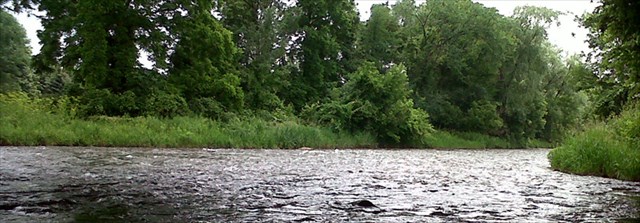
There are many shipwrecks around the world. Some very famous and others not so. Each however has it’s own story to tell. As you travel along the Credit River doing this series of caches, we have highlighted a number of these shipwrecks. During low water levels on these parts of the Credit River, you need to be careful in a canoe or kayak so as you don’t wind up in your own shipwreck. Besides the many large rocks along the way, there are also some other obstacles such as dams which should be avoided. All of the geocaches in this series have been placed by tubing, inflatable boat or on foot by walking in the water along the Credit River. Whichever way you choose to search for these caches, use caution and common sense.
More information about this series can be found here: Credit River - Shipwreck Series
RMS Empress of Ireland
Canada’s deadliest peacetime Maritime disaster didn’t happen at sea or even on the sometimes dangerous Great Lakes, nor did it even happen in stormy weather.
RMS Empress of Ireland was an ocean liner that sank in the Saint Lawrence River following a collision with a Norwegian collier in the early hours of 29 May 1914. Of the 1,477 persons on board the ship, the accident claimed the lives of 1,012 (840 passengers, 172 crew).
The Empress of Ireland departed Quebec City for Liverpool on 28 May 1914 with 1,477 passengers and crew. Henry George Kendall had just been promoted to her captain at the beginning of the month, and it was his first trip down the St. Lawrence River in command of her.
In the early hours of the next morning on 29 May 1914, the ship had reached Pointe-au-Père, Quebec (or Father Point) near the town of Rimouski where the pilot was disembarked. Shortly after resuming her journey, and on a normal outward bound course of about N76E, she sighted the masthead lights of a steamer, which proved to be the Norwegian collier Storstad, on her starboard bow at several miles distant. Likewise, the Storstad abreast of Métis Point (Métis-sur-Mer) and on a course W. by S., sighted the Empress' masthead lights. At the time of these first sightings the weather conditions were clear, but very soon the ships were shrouded in the notoriously dangerous fog. Shortly afterwards, and despite the fog whistles of both ships being repeatedly blown, the Storstad crashed into the Empress' side.
The Storstad did not sink, but the Empress – with severe damage to her starboard side – listed rapidly, taking on water. Most of the passengers and crew in the lower decks drowned quickly when water poured into her from the open portholes, some of which were only a few feet above the water line. However, many passengers and crew in the upper deck cabins, awakened by the collision, made it out onto the boat deck and into some of the lifeboats which were being loaded immediately. Within a few minutes of the collision, the ship listed so far on her starboard side that it became impossible to launch lifeboats (beyond the three already launched). Ten or eleven minutes after the collision, she lurched violently on her starboard side, allowing as many as 700 passengers and crew to crawl out portholes and decks onto her side. For a minute or two, she lay on her side, while it seemed to the passengers and crew that the ship had run aground. But a few minutes later, about 14 minutes after the collision, her stern rose briefly out of the water, and her hull sank out of sight, throwing the hundreds of people still on her port side into the near-freezing water. The disaster resulted in the deaths of 1,012 people.
As reported in the newspapers at the time, there was much confusion as to the cause of the collision with both parties claiming the other was at fault. If the testimony of both captains were to be believed, the collision happened as both vessels were stationary with their engines stopped. As noted at the subsequent inquiry, the witnesses from the Storstad said they were approaching so as to pass red to red (port to port) while those from the Empress said they were approaching so as to pass green to green (starboard to starboard), but "the stories are irreconcilable".
Ultimately, the immense loss of life can be attributed to three factors: the location in which Storstad made contact, failure to close the Empress' watertight doors, and failure to close all portholes aboard. It was later revealed in testimony from surviving passengers and crew that nearly all of her portholes were left open by the passengers and crew who craved fresh air from the cramped and poorly ventilated staterooms. Under maritime 'Safety of Life at Sea' regulations all portholes (that are capable of being opened) should be closed and locked before the ship leaves port, but this rule was frequently broken especially in sheltered waters like the St. Lawrence River. When the Empress began to list to starboard, the water poured through the open portholes, flooding parts of her that were not damaged by the collision, and once that water hit nearly all the decks and compartments, her end was inevitable.

Additional Hints
(Decrypt)
Pnzb'q ghor unatvat sebz bar bs gjb ynetr yvzof bire gur jngre. Zbfg fbhgurea yvzo, nobhg 10 srrg sebz raq. Jvyy yvxryl unir gb fgnaq ba gur oenapu gb frr gur pbagnvare.
Treasures
You'll collect a digital Treasure from one of these collections when you find and log this geocache:

Loading Treasures