THE CACHE IS NOT AT THE POSTED COORDINATES
(however they are a good place to park for this cache)
I’m Going Ballistic
This is the first in what I hope will be a series of projection caches loosely based upon ballistic trajectories. The inspiration for this cache came from GC49TP8 Pool Party Projection by StealthRT.
The Cache
Ahoy, Captain!
Two days ago, you and your swashbuckling pirate crew overtook and plundered a warring vessel from which you seized a relatively new 32-pounder cast-iron cannon. After hoisting this new piece aboard your warship, The Ballistic, you immediately set about determining the cannon’s range so that you could use it effectively in future battles. You owe much of your success on the high-seas not only to guile and ruthlessness, but also to your respect for math and physics. You are centuries ahead of your time.
You know that cannons such as this degrade quickly and often are useless after as few as 500 firings, so having a good idea of the cannon’s firing efficiency is essential to using it well. On your orders, your crew has anchored The Ballistic at the listed coordinates, just south-west of a small island with a long beach that is perfect for range testing your new armament. Your landing crew will then measure the distance to the crater to determine the cannon’s efficiency.
You instruct your crew to aim the cannon 35° East of North and at the vertical angle that provides the maximum range for your projectile. Your battle-tested bunch of misfits knows from experience that the proper angle to maximize the cannon’s range is 45° from horizontal. Additionally, from your previous experiments, you know that your standard "test” charge in a brand new 32-pounder is expected deliver a muzzle exit velocity of 130 ft/sec.*
Based upon this information, and assuming that your newly acquired cannon will fire with the efficiency of a new one, you’ve calculated the expected distance that the ball will travel. Your landing crew will start its search for the ball based on your calculations.
What’s the starting location of your landing crew’s search? Determine that and you’ll find GZ.
You may assume that elevation of the cannon’s muzzle and the elevation of the beach are the same. Also, you may assume that you are operating under ideal conditions in which there is no drag or lift attributable to air resistance or spin of the ball. Finally, assume Earth’s gravity at this location is -32.2 ft/sec^2.
You can use the coordinate checker below to validate your solution.

*Historical Fact: Muzzle velocities for early 18th century smooth bore 32-pounders such as this often would be around 1,700 ft/sec when a battle charge was loaded.
The cache is a 3.5 for difficulty due the compound nature of figuring out the distance the ball should travel, then executing the projection, and finally finding and retrieving the physical cache. The rating could have been higher, but the ease with which one can find plug-n-chug equations on the internet (and at the end of the following lesson) knocks it down a peg. Therefore, I’m not attempting to test your ability to derive the needed equation to solve this puzzle (although future caches in this series may require just that). The physical cache itself is a 2 for difficulty and 3.0 for terrain (because it could be a booger to actually retrieve). Please review the attributes carefully.
Congratulations to kvenator for FTF!
Good luck and good caching!
The Lesson
The curious thing about ballistic trajectories, which to many seems counter-intuitive, is that the vertical component of the motion and the horizontal component of the motion are entirely independent. This means the effect of gravity is completely independent of the horizontal motion of the projectile. For example, a ball dropped from a given height and a ball shot horizontally from a gun over level ground will take the same amount of time to strike the ground. This is a powerful observation as it allows us to create two sets of independent equations that when combined, allow us to solve for the range of a projectile, given only its initial velocity and initial inclination from horizontal.
To find the range of a projectile, we must first resolve the vector of it's initial velocity v0 into it's horizontal and vertical components, vx0 and vy0 respectively.
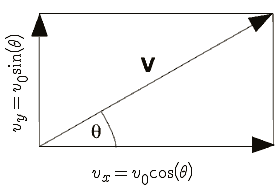
Applying basic trigonometry, we find:
 (Eq. 1)
and
 (Eq. 2)
Solving for vy0 and vx0, we find:
 (Eq. 3)
and
 (Eq. 4)
Equations 3 and 4 match the diagram above and independently describe the vertical and horizontal components of the ball's initial velocity.
Because we've neglected all aerodynamic effects, the horizontal velocity, vx of the ball will remain constant for the duration of its flight. That is:
 (Eq. 5)
Since the horizontal velocity is constant, the horizontal distance the projectile travels, or it's horizontal range R, is determined simply by multiplying the initial horizontal velocity by the time t that marks the duration of its flight as shown in Equation 6.
 (Eq. 6)
Now we are left to describe the length of time the projectile will be in the air. First let's start with a description of velocity in a space of constant acceleration as shown in Equation 7:
 (Eq. 7)
We will be using this equation to determine how long the projectile is in the air. In our case we'll use the vertical component of the projectile's velocity from Equation 3 to determine how long the projectile if shot straight up in the air would take to decelerate to a velocity of zero. To that we'll add the time it would take for the projectile to fall back to it's final elevation. The time t' required for the projectile to reach a vertical velocity of zero can be found using Equation 7 after we substitute the Earth's gravitational constant g for a and set vyt' = 0.
 (Eq. 8)
Now we'll solve Equation 8 for t', the time required for the ball to reach it's apogee:
 (Eq. 9)
Substituting Equation 3 into Equation 9 for vy0 we find:
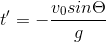 (Eq. 10)
We've now found the time t' it will take for the projectile to rise to its apex. In our case, since we've assumed the deck of the ship and the beach are at the same elevation, the time required for the projectile to fall back to it's starting elevation is precisely the same as the time it took to reach it's maximum height. Thus the total time t is twice that of t' giving us:
 (Eq. 11)
Substituting Equation 11 into Equation 6 and rearranging gives us a description of the horizontal range of the projectile in terms of t':
 (Eq. 12)
Additionally, when we substitute Equation 4 and Equation 10 into Equation 12 for vx0 and t' and rearranging, we obtain:
 (Eq. 13)
Now would be a good time to recall the following trigonometric identity:
 (Eq. 14)
Substituting Equation 14 into Equation 13 we find:
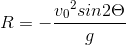 (Eq. 15)
Equation 15 gives the formula needed to solve the puzzle. That is, the range of a projectile, when one assumes no change in elevation, and no drag, can be defined as:
(Range of Projectile)
Where:
R = range of projectile
v0 = velocity of projectile at time = 0
g = gravitational rate of acceleration
θ = the angle of v0 from horizontal
We can take this equation one step further to validate that the angle that maximizes the projectile's range is indeed 45 degrees. To maximize R, we need to maximize sin2θ. We know from the unit circle that the sin function reaches it's maximum value of 1 at 90°. So if 2θ = 90°, then θ = 45° confirming what your crew already knew.