Otira
is in the highest earthquake hazard area in New Zealand and is located 20km southwest of the active Alpine Fault along the Australian-Pacific plate boundary. There are 14 known active faults within 50km capable of generating Magnitude 7 to 8 events. This seismically active area is a common cause of major landslides.
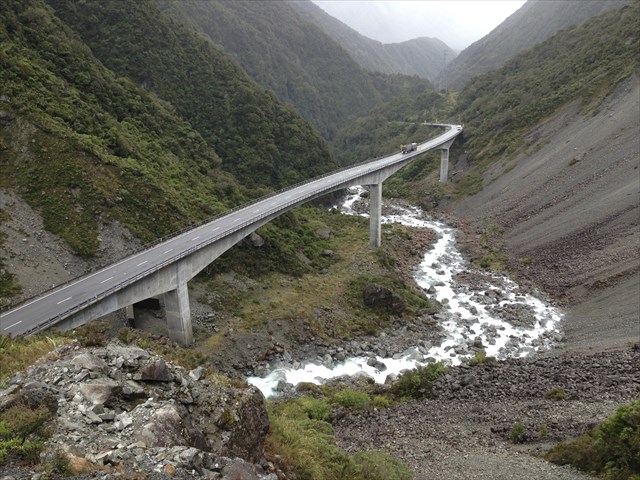
The 1929 Murchison earthquake caused a significant section of the Arthurs Pass Highway below you to slip into the Otira River. Frequent erosion from the 1940s followed which required the highway to be realigned — a process that continued for the next 50 years in order to keep the route open.
Sections of the highway were progressively moved uphill across an old landslide path creating the Zig Zag (Figure 1) until eventually it became infeasible to maintain the highway due to the increased risk that another large landslide would permanently close the highway.
Planning started back in the mid-1980s with design options being developed in the 1990s that presented a new earthquake and landslide resistant highway solution.
The solution is below you. The construction of the Otira Viaduct and continuation of the Arthurs Pass Highway (State Highway 73) were completed in 2000 and connects Canterbury with Westland as it winds its way through the mountains of the New Zealand Southern Alps.
Where you are standing used to be part of the old Zig Zag and is known as
Deaths Corner.

Figure 1. The Zig Zag
Lesson One: Slip, sliding away
Deaths Corner is what remains of a massive rock landslide some 2000 years ago that dammed the valley. It is likely that this was caused by an earthquake allowing rock from the mountain ridge 700m above to fall into the river. Over time the captive river managed to cut its way through the wall of rock creating the river we recognise today.
The alpine terrain that surrounds you consists of hard Greywacke rock with steep high slopes which can develop into landslides that range from rock avalanches which shape mountain peaks to massive rock slides, rock falls and debris flows.
Whole mountainsides can collapse; displacing millions of cubic metres of material at tremendous speed (as high as 200kph) while smaller landslides can be centimetre slow and shallow.
Landslides are categorised by the material (rock, debris, or earth) and then by the movement as shown in Figure 2.
Figure 2. Land Movement Types
To produce a significant landslide, any or a combination of these factors is required:
1. Pre-conditions, such as weak rock and steep slopes.
2. Preparatory factors are processes that further weaken the slope, such as deforestation or undercutting by streams.
3. Triggering factors, such as intense rainstorms (100 millimetres or more in 24 hours) and large earthquakes (magnitude 7 or greater).
Lesson Two: Surrounded by Rock
The Arthur's Pass highway is one of the main alpine routes (Haast and Lewis Passes are the others) that cross the South Island and traverses entirely through Rakaia Terrane rock.
The Rakaia Terrane is made up of mostly marine sandstone and mudstone known as Greywacke (yep, this area used to be under an ancient ocean), which has been dated as belonging to the Permian to late Triassic age, 290–206 million years ago as shown in Figure 3.
Figure 3. New Zealand Geologic Time Scale
Greywacke sandstone forms the backbone of the Southern Alps and contains a substantial variety of minerals including quartz, feldspar, mica, biotite (red-brown colour), epidote and rare garnet.
Rakaia Terrane Greywacke is strong, hard and variably jointed ranging in size from sand to massive boulders. You can see, and may have noticed on your journey here, that slopes cut in fresh rock appear stable, whereas rocks in very steep faces tend to form as landslides.
As greywacke makes up the main mountain ranges in New Zealand, most of the material being eroded from the mountains is greywacke, so boulders and stones of Greywacke are abundant in most rivers and beaches around the coastline.
Several greywacke boulders located in the river valley have cultural significance to the local Māori as markers for the Greenstone Trail.
Answer the following questions to log your visit
1. Greywacke is the predominant rock throughout Otira and it makes up significant portions of New Zealand. Right now you'll be standing on plenty of good examples, although I prefer the bigger chunkier versions under the nearby pylon. Describe the texture and colouration of a sample rock.
2. Looking around you describe in your own words why the slope above the viaduct is prone to landslide?
3. Given what you have learnt about landslides what name would you give to the landslide movement type here?
4. At Deaths Corner the topography is mountainous where the Southern Alps rise from near sea level to a height of over 2200 metres. Using your GPSr, what is your precise elevation at GZ? If you use a smartphone you may upload a photo of GZ.
The answers to the questions are easily found within this page and at GZ. Please email me your answers using the link off my profile page. You can expect an emailed reply within 12 hours confirming your opportunity to log your visit. Please do not post the answers in your log.
You can also collect my Shareable for your find. Surely that's worth a favourite!
What are Shareables?
Shareables™ are custom digital artwork that players can create, collect, and share with the geocaching community. A Shareables subscription is not included with Premium membership.
Shareable creators can gift them to other players by linking them to geocaches they own, gifting them to cache owners through cache logs, or sending them to nearby players in person using the Geocaching® mobile app (version 10.14.1+ on iOS and Android).
Any player can collect Shareables.