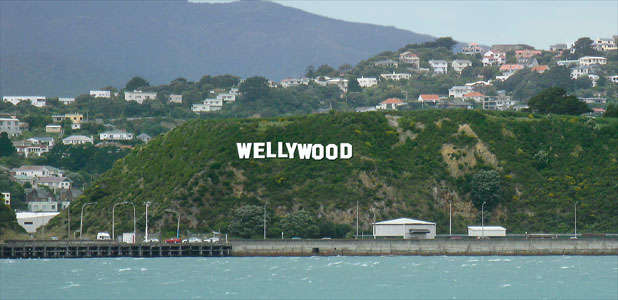
Welcome to WELLYWOOD, a series of caches designed to enlighten you and show you around some of the wonderful locations in 'the coolest little capital of the world'.
You will be required to do some 'pre-work' to complete and find some of these caches, while others will require you to do some exploring 'out in the field', and some will require a combination of both. Most caches can be found in the greater Wellington area, although there may be a few that are further afield. We hope you enjoy the series.

Sir Francis Henry Dillon Bell
Sir Francis Henry Dillon Bell GCMG KC (31 March 1851 – 13 March 1936) was the first New Zealand-born Prime Minister of New Zealand. Bell is one three New Zealand Prime Ministers of Jewish extraction, the others being Julius Vogel and current Prime Minister John Key.
Early life
He was born in Nelson, the eldest son of Sir Dillon Bell. His mother was Margaret Hort (who was Jewish, but became a Christian). He attended Auckland Grammar School and Otago Boys' High School. At Otago Boys he was Dux. After finishing high school, he travelled to England where he attended St John's College, Cambridge, receiving a BA in 1873. On returning to New Zealand, he began practising law in Wellington, being involved in Bell, Gully, MacKenzie and Evans.
He played two first-class matches for Wellington in the 1870s before giving up cricket for politics and also served as Crown Solicitor in Wellington from 1878 to 1890, and from 1902 to 1910. He was a prominent member of both the local and national law society. He served as the latter's President from 1901 to 1918.
He married Caroline Robinson on 24 April 1878 at St John's Church in Christchurch. She was the third daughter of William Robinson. They had four daughters and four sons. His son William Henry Dillon Bell (1884–1917) was a Member of Parliament, but resigned and volunteered for service in World War I. He was killed in 1917. Another son Cheviot Wellington Dillon Bell was appointed to the Legislative Council as a member of the suicide squad by the First National Government on 27 July 1950 to vote for the abolition of the Council, so served to 31 December 1950. The two children of his brother Alfred, Brenda and Frank Bell, became notable radio pioneers.
Political career
His political career began with being elected Mayor of Wellington in 1891, 1892 and 1896. In his first general election in 1890, he was defeated running as an independent for the City of Wellington electorate. He was narrowly defeated by William McLeanin an 1892 by-election by 3388 votes to 3245. He finally entered Parliament in the 1893 election, serving for one term.
In 1912, the Reform Party came to power, and on 10 July 1912 Bell was appointed to the Legislative Council. He became Minister of Internal Affairs (1912–1915), and Minister of Immigration (1912–1920).He was Attorney-General (1918–1926). He was the first Commissioner of State Forests, and from 1923 he would also serve as the Minister of Foreign Affairs. He represented New Zealand at the League of Nations in 1922. He would also attend the allied conferences at Genoa and the Hague. In 1923 he was appointed a Knight Grand Cross of the Order of St Michael and St George and was appointed to the Privy Council.
Prime minister
On returning to New Zealand, Bell became Acting Prime Minister while William Massey was in London. Massey's health began to fail, and Bell took over most control of the government. He officially became Prime Minister on 14 May after the death of Massey on 10 May. He would serve as Prime Minister for the next 16 days. Bell declined the party's offer to become Prime Minister and was replaced by Gordon Coates.
After giving up his portfolios in 1926, he returned to the League of Nations with Coates. In 1935, he was awarded the King George V Silver Jubilee Medal. He died in Wellington on 13 March 1936.

This cache can be found somewhere in the greater Wellington region in a likely location. There's a geochecker in case you need assistance, it will give you +-30m to help you.