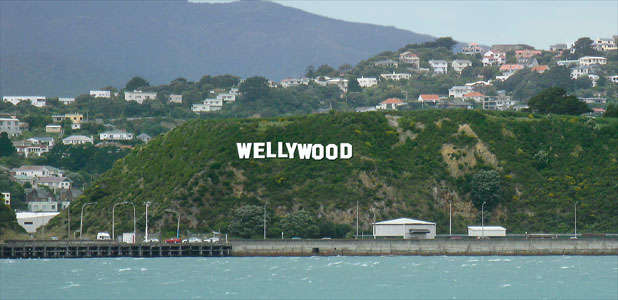
Welcome to WELLYWOOD, a series of caches designed to enlighten you and show you around some of the wonderful locations in 'the coolest little capital of the world'.
You will be required to do some 'pre-work' to complete and find some of these caches, while others will require you to do some exploring 'out in the field', and some will require a combination of both. Most caches can be found in the greater Wellington area, although there may be a few that are further afield. We hope you enjoy the series.

Fort Ballance
On Gordon Point are the remains of Fort Ballance, a defence site that was once Wellington's primary source of protection against sea-borne invasion. Built in 1885 following fears of an impeding war with Russia, Fort Ballance is one of the best preserved of a string of nineteenth century coastal defences constructed to protect New Zealand from a naval attack. In 1885, the Government, reluctantly acknowledging that they could not rely solely on Britain for protection, commissioned engineer Major Henry Cautley to design a series of fortifications to protect the country's main ports.
Fort Ballance, Wellington's main fortification, was built by the Armed Constabulary, day labourers and prison inmates. Erected on the former site of Te Mahanga Pa the fort was named after the then Minister of Defence, John Ballance [1839-1893]. In the event of war Fort Ballance was to prevent enemy ships entering the inner harbour and provide covering fire for the minefield between Gordon Point and Ward Island. Supported by positions at Kau Point and Point Halswell, when fully armed, Fort Ballance had more guns than any other fort in New Zealand.
Although the Russian attack never eventuated, Fort Ballance was continually upgraded to keep abreast of artillery technology. Yet by 1911 the increased firing range of enemy guns meant that defence of the coast, rather than the inner harbour became the primary concern. Fort Ballance remained operational throughout World War One but Fort Dorset, located in the harbour entrance, became the new bastion of Wellington's coastal defence. In 1924 two of its gun pits were converted into magazines and Fort Ballance was Wellington's main ammunition supply depot until 1959. The fort was briefly rearmed during the Second World War when additional, emergency defences were added.
After the war the site was used for army housing. When the fort was first built, bombproof, wartime accommodation for 40 men had been provided. This proved uncomfortably damp and in 1946 three 40 man huts were rapidly constructed behind the fort. The site was used for accommodation until 1990. Its use as housing saved the fort from being destroyed in the 1960s and 1970s when many of New Zealand's 'unsafe and unsightly' coastal defences were demolished. Fort Ballance is now one of the best, intact examples of that string of fortifications constructed in the 1880s to defend the country from naval attack.

Fort Ballance is a highly significant historical site. Designed and built by the New Zealand Government, it is tangible evidence of New Zealand's first step towards independence from the British Crown. Fort Ballance was the first fort built in Wellington and remained the primary source of the city's protection between 1885 and 1911. As one of New Zealand's best-preserved fortifications from the period of the 'Russian scares' the site has great physical significance. The 1880s layout of the fort is largely unaltered and a good impression of the original nineteenth century fort remains. It is also technologically significant as an early example of the use of concrete as a building material. Fort Ballance is unusual as one of the few military sites in continuous use for 105 years and has immense educational value as a rare illustration of the New Zealand response to the rapid and continuing developments in military technology that characterised the first half of the twentieth century.
Historical Significance
Fort Ballance and the associated positions on Point Gordon have historical significance resulting from their role in national defence. The coastal defences were built to strengthen the major ports against the threat of Russian expansion in the Pacific. Fort Ballance was the premier fort in the Wellington area for 26 years (1885-1911).
Physical Significance
Constructed in the 1880s Fort Ballance was prominent in Wellington's coastal defence network and today has the most significant remains of any of the forts built in and around Wellington at this time.
Used by the military over a period of 60 years (1885-1945), the 1880s layout of Fort Ballance is largely unaltered and a good impression of the original nineteenth century fort remains. The fort is a permanent reminder of the technology used in the coastal defence network of the 1880s and it is an early example of the use of concrete as a building material.
Designed as a coastal defence position, Fort Ballance was and still is camouflaged by earthworks, trees and bushes. It is largely hidden from general view except from above or near at hand.
To complete this cache you'll need to head up to Fort Ballance - we recommend you use the trailhead indicated in this cache listing to help find your way here.
Once up top you'll be looking for a five digit numer which, when added together, will equal ten. It can be found within 35 paces of a colourful chimney. We'll call this number ABCDE. (sum check 10).
Cache can be found at S41 ab.cde E174 fg.hij
a = E
b = B + a
c = B
d = f
e = A + B
f = B - E
g = D - C
h = D
i = C
j = b