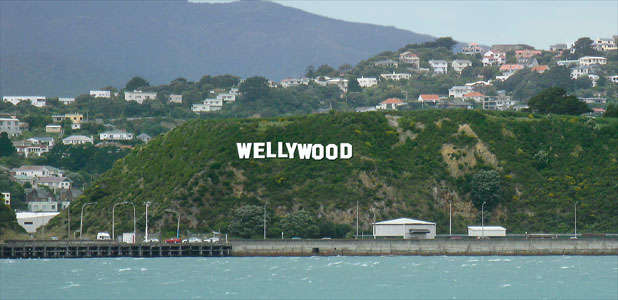
Welcome to WELLYWOOD, a series of caches designed to enlighten you and show you around some of the wonderful locations in 'the coolest little capital of the world'.
You will be required to do some 'pre-work' to complete and find some of these caches, while others will require you to do some exploring 'out in the field', and some will require a combination of both. Most caches can be found in the greater Wellington area, although there may be a few that are further afield. We hope you enjoy the series.

Matiu/Somes Island
Matiu/Somes Island, at 24.9 ha, is the largest of three islands in the northern half of Wellington Harbour, New Zealand. It lies 3 km south of the suburb of Petone and the mouth of the Hutt River, and about 5 km northwest of the much smaller Makaro/Ward Island.
Legend has it that both Matiu and Makaro Islands received their original Māori names from Kupe, the semi-legendary first navigator to reach New Zealand and get home again with reports of the new land. He named them after his two daughters (or, in some versions of the tale, nieces) when he first entered the harbour about 1000 years ago.
After European settlement the island was known for over a century as Somes Island. In 1839 it fell under the control of the New Zealand Company along with much of the greater Wellington region. The island was renamed after Joseph Somes, the company's deputy-governor and financier at the time. In 1997 however, the New Zealand Geographic Board assigned the official bilingual name of Matiu/Somes in recognition of the island's colourful European and Māori histories.
Matiu/Somes became part of Lower Hutt in 1989, and came under the full control of the Department of Conservation as a scientific and historic reserve in August 1995. The island is free of introduced mammalian predators (such as stoats), an unusual state for an island so close to an urban centre.
Human history
Matiu/Somes Island has had an extensive Māori history and a varied, and a sometimes colourful and tragic, European one. Prior to the mid 17th century there were two Māori Pa on the island, however, like the Ngati Ira Pa on Ward Island, they were not permanently inhabited, being "Pa of refuge" where the tribespeople could retreat to in times of war. One was in the centre of the island and little more than the remains of some middens are left there, however there was another Pa on the northern tip of the island, strategically positioned with cliffs on three sides for ease of defence.
A lighthouse was built at the island's southwestern end in 1866, the first harbour light in New Zealand. The lighthouse that stands in place of the original today was constructed in 1900 and later automated.

Defence history
Matiu/Somes Island’s harbour location near a major settlement means it was perfectly placed to have a key role in New Zealand’s defence history.
During World War I (1914-1918) the human quarantine barracks were used to hold enemy aliens who were considered a risk to New Zealand’s security. Around 300 prisoners were held on the island, most of whom were German nationals. Some of those held were born in New Zealand and had families, businesses and established lives here.

In World War II (1939-45) the island once again became an internment camp. While the prisoners were primarily German, there were a large number of Italian and Japanese nationals. They were moved to Pahiatua at the start of 1943 during the short period when the anti-aircraft artillery battery was operational but returned to the island in September 1944 when the guns were removed.
The internees were required to do road-building, gardening and fishing. For this they were paid a small daily allowance. They also had the opportunity to earn additional money by making small items such as wooden toys and päua jewellery. Some internees tried to escape the island by swimming or stealing a boat but there are no successful escape tales from Matiu/Somes.
In 1942 four 3.7-inch heavy anti-aircraft guns were mounted on Matiu-Somes Island. Their job was to combat high flying enemy aircraft. They were built at a time when the war in the Pacific was finely balanced. Japan had bombed Pearl Harbour, but the fear was brought much closer to home when Darwin, Australia was first bombed in February 1942.

The guns used on Matiu/Somes Island were 3.7 inch calibre and could punch a shell to 10,000 feet in 14 seconds. The position was manned from January 1943 to September 1944 but was never called into action. Many of the physical features of these sites are present on the island today.
Island geography and ecology
A distinct gully runs from the south of the quarantine station and terminates at the sea on the southern end of the island between two (now) largely forested ridges on either side to the east and west. Generally this gully is a swampy area but it also represents an ephemeral watercourse and during and following periods of heavy rain a small creek flows down it.
The island is a stronghold for the little blue penguin, several species of shag, the spotted skink, the silver gull and several rare and endangered species of plants.
The Royal Forest and Bird Protection Society of New Zealand has been revegetating the island since 1984 and successfully eradicated rats and mice over a period between 1988 and 1989. Eleven male red crowned kākāriki (parakeets) were first introduced to the island in 2004 and immediately began breeding with a further eleven released in 2005. There are more than 500 species of invertebrates on the island including a couple of species of weta - Wellington tree weta’s and Cook Strait giant weta’s have been successfully transferred from Mana Island. A number of endangered plant species have found a refuge in the island.
The island is now home to six species of native reptiles - Common skink, Spotted, Copper and the Common geck). Brothers Island tuatara were released in 1998. Forest geckos were transferred to the island in 2006. North Island robins sourced from Kapiti Island were released in April 2006, they bred for the first time in late September and this is viewed as encouraging by DOC staff as it appears to indicate that the island ecosystem represents a suitable habitat for this species. A solar-powered speaker system to attract fluttering shearwaters was installed and began transmitting later that year.
Many of these projects have been supported by the community and the local iwi, Te Ati Awa. The Matiu/Somes Island Charitable Trust was established in 1998 as a partnership between Te Ati Awa and the general community to help protect, nurture and enhance the island by raising funds for projects that increased biodiversity and enhanced visitors’ enjoyment of the island. Through its active arm, “The Friends of Matiu/Somes”, it encourages community participation in work on the island. It also works closely with DOC and community groups such as Forest and Bird.
Matiu/Somes Island is an increasingly popular tourist attraction and educational resource for local schools, with about 15,000 visitors per year.
Mokopuna Island
Mokopuna (the 'grandchild') Island is a small island in Wellington Harbour, New Zealand. It is about 200 metres on its long axis and about 80 meters across. It lies immediately north of the much larger Matiu/Somes Island, from which it is separated by a channel about 50 metres wide.
A number of wave-cut arches and caves line the shore. For about three months in 1904 one of these caves was the home of one Kim Lee, a Cantonese fruiterer who had been diagnosed (possibly mistakenly) as a leper. Even though Matiu/Somes was the human quarantine station at the time, Lee was exiled to Mokopuna, where he was supplied with food and water by a flying fox from Matiu/Somes.
Lee died on Mokopuna on 14 March 1904, and was buried on Matiu/Somes. Today Mokopuna is a bird reserve where gulls and Blue Penguins nest, and no landings are allowed.

To find this cache you wont need to go to the island (however if you get the chance, it's a fantastic location for a day trip) but you'll need to find a number associated with NZTM; we'll call this number ABCDEFG HIJKLMN. At GZ you should get some great views of the island.
Cache can be found at 41 ab.cde 174 fg.hij
a = H
b = M
c = I
d = C
e = G
f = J
g = D
h = K - A
i = E
j = N/2