Lake Mackenzie
GLACIAL LAKES
Hundreds of lakes ranging in size from small ponds to large bodies of water tens of kilometres long are scattered throughout the South Island, over an area that was covered in ice during the last Ice Age, about 15,000 years ago. Most of the big lakes owe their permanence and great depth to glaciers which were able to cut depressions far below the level of the bedrock at the outlet end of their valleys. This includes lakes such as Hawea, Manapouri, Pukaki, Te Anau, Tekapo, Wakatipu, and Wanaka. These large lakes can be hundreds of metres deep: Te Anau is 276 metres deep, Manapouri 444 metres and Hauroko in Southland is New Zealand’s deepest lake at 462 metres, the 16th deepest lake in the world.
Some of these lakes have prominent ridges of terminal moraine encircling their southern ends which show that the lakes occupy the sites of valley glaciers. During the early stages of melting back of the glaciers, the early lakes would have been at a higher level than they are today and supported the floating ice tongues of the retreating glaciers. Outlet streams cut progressively deeper valleys through the unconsolidated glacial deposits at the outlet end, lowering the lakes to their present levels. In the case of lakes such as Wakatipu and Hawea this lowering process has been less pronounced, as the outlet streams exposed comparatively hard bedrock, forming resistant sills at the outlets.
A very large number of smaller lakes and ponds dot the glaciated areas of the South Island, ranging in height from a few hundred metres above sea level almost to the summits of peaks over 2000 metres in height. Most of the higher ponds occupy the floors of cirques: amphitheatre-shaped depressions on mountain slopes abandoned by ice comparatively recently in geological time. The water is held behind sills of rock at the outer edge of the cirques across which outlet streams usually run in a shallow notch. Lake Harris, located alongside the Routeburn Track at 1225 metres just below the Harris Saddle, is a lake of this type and empties through a shallow rocky sill into the Route Burn.
Lake Harris showing the shallow outlet
The core information about Glacial Lakes has been obtained from ‘Te Ara – An Encyclopaedia of New Zealand, 1966’, with updates from various other sources to reflect current knowledge.
LAKE MACKENZIE
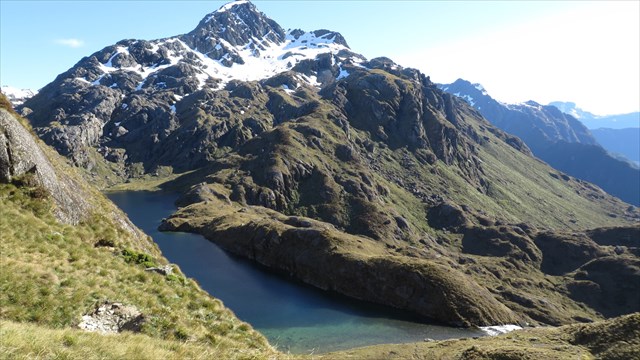
Lake Mackenzie was also formed by a retreating glacier, yet is unusual in having no outlet stream. In its case the terminal moraine that blocked the outlet from the valley consists mainly of very large blocks of hard stone and did NOT get eroded to form a stream. Over time trees have grown over this barrier, which rises well above the lake level. Yet if you stand on the lake shore near the Lake Mackenzie Hut you can see an obvious flow of water from the main body of the lake around the rocks past the ‘island’ in the middle of the lake to the southern end. So where does it go?

Lake Mackenzie
LOGGING THIS EARTHCACHE
To log this Earthcache, please send answers to the following questions to the cache owner via the link on the owner’s profile. Please do not log the cache as found until you have received a reply authorising you to do so. Please include the name of this Earthcache in your email.
- From your observations as you walk around the southern end of the lake, please supply your own theory as to what happens to the water that is flowing to this end.
- The lake level is not constant: it rises and falls over time and can rise very rapidly during heavy rain. Sometimes it is high enough that you have to take a higher level detour to get to the Hut when walking along the Routeburn Track from the Routeburn Shelter end, sometimes it is low enough that the ‘island’ is joined to the ‘mainland’ and you can walk to it without getting your feet wet. Why would this large variation occur with this particular lake?
- Please take a photo of some of the larger blocks of stone in the general vicinity of GZ (which may be under water at times!). Anywhere within a hundred metres or so is fine, so there is some variation in the uploaded photos, showing the current lake level during your visit. Please show your GPS device in the photo. This photo does not need to be sent with your answers to the above two questions, and can be uploaded along with your log once the cache owner has given you the go-ahead to post your find.
If you are lucky enough to be at Lake Mackenzie on a fine day you are lucky indeed, as this is a magical spot. Take time to appreciate it.