Granite:
From the Latin word granum, meaning "a grain". This is in reference to the coarse-grained structure of this crystalline rock. Granite is a common type of felsic, igneous rock. Felsic refers to rock types that are relatively rich in the elements that form feldspar and quartz. Mafic refers to rocks that are relatively rich in magnesium and iron (ferric), such as basalt. Granite can be from pink to gray in color, depending upon chemistry and mineral content. Outcrops of granite tend to form tors and rounded massifs and are usually found in the continental plates of the Earth's crust. A tor is a large, free-standing rock outcrop, that rises abruptly from a rounded hill summit or ridge crest. A massif (basis of the word massive) is a large section of earth's crust, bordered by faults or flexures, retaining its internal structure and moving as a whole.
Granite Weathering:
The rounded erosional pattern of the granite bedrock outcrops is called spheroidal weathering, and is typical of granitoids worldwide. Granite, over time, becomes jointed and cracked and takes the shape of sharp edged blocks. Water seeps into the rocks along the cracks and breaks down the minerals within the granite itself. The corners of these blocks become more susceptible to weathering and erosion now that water can attack them from 3 sides at the same time. As the corners are eroded away, the remaining granite develops a characteristic rounded stacked boulder landscape.
Grus:
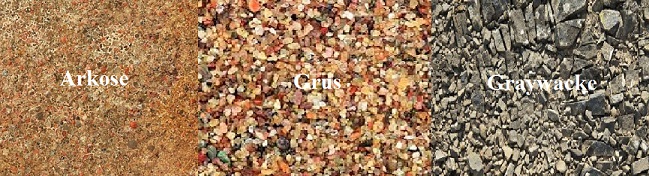
Grus ("groos") is a residue formed by the weathering of crystalline rocks, such as granite. The quartz and feldspar crystals contained within granite, separate into clean individual grains, creating a type of rough granite sand. In part, this is caused by the hot and cold cycling of daily temperatures, repeated countless times over the ages. Chemical weathering from groundwater also aids in this process. Once broken down, grus has the same makeup and consistency as the finely crushed granite you find spread on hiking and biking trails.
Arkose:
Arkose is a semi-coarse sandstone primarily made of quartz, feldspar (more than 25 % of the crystals) and small amounts of mica. The grains (grus) will be moderately well sorted, slightly worn and loosely cemented with calcite or, less commonly, iron oxides or silica. Arkose, when not showing evidence of stratification (layering), bears an uncanny resemblance to its parent rock, which in this case is granite. Because of this resemblance it has been described as reconstituted granite or granite wash. Like the granites from which it was formed, arkose is generally brown to reddish in color and feels grainy and rough to the touch. The central Australian monolith Uluru (Ayers Rock) is composed of late Neoproterozoic/Cambrian arkose, which was deposited in the Amadeus Basin.
Greywacke:
Greywacke is easily distinguished from Arkose. Greywacke contains quartz and feldspar, as does Arkose, but will be harder and darker in color. It contains poorly sorted angular grains of rock fragments set in a clay-fine matrix. It is a texturally immature sedimentary rock. The larger grains range in size from sand to gravel and the matrix materials generally constitute more than 15% of the rock by volume. According to the normal geologic laws of sedimentation, gravel, sand and mud should not be laid down in a mixture, but have layers of seperation. Geologists attribute this formational mixture to sub-marine avalanches or strong turbidity currents which cause mixed-sediment slurries to settle out of solution and create Greywacke.
The coordinates given are for Stage 1. Email your answers to the questions, to me, using the link in my profile only. If your answers are not received by me, your log will be deleted. Photos are accepted and appreciated as long as the stage numbers are not revealed. You do not have to wait for confirmation from me before logging this cache as completed. Most of all……learn……and enjoy the view.
1. At stage #1, are you standing on grus or granite?
2. At stage #2, are you standing on greywacke or granite?
3. At stage #3, are you standing on grus or greywacke?
A magnifying glass might come in handy for these next 3 tasks but is not required.
4. At stage #1, describe the color of the individual crystals found in the ???.
5. At stage #2, describe the texture of the individual crystals found in the ???.
6. At stage #3, describe the size of the individual crystals found in the ???.
I have described 4 things........granite, grus, greywacke and arkose........ but only provided 3 stages. All 3 stages are within 25 feet of each other. Does that mean that only 3 of the 4 will be found at the stages listed? Reading the above write-up and visiting the stages will make this an easy EarthCache. Multiple trails crisscross the area allowing you to pick and choose your own terrain and length of hike. Trail maps can be found at the trail head along with a memorial and wreckage of a Military Air Transport Service C-121G (Constellation) plane that crashed here in 1959, killing all 5 aboard.
Permission granted by Joe Baynes
Parks and Recreation Director
928-777-1599