*NOT AT POSTED COORDINATES.*
Some things to remember when doing this series:
- This is the Homochitto National Forest; home to many animals, poisonous snakes, mosquito’s, ticks and chiggers. Please plan accordingly and take precautions.
- The dirt roads around the area can get muddy, especially after a rain. May not be good for some vehicles. Some roads are single lane, so please be careful if caching in groups.
- Make sure you have plenty of water and snacks.
- Carry out what you take in, don’t leave anything behind.
- The roads can be busy during hunting season, so plan accordingly.
- We had good cell phone and satellite coverage, your results may vary.
- Most important of all --> Have fun! <--
This cache is located at N31 26.0A3 W91 0.A0B.
Texas was admitted to the Union in 18AB.
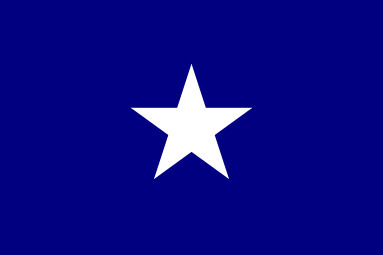
In 1810, a small group of Americans living below the thirty-first parallel in Spanish Florida rebelled against Spain and established the Republic of West Florida. The flag adopted by that short-lived republic was a field of blue with one white star, an emblem that would later be heralded in song and verse as The Bonnie Blue Flag. The Republic of West Florida was eventually annexed by the United States and its territory was divided between Mississippi and Louisiana.
By the time Mississippi was admitted to statehood in 1817, the thirteen stars and thirteen stripes in the United States flag had increased to fifteen. With the prospects of many more states being added to the Union, Congress passed a law in 1818 which specified that the number of stripes on the flag would remain at thirteen, one for each of the original thirteen states, but a new star would be added to the canton on the Fourth of July following the admission of each new state.
Twenty-six years after the West Florida rebellion, Texas won its independence from Mexico. Many of the West Florida rebels had moved on to Texas and were prominent players in its revolution. Texas, known as the “Lone Star Republic,” also adopted the Bonnie Blue Flag as its official standard. When Texas was admitted to the Union in 1845, the new state flag included the Bonnie Blue star along with one red and one white bar.
The Bonnie Blue Flag resurfaced in Mississippi in 1861 when the state seceded from the Union and declared itself a sovereign and independent state. When the Secession Convention, which was meeting in the House chamber in the Mississippi capitol, approved the Ordinance of Secession on January 9, 1861, spectators in the balcony handed a Bonnie Blue Flag down to the delegates on the floor.
The appearance of that famous banner prompted a tumultuous response. Later that night, residents of Jackson paraded through the streets under the blue banner bearing a single white star. Harry McCarthy, a singer and playwright who observed the parade, was inspired to write The Bonnie Blue Flag, which, after Dixie, was the most popular song in the Confederacy.

You can validate your puzzle solution with certitude.