Welcome to The Baobab's Family !
You are standing at the GPS-point (car park) in the middle of nowhere, where a big amount of Baobabs decided to grow here.

General information:
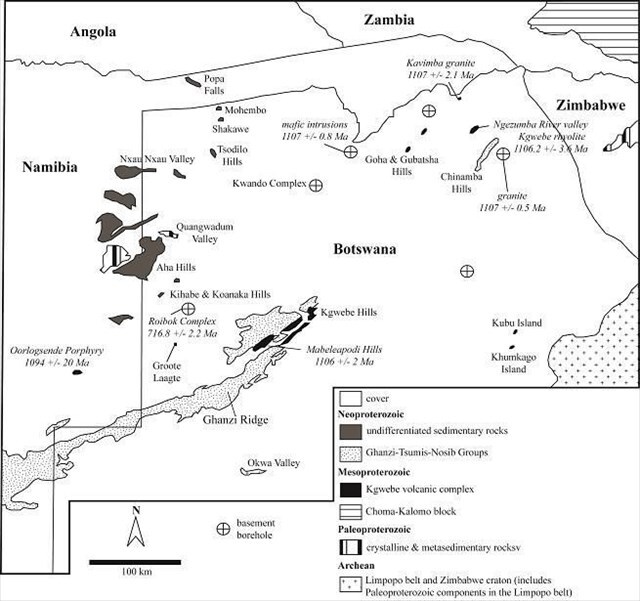
Picture:
Precambrian rock exposures in northern Botswana, with locations of Kgwebe volcanic complex rocks and basement borehole locations.
The place where these Baobabs live is part of the Ghanzi-Chobe Belt going up to the northeast part of Botswana reaching the Goha & Gubatsha Hills area where you are standing right now.
Ghanzi-Chobe Belt (Ghanzi-Tsumis-Nosib Groups in the picture):
The Kgwebe volcanic complex is considered the base of the Ghanzi-Chobe volcano-sedimentary basin. It is exposed in several inliers containing felsic intrusive rocks with spatially associated mafic igneous rocks that have been dated by the U-Pb zircon method to approximately 1106 Ma (1 Ma = 1 Megaannum - 1 Million years).
Exposures of rhyolitic volcanic rocks include the Kgwebe Hills, Mabeleapodi Hills, and the Groote Laagte area in the Ghanzi Ridge area, and the Goha, Gubatsha, and Chinamba Hills areas in the northeastern portion of the Ghanzi-Chobe Belt. Intrusive rocks within the Ghanzi-Chobe Belt include the Kavimba granite and granite near the Chinamba Hills (U-Pb zircon age of 1107 ± 2.1 Ma; U-Pb zircon age of 1107 ± 0.5 Ma, respectively).
Mafic intrusions within the Kwando Complex have a U-Pb zircon age of 1107 ± 0.8 Ma.
Within the Ghanzi Ridge area, the Kgwebe volcanic complex attains a maximum known thickness of 2500 m near the Kgwebe Hills east of Boseto and gradually thins to near zero thickness in the southwest. The lower member of the Kgwebe volcanic complex consists of a bimodal volcanic suite composed of porphyritic rhyolite-dacite flows and tuffs with minor ignimbrites and basaltic flows intercalated with minor arenites. The chemical composition of the igneous rocks indicates they are within-plate low titanium-phosphorus (LTP) continental tholeiites and post-orogenic high-K rhyolites. The chemical composition and field relations suggest that these volcanic rocks were emplaced during a collision-related extensional collapse event. Volcanism appears to have been concentrated within northeast-southwest elongate sub-basins developed during early phases of extension. The middle and upper members of the complex contain fluvial arkosic sedimentary rocks with paleocurrent data indicating a northeasterly transport direction.
U-Pb ages from detrital zircons within the arkosic rocks indicate two sediment sources:
1) local erosion of the Kgwebe volcanic complex volcanic rocks, and
2) Paleoproterozoic basement rocks.
The Ghanzi-Chobe Supergroup represents a basin-fill package that unconformably overlies the Kgwebe volcanic complex. The sequence attains maximum stratigraphic thickness of 13,500 meters thick near the Namibian border and thins to 5000 meters thickness. The sedimentary rocks of the Ghanzi Group were probably deposited during renewed rifting, marine incursion, and basin infilling; the sequence is capped by progradational fluvial sediments.
Geography and ecosystems:
In the Palaeozoic, this little area came up from deeper rock stratigraphy, and made this point so attractive for these Baobabs. After the rocks came up from the deep below and the elements took off the first layers of sand, the solid rocks began to split and were now open for the seeds of plants.
The Baobab (Adansonia digitata) is a massive tree, up to 20 meters tall and 12 meters in diameter.
With its unusual "upside down" silhouette, the Baobab is probably the best known of all the African trees.
The distinct thick stem and sheer size of the Baobab makes it difficult to ignore when encountered in the bushveld.
The Baobabs love to grow in dry woodland (bushveld) preferring rocky and well drained soil.
On your further way you will find more Baobabs most often located on this kind of ground.
Baobabs may be the oldest life forms on the African continent, and many of them, still standing today, have certainly been around since the birth of Christ; others for far longer.
Carbon-dating experiments have calculated that trees with a trunk diameter of five metres were over 1000 years of age, and similar experiments elsewhere have dated trees at over 3000 years.
If you look around you will see the geological particularity why these Baobabs are standing here.
Car parking place with good access is here: S 18 32.283 E 24 06.466
Safety advice
This is a wild animal region! Make sure that no dangerous animals are nearby!
Log conditions:
To log the Cache you have to do the following:
1) Describe in your own words, what do you think is the geological particularity why these Baobabs are standing here (look at the ground of the Baobabs and the area around to see the difference)
2) How many Baobabs are situated on the special geological area?
A photo with you and/or your GPS in front of the Baobabs, so that I am sure you were really there, would be very welcome.
Please send me an e-mail over my geocaching.com profile with your answers. You can log immediately. I will contact you if something is completely wrong.
If you were there in former times before the publish and you made the right picture with you and the Baobabs, you are allowed to log this cache after the FTF, STF and TTF by also sending me the right two answers.
Tusker-Team