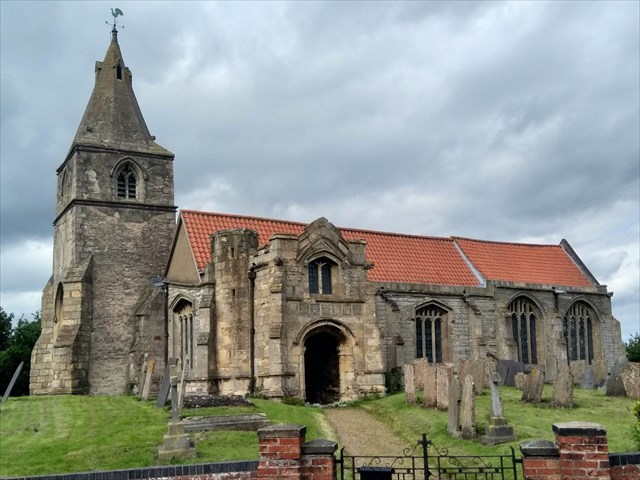
ST GILES, HOLME
St Giles, Holme is a Grade I listed building, achieving the status on 16 January 1967.
The church, with its low broach spire, stands on a sandy knoll overlooking the village close to the River Trent. St Giles as we see it today was mainly built in about 1485 by a wool merchant, John Barton, whose rebus, a bar and a tun (barrel) can be seen time and again both inside and outside the church.
From the churchyard the tower of St Wilfrid, North Muskham on the opposite side of the river is visible and it was to this church that St Giles was attached until the mid-19th century. Up until the late 16th century, when the Trent changed its course, both settlements would have been on the same (western) side of the river. For centuries after, the connection continued with the use of a ferry.
St Giles’ major claim to fame is its exceptional collection of early Tudor carved poppy heads of birds, animals and angels and the tomb that John Barton commissioned for himself and his wife during their lifetime.
The room over the porch is at the centre of the local legend of ‘Nan Scott’s Chamber’. It is said that Nan Scott left her house in Holme during the great plague of 1666 to live in this room away from infection for several weeks. When forced to visit her house for supplies she found the parish deserted except for herself and one other, and was so horrified she returned to the chamber and ended her days there.
In 1932, after centuries of neglect, Nevile Truman, a local historian and member of the British Association of Master Glass Painters, undertook the restoration of this unique building.
Around the years AD 43-47 the Vale of Trent was first occupied by the armies of Rome and it is believed that a marching camp was sited at Holme, just three miles away from where the Fosse Way passes through Newark.
The name ‘Holme’ reflects the origin of the village within the Danelaw. In Scandinavia, the place-name element ‘holm’ is usually associated with an island. Not far from this meaning is ‘holmr’ and ‘-holme’ which, in the old Norse language of the Danelaw, appears to indicate farmland reclaimed from marshy waste. Such an area would, in essence, be an ‘island’ in an otherwise wet area.
Holme does not appear in the Domesday Book but is mentioned in the earliest document in the Corporation Papers of Newark-on-Trent. This was a deed dated 1160-1170; a grant from the Lady Isabel, formerly wife of Thomas de Muscam to Helias de Wymphetorp (Winthorpe), of the third part of a half oxgang of land and four tofts and the buildings in the town of Hollum (Holme?). One of the witnesses was William the Sergeant of Holum.
-----------------------------------------------------
THE CACHE
You are looking for the vault containing the Revell's and the Bullen's.
The cache can be found at:
N 53 07. ABC
A = Letters in Mrs Bullen's first name
B = Letters in Mrs Revell's first name
C = Number of words under Mr Bullen's age
W 000 48.DEF
D = How many people did NOT die at Newark
E = The first digit of Mr Bullen's age on death
F = How many people lived at Holme
****************** ********************
For full information on how you can expand the Church Micro series by sadexploration please read the Place your own Church Micro page before you contact him at churchmicro.co.uk
See also the Church Micro Statistics and Home pages for further information about the series.
****************** *******************