Meander
A meander, in general, is a bend in a twisting watercourse or river. A meander is formed when the moving water in a stream erodes the outer banks and widens its valley and the inner part of the river has less energy and deposits what it is carrying. A stream of any volume may assume a meandering course, alternately eroding sediments from the outside of a bend and depositing them on the inside. The result is a snaking pattern as the stream meanders back and forth. When a meander gets cut off from the main stream, an oxbow lake is formed.
This is how a "meander scar" comes to be.
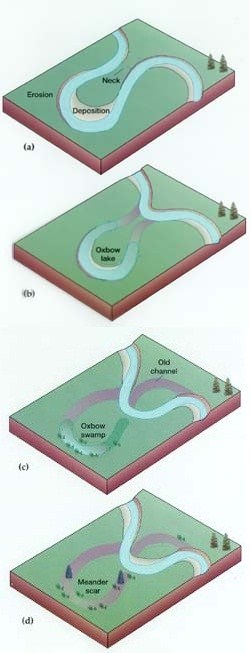
Erosion
Erosion is the process by which soil and rock are removed from the Earth's surface by natural processes such as wind or water flow, and then transported and deposited in other locations.
In this particular area at GZ, Water has caused most of the Erosion here. Springs are both caused by erosion and causes of erosion.
Types of Erosion:
Splash Erosion: Small soil particles are detached and sent airborne through the impact of raindrops on soil.
Sheet Erosion: Raindrops break apart the soil structure and it's moved down-slope by water that flows overland as a sheet rather than definitive channels. This occurs frequently during cloud bursts.
Rill Erosion: This process develops small, short-lived, concentrated flow paths. These paths create a sediment source and delivery system for hill-slope erosion. Areas where precipitation rates exceed soil infiltration rates are more prone to this type of erosion.
Gully Erosion: Water flows in narrow channels during or directly following heavy rains or melting snow. The gullies can erode to considerable depths.
Valley or Stream Erosion: Continual water flow alongside land (along a linear feature) creates this type of erosion. It extends downward, deepening a valley, and head-ward, extending the valley into the hillside. This occurs most frequently in times of flooding.
Bank Erosion: Over time, banks of rivers and streams are naturally worn down.
Freezing and thawing: Cold weather causes water trapped in tiny rock cracks to freeze and expand, breaking the rock into several pieces.
**Logging requirements**
DO NOT POST ANSWERS IN YOUR LOG.
Send the following answers to me via email.
- The text "GC52VH6 A meander about to change" on the first line
- What material does this creek have to move before it can create an oxbow lake and eventually a meander scar? Look at the creek bank directly in front of you, right where the creek makes a hard right turn.
- What stage is this creek in? (Meander, oxbow lake, or meander scar)
- What is the current creeks water height? (There is a water gauge attached to the bridge on the west side)
- Now estimate how high the creek needs to get before it goes over the top of the bank?
| I have earned GSA's highest level: |
 |