Limestone, Old Bones & a 400 Million Year Journey
From where you are standing, you are 23 miles from the "Falls of the Ohio".
This Earthcache is a nice treat for the passing weary traveler. You will need to gather information from this sign and gather observation from this Limestone Boulder, right next to the information sign.
You will gather information, come to your own conclusions based on what you have read and what you see in front of you and email me the answers.
"The Falls of the Ohio (or FOTO) is one of the most unusual fossil bed in the world!
When the river is low, up to 200 acres of ancient Devonian tropical sea floor are visible.
Millions of ancient corals, sponges and shells are preserved. The falls are the only natural rocky outcrop with rapids over the 981 mile length of the Ohio river. Today the falls are mostly flooded, but are visible when the McAlpine Dam hasn't flooded it."


Indiana is famous for it's Limestone. We see many structures (including the Empire State Building) that have been constructed with Indiana Limestone.
This boulder here has served as a 387 million year old time capsule from the Devonian period.
Limestone falls under the catergory of Sedimentary rock type. This particular Limestone is know as Jeffersonville Limestone and it is indigenous to the Indiana/Kentucky area. Geologist Perkins described Jeffersonville Limestone to be divided up into four to six layers.
1.) "Mostly brown coarse-grained medium- to thick-bedded, highly fossiliferous limestone and dolomite limestone"
2.) "Variably colored coarse-grained medium-bedded stromatoporoidal limestone"
3.) "Variably colored dense to medium-grained cherty hard fossiliferous limestone"
4. & 5.) "Light-colored thin-bedded to massive granular cherty fossiliferous limestone"
We made mention above about this being a 387 million year old time capsul. However, how do we know? There are various dating methods geologist use to date rocks. Stratigraphy, superposition, carbon dating. However the method we will use here today index fossils.
Fossils occur for a distinct, limited interval of time. In the figure, that distinct age range for each fossil species is indicated by the grey arrows underlying the picture of each fossil. The bottom arrow indicates when the fossil first appears and the upper arrow is when the fossil's last appearance is recorded or when it is extinct.
Because geologist know the time frame of when life forms have began and ended, they are able to date rock formations based on the fossils found within them.

Let's explore some of the fossils that have been captured in time in our Limestone boulder.
Horn Coral: Horned Coral come from the order of Rugosa. It's life period has been documented to have started in the Ordovician Period (around 488 million years ago) to the Permian Period (around 251 million years ago).
Their skeleton is made of calcite and as seen here, are often fossilized.
They were carnivores, however due to their small size of their prey, they were considered micro predators.

Honeycomb Coral: Honeycomb coral, whose genus name is favosites, can also be traced back from the Ordovician age to the Permian age.
They receive their name due to their honeycomb, polygonal attributes. As they are connected, their walls were pierced, allowing the transfer of nutrients between the combs or polyps.
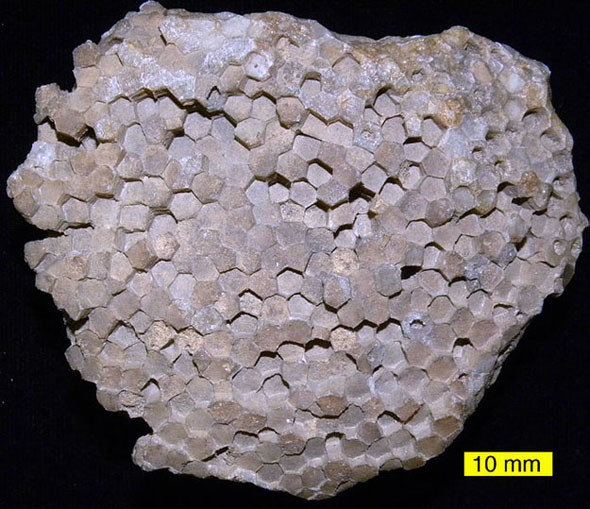
Sponge: Sponge, which falls into the class of Stromatoporoidea, were very abundant in the Devonian period (the time period this boulder and fossils come from)
Sponge originated in the Ordovician Period to the Devonian period.
These invertebrates had an exo-skelton of calcium carbonate (or calcite). These were important to reef formers of the Devonian period and are thought to be relation to our modern day coral.

Questions:
1. Which time period is this boulder and fossils from?
2. What is the name of the stone this boulder is made of?
3. On the bottom right hand corner of the sign, there is a prehistoric fossil that begins with the letter "T". What is that fossil and can you spot it in the boulder next to the sign?
4. Out of the three fossils mentioned and taught on above, what is the most abundant with this boulder?
5. Take your hand and run it across the stone. Is it course or fine/smooth?
6. Based on the zone information provided above, what zone layer (1-5) do you believe this limestone come from? Why did you come to this conclusion?
7. Besides index fossils, what is another method geologist use to date rock?
8. Optional: Take a photo of yourself or your favorite fossil...or with your favorite fossil!
Thanks for much for taking your rest stop to learn about your Earth and the rich history of Indiana!
