Getting Started
This EarthCache is located along the beach in Crystal Cove State Park. The closest parking is in the Los Trancos Area parking lot. From PCH, turn at the intersection with Los Trancos (see Additional Waypoints below). There is a day use fee for parking. At the time of cache publication, it was $15. But you can easily spend the whole day exploring the beach and backcountry of this park. You can also use your receipt for this park to gain free access to any other state parks on the same day.
From the parking lot, take the walkway that begins in the southeast corner. Follow it down through the tunnel under PCH towards the beach. Then walk south through the Crystal Cove Historic District and onto the beach. You may want to make this an EarthCaching two-fer, by pairing it with “Crystal Cove - Giant Concretions” (GC543MM).
Shell Fossils and Missing Time
On the beach, along the base of the cliff, you will see shells embedded in sandstone. While these may look like contemporary shells, they are actually about 120,000 years old. The sandstone rocks in which these shells are embedded have fallen from an overhanging fossil bed higher up the cliff. This bed lies immediately above the Monterey Formation. Since the youngest part of the Monterey Formation is about six million years old, and these fossils are about 120,000 years old, a lot the geologic record is missing from this locality.
What has happened here? The rocks deposited during the interval between six million and 120,000 years are gone. Prior to the deposition of these fossil beds, erosion obliterated nearly six million years of rocks in the Capistrano Formation. Geologists call this time gap an unconformity.
Unconformities
The concept of an unconformity arises from two of the oldest principles of geology:
The Law of Original Horizontality - Layers of sedimentary rock (strata) are originally laid down flat, parallel to the Earth's surface.
The Law of Superposition - Younger strata always overlie older strata, except where the rocks have been overturned.
So in an ideal sequence of rocks, all the strata would stack up like the pages in a book. They would be in a “conformable” relationship. Where they don't, the plane between the mismatched strata, representing some sort of gap, is an unconformity. There are four main kinds of unconformity.
The Angular Unconformity
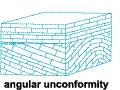 The most famous and obvious kind of unconformity is the angular unconformity. Rocks below the unconformity are tilted and sheared off, and rocks above it are level. The angular unconformity tells a clear story:
- First a set of rocks was laid down.
- Then these rocks were tilted, then eroded down to a level surface.
- Then a younger set of rocks was laid down on top.
The Disconformity
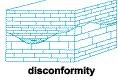 Now, omit the tilting in the second step of the angular unconformity sequence. First, strata are laid down, then a period of erosion happens , then more strata are laid down. The result is a disconformity or parallel unconformity. All the strata line up, but there is still a clear discontinuity in the sequence. The erosional surface of the disconformity may be horizontal, or it may be irregular.
The Paraconformity
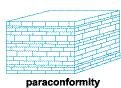 If the discontinuity is not visible, it is called a paraconformity. These are harder to detect, as you might imagine. A sandstone in which trilobite fossils suddenly give way to oyster fossils would be a clear example. More technical means can also be used to recognize paraconformities, such as radiometric dating, or detailed mineralogical analysis.
The Nonconformity
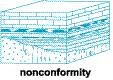 There is a body of rock that is not sedimentary, upon which strata are laid down. Because we aren't comparing two bodies of strata, the notion of them being conformable doesn't apply. This kind of junction between two different major rock types is a nonconformity.
Logging Requirements
The unconformity is easily seen in the cliff above you as you walk south along the beach. The younger beds are typically dark brown and contrast with the lighter underlying Monterey. In many places, the unconformity appears as an overhanging fossil bed “shelf”.
Send me a note with:
- The text “Crystal Cove - A Gap In Time (GC543MM)” on the first line.
- The names of all the geocachers in your group for whom you are submitting answers.
- What kind of unconformity do you observe at this location?
- Roughly how high above the beach is this unconformity?
- Are the fossil shells generally intact or broken, and what is the range of the average sizes?
- Extra Credit: Continue south along the beach. What are the coordinates for the location farthest south at which the overhanging shelf of this unconformity can be seen?
Please submit your answers when you log this cache. You do not have to wait for confirmation before logging. Logs for which answers are not submitted will be deleted.
Please don’t include the answers to any questions in your log, even if encrypted!
The following sources were used to create this EarthCache:


