If someone would like to go out geocaching with me before the event please let me know. So we can go out together.
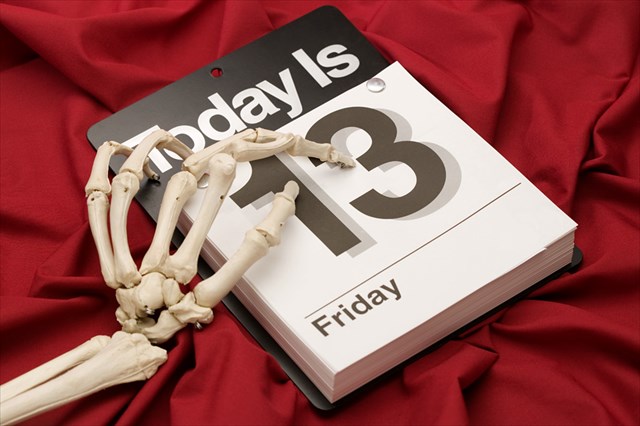
Friday the 13th is considered an unlucky day in Western and Eastern superstition. It occurs when the 13th day of the month in the Gregorian calendar falls on a Friday.
History
According to folklorists, there is no written evidence for a "Friday the 13th" superstition before the 19th century. The earliest known documented reference in English occurs in Henry Sutherland Edwards' 1869 biography of Gioachino Rossini, who died on a Friday 13th.
He [Rossini] was surrounded to the last by admiring friends; and if it be true that, like so many Italians, he regarded Fridays as an unlucky day and thirteen as an unlucky number, it is remarkable that on Friday 13th of November he passed away.[4]
One theory states that it is a modern amalgamation of two older superstitions: that 13 is an unlucky number and that Friday is an unlucky day.
- In numerology, the number twelve is considered the number of divine organizational arrangement or chronological completeness, as reflected in the twelve months of the year, twelve hours of the clock day, the twelve deities of Olympus, twelve tribes of Israel, twelve Apostles of Jesus, the 12 successors of Muhammad in Shia Islam, twelve signs of the Zodiac, the 12 years of the Buddhist cycle, etc., whereas the number thirteen was considered irregular, transgressing this completeness. There is also a superstition, thought by some to derive from the Last Supper or a Norse myth, that having thirteen people seated at a table results in the death of one of the diners.
- Friday has been considered an unlucky day at least since the 14th century's The Canterbury Tales, and many other professions have regarded Friday as an unlucky day to undertake journeys or begin new projects.
- Christians commemorate the crucifixion of Jesus on the Friday before Easter.
- Records of the superstition are rarely found before the 20th century, when it became extremely common. The connection between the Friday the 13th superstition and the Knights Templar was popularized in Dan Brown's 2003 novel The Da Vinci Code and in John J. Robinson's 1989 work Born in Blood: The Lost Secrets of Freemasonry. On Friday, 13 October 1307, hundreds of the Knights Templar were arrested in France, an action apparently motivated financially and undertaken by the efficient royal bureaucracy to increase the prestige of the crown. Philip IV was the force behind this ruthless move, but it has also tarnished the historical reputation of Clement V. From the very day of Clement V's coronation, the king falsely charged the Templars with heresy, immorality and abuses, and the scruples of the Pope were compromised by a growing sense that the burgeoning French State might not wait for the Church, but would proceed independently. However, experts agree that this is a relatively recent correlation, and most likely a modern-day invention.
Phobia names and etymology
The fear of Friday the 13th has been called friggatriskaidekaphobia (Frigga being the name of the Norse goddess for whom "Friday" is named in English and triskaidekaphobia meaning fear of the number thirteen), or paraskevidekatriaphobia a concatenation of the Greek words Paraskeví (Παρασκευή, meaning "Friday"), and dekatreís (δεκατρείς, meaning "thirteen") attached to phobía (φοβία, from phóbos, φόβος, meaning "fear"). The latter word was derived in 1911 and first appeared in a mainstream source in 1953.
Social impact
According to the Stress Management Center and Phobia Institute in Asheville, North Carolina, an estimated 17 to 21 million people in the United States are affected by a fear of this day making it the most feared day and date in history. Some people are so paralyzed by fear that they avoid their normal routines in doing business, taking flights or even getting out of bed. "It's been estimated that [US]$800 or $900 million is lost in business on this day". Despite this, representatives for both Delta Air Lines and Continental Airlines have stated that their airlines do not suffer from any noticeable drop in travel on those Fridays.
In Finland, a consortium of governmental and nongovernmental organizations led by the Ministry of Social Affairs and Health promotes the National Accident Day, which always falls on a Friday 13th.
Rate of accidents
The Dutch Centre for Insurance Statistics (CVS) on June 12, 2008, stated that "fewer accidents and reports of fire and theft occur when the 13th of the month falls on a Friday than on other Fridays, because people are preventatively more careful or just stay home. Statistically speaking, driving is slightly safer on Friday the 13th, at least in the Netherlands; in the last two years, Dutch insurers received reports of an average 7,800 traffic accidents each Friday; but the average figure when the 13th fell on a Friday was just 7,500."
Occurrence
The longest period that can occur without a Friday the 13th is fourteen months, either from July to September the following common year (e.g., between 2001–02, 2012–13, and 2018–19), or from August to October the following leap year (e.g., between 1999–2000 or 2027–28).
More info about the event:
The rating D1T3.5 is intentional... It makes up 13 and 5 (Friday is the fifth day of the week in the Gregorian calendar which defines friday the thirteenth) The terrain rating reflects the possible temperature of the sand on the beach after a day of sunlight.... Protect your feet with some shoes. And if you think it helps wear two socks with different colors... Off course the attributes about scary creatures are only meant for those afraid of black cats... There are no ticks or snakes as far as I know in the beacharea..