The Mississippian era, around 340 million years ago.

This part of the world was covered by oceans that where about 50 feet deep. Over time debris and sediment settled to the bottom and as more and more settled on the bottom it created enough pressure to turn that sediment into rock. This rock is called limestone. Over the millions of years the ocean would retreat and a wondering river, known today as the Mississippi river slowly over time carved out a river floodplain. This is one side of the floodplain “walls” if you would. As more time passed rains, and earthquakes among other things helped to erode this cliff “wall” to the point you see it today.
Erosion
Erosion is the process by which soil and rock are removed from the Earth's surface by natural processes such as wind or water flow, and then transported and deposited in other locations.
In this particular area at GZ, Water has caused most of the Erosion here. Springs are both caused by erosion and causes of erosion.
Types of Erosion:
Splash Erosion: Small soil particles are detached and sent airborne through the impact of raindrops on soil.
Sheet Erosion: Raindrops break apart the soil structure and it's moved down-slope by water that flows overland as a sheet rather than definitive channels. This occurs frequently during cloud bursts.
Rill Erosion: This process develops small, short-lived, concentrated flow paths. These paths create a sediment source and delivery system for hill-slope erosion. Areas where precipitation rates exceed soil infiltration rates are more prone to this type of erosion.
Gully Erosion: Water flows in narrow channels during or directly following heavy rains or melting snow. The gullies can erode to considerable depths.
Valley or Stream Erosion: Continual water flow alongside land (along a linear feature) creates this type of erosion. It extends downward, deepening a valley, and head-ward, extending the valley into the hillside. This occurs most frequently in times of flooding.
Bank Erosion: Over time, banks of rivers and streams are naturally worn down.
Freezing and thawing: Cold weather causes water trapped in tiny rock cracks to freeze and expand, breaking the rock into several pieces.
Wind erosion is a major geomorphological force, especially in arid and semi-arid regions. Wind erosion is of two primary varieties: deflation, where the wind picks up and carries away loose particles; and abrasion, where surfaces are worn down as they are struck by airborne particles carried by wind.
Mass movement is the downward and outward movement of rock and sediments on a sloped surface, mainly due to the force of gravity. Mass movement is an important part of the erosional process, and is often the first stage in the breakdown and transport of weathered materials in mountainous areas. It moves material from higher elevations to lower elevations where other eroding agents such as streams and glaciers can then pick up the material and move it to even lower elevations. Mass-movement processes are always occurring continuously on all slopes; some mass-movement processes act very slowly; others occur very suddenly, often with disastrous results.
Bedding types
Sedimentary Bedding
“STRATIFICATION refers to the way sediment layers are stacked over each other” (University)
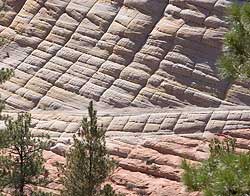
Cliffs such as this can often tell you how the sediment making up the rock was deposited prior to diagenesis. All you have to do is look at the rock’s structure and appearance for a characteristic known as bedding. There are two types of bedding, graded and cross-bedding.
Graded Bedding is seen when the structure of the sedimentary rock appears to take on a horizontal sheet-like appearance. That is to say, the rock appears to be “layered” like pancakes, and often has larger particles underlying smaller ones. The term “graded” comes from the fact that the particles arrange themselves by relative size as they settle. Often there may be numerous beds of varying depth stacked horizontally on top of one another. Sometimes the grades or strata may be very thin and not easily seen. But color, amount of erosion in exposed surfaces, or even slight textural changes in the rock, may signify a change from one bed to another. (University)

Cross-bedding occurs when sediments are laid down at angles or arcs, sometimes cutting into one another, and not necessarily in even “layers”. This type of bedding often occurs in areas where a sandbar or dune existed prior to diagenesis. (University)
**Logging requirements**
DO NOT POST ANSWERS IN YOUR LOG.
Send the following answers to me via email.
- The text "GC55WAE Inspiration at Pine Bluffs" on the first line
- Name at least two types of erosion that you can see happening to this cliff area?
- What is the elevation here?
- The high point of the cliff here has an elevation of 635 feet how high is this cliff here?
- What colors are present in the sandstone and Limestone cliffs here?
- What kind of bedding do you see in the cliff?
| I have earned GSA's highest level: |
 |