The Geology
Karst topography
Karst topography is a geological formation shaped by the dissolution of a layer or layers of soluble bedrock usually carbonate rock such as limestone or dolomite. Subterranean drainage may limit surface water with few to no rivers or lakes. Many karst regions display distinctive surface features, with sinkholes being the most common. However, distinctive karst surface features may be completely absent where the soluble rock is mantled, such as by glacial debris or confined by one or more superimposed non-soluble rock strata. Some karst regions include thousands of caves, although evidence of caves large enough for human exploration is not a required characteristic of karst.
Types and formation
A cave or cavern is a hollow place in the ground, especially natural underground space large enough for a human to enter. Caves form naturally by the weathering of rock and often extend deep underground.
solution caves
Solutional caves are the most frequently occurring caves and such caves form in rock that is soluble, such as limestone, but can also form in other rocks, including chalk, dolomite, marble, salt, and gypsum. Rock is dissolved by natural acid in groundwater that seeps through bedding-planes, faults, joints and so on. Over geological epochs cracks expand to become caves and cave systems.
primary caves
Caves formed at the same time as the surrounding rock are called primary caves.
Lava tubes are formed through volcanic activity and are the most common primary caves. As lava flows downhill, its surface cools and solidifies. Hot liquid lava continues to flow under that crust, and if most of it flows out, a hollow tube remains. Examples of such caves can be found in the Canary Islands, Jeju-do, the basaltic plains of Eastern Idaho and other places. Kazumura Cave near Hilo, Hawaii is a remarkably long and deep lava tube; it is 65.6 km long (40.8 mi).
How caves form
Cave formation begins when rainwater absorbs carbon dioxide as it falls through the atmosphere. Rain water must have carbon dioxide to become acidic. It must be acidic to chemically react to the limestone bedrock. Rainwater is absorbed by the soil into the ground.
As rainwater comes through the soil it absorbs more carbon dioxide that is being produced by plants that are dead. This changes the ground water to a weaker form of carbonic acid (H2O + CO2 = H2CO3). As it travels down through the ground it comes to solid rock. When the rock is limestone or dolomite caves can form.
The water reacts chemically with limestone and slowly a larger and larger space will form. This happens because the rocks are made of calcium carbonate (CaCO3). This is what you call chemical erosion.
As the space becomes larger and larger the water can flow through. As it flows it erodes. Physical erosion washes away rock and sand. This is what makes a cave larger and forms an underground stream. Finally over hundreds of thousands of years or even millions of years the cave is formed.

Rocks Elements Minerals and Crystals
Rocks go through cycles
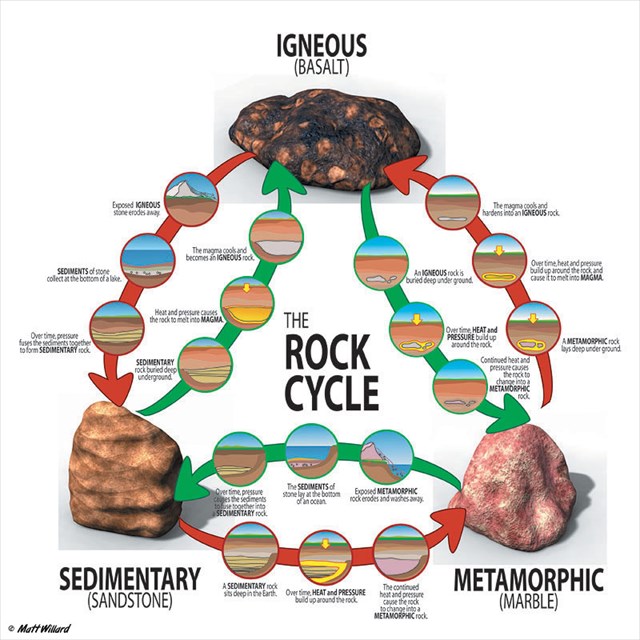
Types of rocks
Sedimentary
Sedimentary rocks are formed by sediment that is deposited over time, usually as layers at the bottom of lakes and oceans. This sediment can include minerals, small pieces of plants and other organic matter. The sediment is compressed over a long period of time before consolidating into solid layers of rock. Sedimentary rocks form layers called strata which can often be seen in exposed cliffs.
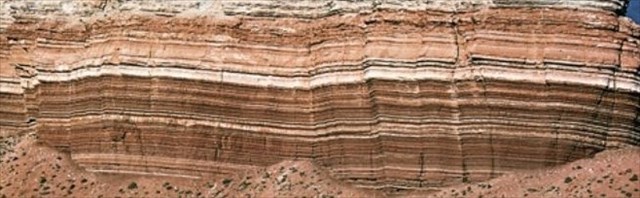
Sedimentary rocks cover the majority of the Earth's rocky surface but only make up a small percentage of the Earth’s crust compared to metamorphic and igneous types of rocks. Some examples of sedimentary rocks include limestone, sandstone, mudstone, greywacke, chalk, coal, claystone and flint.
- Limestone forms the metamorphic rock marble when subjected to extreme heat and pressure over time (metamorphism).
- Sandstone forms the metamorphic rock quartzite.
- Mudstone forms the metamorphic rock slate.
- Chalk is a soft, white form of limestone.
- Flint is a hard, sedimentary form of the mineral quartz
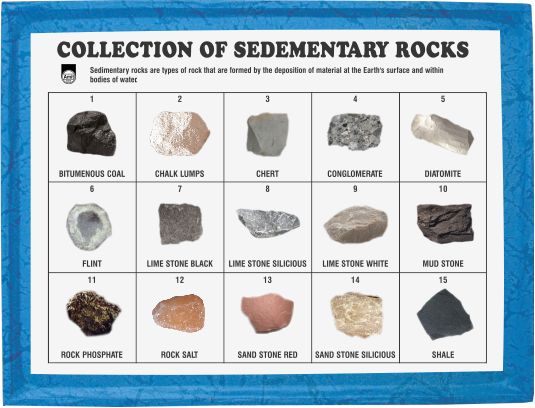
Chert is a fine-grained silica-rich microcrystalline, cryptocrystalline or microfibrous sedimentary rock that may contain small fossils. It varies greatly in color (from white to black), but most often manifests as gray, brown, grayish brown and light green to rusty red; its color is an expression of trace elements present in the rock, and both red and green are most often related to traces of iron
**Logging requirements**
DO NOT POST ANSWERS IN YOUR LOG.
Send the following answers to me via email.
- The text "GC565MZ Joplin Cave" on the first line
- How wide is this cave overhang?
- The underside roof of this cliff cave overhang is a distinct color, what is it and why?
- What colors are present in the limestone and chert in the cliff face?
- What are the dimensions of the cave entrance at the steel gate?
- What two minerals where mined from the cave?
- What is the average temp of the cave?
- How far back does the cave go?
| I have earned GSA's highest level: |
 |