Types of Runways
There are three types of runways:
Visual runways are used at small airstrips and are usually just a strip of grass, gravel, ice, asphalt, or concrete. Although there are usually no markings on a visual runway, they may have threshold markings, designators, and centrelines. Additionally, they do not provide an instrument-based landing procedure; pilots must be able to see the runway to use it. Also, radio communication may not be available and pilots must be self-reliant.
Non-precision instrument runways are often used at small- to medium-size airports. These runways, depending on the surface, may be marked with threshold markings, designators, centerlines, and sometimes a 1,000 ft (305 m) mark (known as an aiming point, sometimes installed at 1,500 ft (457 m)). They provide horizontal position guidance to planes on instrument approach via Non-directional beacon, VHF omnidirectional range, Global Positioning System, etc.
Precision instrument runways, which are found at medium- and large-size airports, consist of a blast pad/stopway (optional, for airports handling jets), threshold, designator, centerline, aiming point, and 500 ft (152 m), 1,000 ft (305 m)/1,500 ft (457 m), 2,000 ft (610 m), 2,500 ft (762 m), and 3,000 ft (914 m) touchdown zone marks. Precision runways provide both horizontal and vertical guidance for instrument approaches.
Runway Lights
Runway lighting is used at airports that allow night landings. Seen from the air, runway lights form an outline of the runway.
Approach lights:
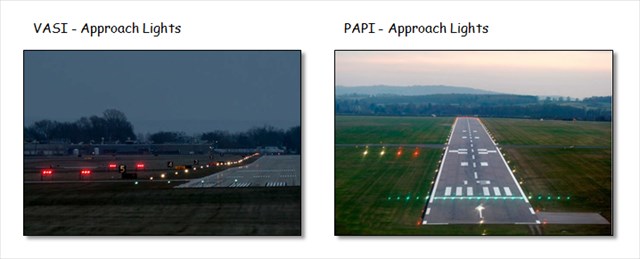
The Visual Approach Slope Indicator (VASI) is a lighting system designed to help a pilot maintain a correct glide path on the approach to the runway. There are now fewer VASI installations in place, the PAPI system having now taken precedence. Both VASI and PAPI operate on similar principles. The system consists of a set of upwind and a set of downwind lights. Each light unit projects a beam of white light in its upper part and a red light in its lower part. The light units are so arranged that when an airplane is approaching the runway on the proper approach slope, the downwind lights will appear white and the upwind lights will appear red. If the airplane is below the proper approach slope, both sets of lights will be red. If it is above the approach slope, both sets lights will be white.
The Precision Approach Path Indicator (PAPI) system has been developed to replace VASI which is being phased out. PAPI consists of four light units installed on the left side of the runway in the form of a wing bar. If the airplane is flying the proper approach slope, the two units nearest the runway show red and the two units farthest from the runway show white. If the airplane is above the approach slope, 3 or all 4 units will show white (depending on the degree of displacement from the approach slope). If the airplane is below the approach slope, 3 or all 4 will show red.
Feel free to contact the airport tower on 041-5015900 if you have any questions regarding their work. If you ask nicely, they may even allow a quick visit to the top to see what they do. Your visit must however be prearranged with Willie, the tower Manager.
This cache is a micro container hidden on the right side of runway 17/35. We hope that you will be lucky enough to see a plane touchdown while you are looking for the cache.