Así se conoce uno de los tipos de mármol más conocidos a nivel nacional. El mármol "Rojo Bilbao" o "Rojo Ereño", procedente de las canteras del municipio de Ereño, provincia de Vizcaya, es un mármol muy apreciado debido a su pigmentación roja con vetas blancas que le hace propicio para engalanar edificios.
Las calizas rojas urgonianas de Ereño han sido explotadas como roca ornamental desde el siglo I d. C., en la época romana, hasta la década de los 80. La singular belleza de esta roca metamórfica ha traspasado fronteras y, además de haber sido utilizada en numerosas ocasiones en Vizcaya, no es difícil encontrarla por toda España e incluso en el extranjero a pesar de que en la actualidad no se explota sistemáticamente.
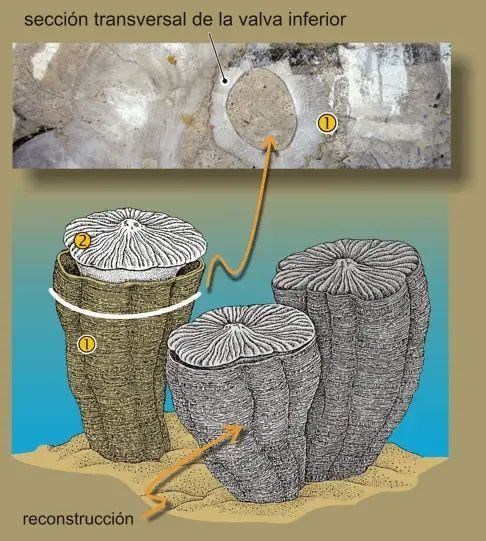
El interés principal de este mármol se debe a la abundancia de contenido fósil del cretácico inferior, compuesto principalmente por bivalvos, de entre los que destacan, diferentes familias de rudistas (foto), conchas de Chondrodonta sp., corales solitarios o coloniales, briozoos, braquiópodos equinodermos y otros fósiles típicos de plataforma somera de ambiente subtropical. Las conchas destacan por su color blanco, sobre una matriz micrítica de color rojo intenso, debido a que se encuentra impregnada por óxidos de hierro de tipo hematites. Este contraste es el que confiere a la roca su valor como roca ornamental haciéndose común en portales o edificios de señorío como al que llevan las coordenadas que se trata de un edificio catalogado como Bien de Interés Cultural desde el año 2000.
En estos espectaculares afloramientos podemos observar secuencias de colonización de rudistas, distintas asociaciones paleoecológicas, y como éstas han sido truncadas por eventos como tormentas o grandes ciclones.
El Caché
Para poder contabilizar este Earthcache como encontrado debes mandar un mail a nuestro perfil con la respuesta de las siguientes preguntas y, de forma voluntaria, te puedes tomar una foto con tu GPS y con el "Rojo Bilbao" y subirla a la página. Solo tras recibir un mail con el visto bueno podrás loggear el Earthcache. (Se intentará responder antes de las 48 h).
Todo los logs que se registren sin haber enviado las respuestas, será eliminados.
1) ¿Qué tipo de roca es el "Rojo Bilbao"? Sedimentaria, metamórfica o ígnea.
2) ¿Qué tipo de fósil es el más común? Describe uno de los fósiles (tamaño, forma, color...)
3) ¿De qué periodo datan los fósiles?
4) ¿A qué se debe la tonalidad rojiza del mármol?
5) El "Rojo Bilbao" se suele encontrar en edificios de la alta aristocracia ¿Qué selecto club alberga este edificio?
6) ¿Qué altura máxima alcanza el zócalo? 1 metro, 2 metros ó 3 metros.
¡Feliz geocaching!

Rojo Bilbao
This is the name of the most popular types of marble nationwide. Marble "Red Bilbao" or "Red Ereño" comes from the quarries of the municipality of Ereño, province of Vizcaya. It is a prized marble due to its red pigmentation with white veins which makes it suitable to decorate buildings.
Red limestone Urgonian from Ereño have been exploited as ornamental rock from the first century. C., in Roman times, until the decade of the 80. The singular beauty of this metamorphic rock has crossed borders and, besides being used on numerous occasions in Bizkaia. It is not difficult to find throughout Spain and even abroad although at present it is not systematically exploits.
The main interest of this marble lies in to the abundance of fossil content of the Lower Cretaceous, composed mainly of bivalves, from among them, different families rudist (photo), shells Chondrodonta sp., solitary or colonial corals, bryozoans, echinoderms brachiopods and other fossils typical of subtropical shallow shelf environment. The shells out for its white color, on a micritic matrix intense red color, because it is impregnated with iron oxide hematite type. This contrast is what gives the rock its value as an ornamental rock becoming common common in entrance halls or stately buildings. For example, the building where the coordinates lead you is a listed as a “Bien de Interes Cultural” since 2000.
In these spectacular outcrops we see sequences rudistid colonization, other paleoecological associations, and how they have been dashed by events such as storms or large cyclones.
The Cache
To log this earthcache as a find, you must send an email to our profile with the answer of the following questions. Opcional: you can take a picture with your GPS and the "Red Bilbao" and upload it. Only after receiving a mail with the approval you can log the Earth Cache. (I try to respond within 48 h).
All logs that sent to register without answers, will be deleted.
1) What kind of rock is the "Red Bilbao"? Sedimentary, igneous or metamorphic.
2) What type of fossil is the most common? Describes one of these fossils (size, shape, color...)
3) What period date the fossils?
4) Why has the marble a reddish coulour?
5) "Red Bilbao" is often found in buildings of the aristocracy. What exclusive club is situated in this building?
6) What is the maximum hight of the marble part of the wall? 1 meter, 2 meters or 3 meters.
Happy geocaching!