City of Rocks Earthcaching
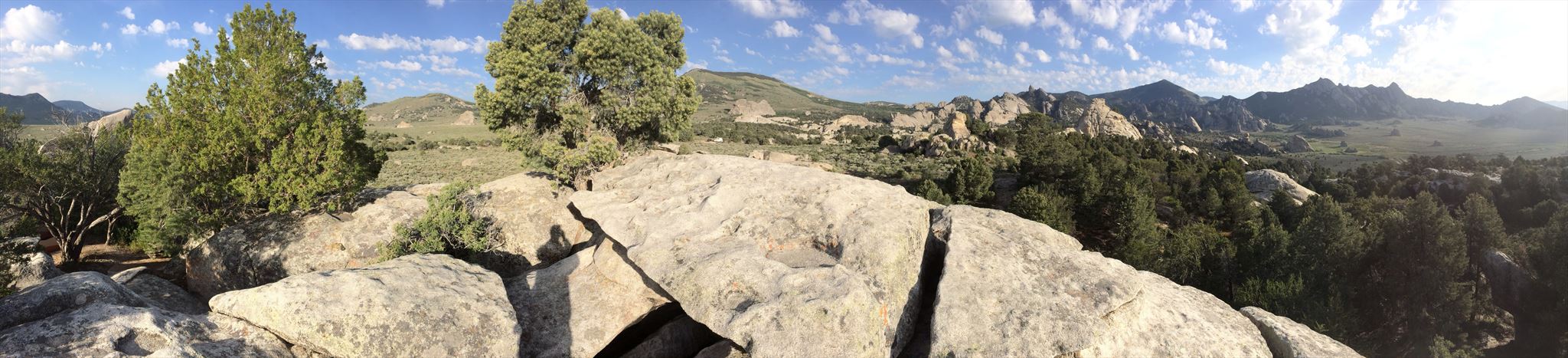
In the Idaho venacular, these formations are called "panholes" In the Southern Albion Mountains, these flat floored features can range from a few inches to several feet across, and just as deep. They generally have overhanging surfaces, and are more common on the tops of spires and pinnacles in the area, and less so on more recently exposed surfaces. This gives a clue to their formation.
Although most contain water for only a few days or weeks, following a rainfall or snowmelt, a few of the largest panholes can provide permanent reservoirs of water. The most famous of these, and I was sorely tempted to place the Earthcache on its nearly inaccessible summit, is on top of Bath Rock near the center of camping area. If you are tempted to take a look at those (and you are entirely on your own on that one), there is a climbers descent route on the backside of the formation (rebar anchored in rock, sometimes referred to as "staples").
For the purposes of this Earthcache, all that is needed is a short walk on a well graded trail from a nearby parking area.
Sometimes mistakenly called "potholes", panholes are formed by a completely different process. While potholes require the action of moving water, such as a river or stream, such action is not readily available in the high desert of City of Rocks. The appearance and distribution of panholes in the area, suggest that they are the result of subaerial weathering and erosion. As stated earlier, freshly exposed rock is devoid of these features, yet the largest panholes suggest prolonged exposure to the elements.
They begin as at small depressions or cracks, where the initial tiny depressions are caused by various processes. The first is the loss of large mineral grains by weathering and erosion. This is enhanced by the rhizomes (roots) of mosses, which leaves some of the minerals more susceptible to additional weathering and erosion. Further erosion can be the result of pooling of water and ephemeral rivulets.
Acceleration of this process is also the result of organic acids due to biologic activity. The panhole increases in size in large part due to residence time of the water which leads to further dissolution of minerals by this acidic water. Once the panhole was deepened to a depth below the case hardened crust of the rock surface, lateral growth of the panhole proceeds more rapidly. Lateral enlargement is also aided by frost weding and moss growth along the edge of the pool. Most panholes have overhanging rims produced as they laterally enlarge into the less resistant rock below the crust.
At the posted coordinates is one of the markers for the official Geology Trail which is sponsored by the NPS. Answer the following questions based on the panholes near this marker.
Logging Requirements:
1. How many panholes are visible on the nearby rock (about waist high or so)?
2. How deep is the deepest one?
3. Is there any evidence of a crust, or has it all worn away at this point?
References:
Etched In Stone: The Geology of City of Rocks National Reserve and Castle Rocks State Park, Idaho; Keven R. Pogue
Geologic Interpretive Trail, City of Rocks National Reserve; A self guided journey to discovering secrets in the rocks of City of Rocks, Prepared by Idaho Department of Parks and Recreation and the National Park Service.