City of Rocks Earthcaching
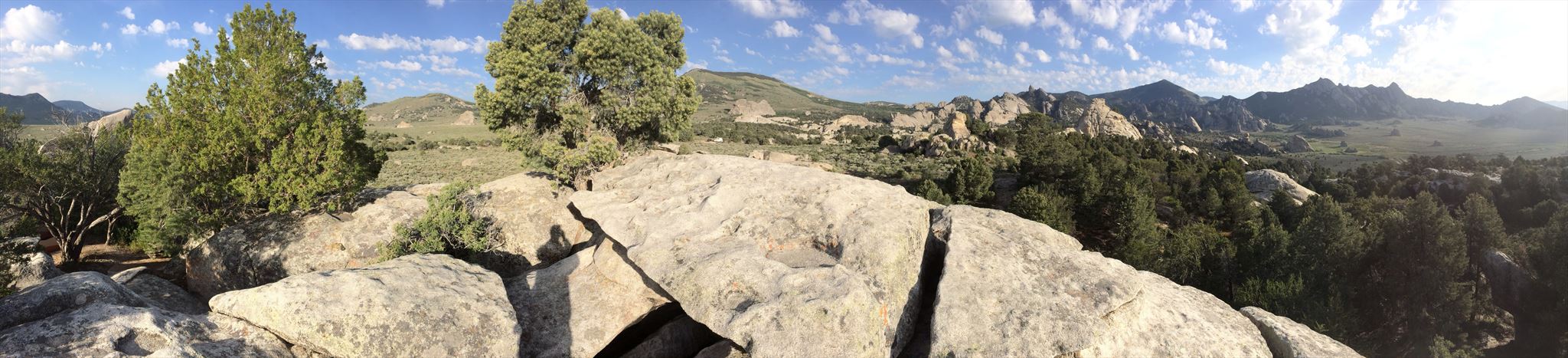
I'm guessing that the location of the Geological Interpretive Trail was chosen, not just for it's easy access from the Circle Creek Overlook parking area, but also for one of the more unique locations, geologically speaking, in the Preserve.
The subject of this Earthcache is a small rock outcrop near one of the Interpretive Trail markers (#6) which shows an intrusive contact between the two dominant rock types of the Reserve.
Green Creek Complex
Granite, granitic gneiss, shist, and amphibolite compose the principal rock types of the Green Creek Complex, which was named for the creek that runs through a valley on the Northeast flanks of Cache Peak. For reference, the rocks of the Green Creek Complex are similar in age and type to those found in the Wasatch Range of Utah to the South and the Wind River Range in Wyoming. The Albion Mountains, where you are now, represents the most Westward exposure of this rock formation that runs between the 35th and 45th parallels in North America.
From a distance, the rocks of the Green Creek Complex are hard to differentiate from the Almo Pluton (which we'll discuss shortly), which is much younger. However on closer inspection, the differences can be quite obvious. The major difference is the large feldspar crystals in the Green Creek Complex which gives it it's characteristic rough appearance, as well as the darker color due to its iron bearing minerals. The majority of the Green Creek Complex rock in the Reserve, sits on the ridge just above the cache location, and in particular, the prominant dome of rock that makes up Steinfells Dome.
Almo Pluton
The granite of the Almo Pluton makes up most of the visible rock of the City of Rocks Preserve and nearby Castle Rock State Park. The Almo Pluton is made of igneous rock formed by the slow cooling of magma that intruded into the older rock. Pluton is a generic that is applied to any body of intrusive igneous rock, regardless of its shape or size. In contrast, a large body of granite is called a batholith (Yosemite Valley and parts of the Sierra Nevada are an example of a batholith). In fact some of the first geologic studies of the Albion Mountains concluded that the entire range was one large batholith, called the Cassia batholith in earlier literature. Subsequent surveys have concluded that the magma that intruded upon the range, crystallized in two separate events. The older Archean granits is now mapped out as part of the Green Creek Complex, while the younger granitic rock is classified as the Almo Pluton., which makes it too small to be classified as a batholith.
The rocks of the Almo Pluton are a mixture of true granite (equal parts quartz, potassium feldspar and sodium-calcium feldspar), and granodiorite (a higher percentage of sodium-calcium feldspar). In addition, there are smaller amounts of muscovite mica and an iron bearing garnet called almandine. The grain size is fairly uniform, ranging from 3-6 mm in width. This equigranular texture of the Almo Pluton, is what helps distinguish it from the more porphyritic granite of the Green Creek Complex.
The subject of this Earthcache can be found just behind the Interpretive Trail Marker. There is a small outcrop of rock with distinctive bands of rocks which demonstrate the two major rock types of the area.
Logging Requirments:
1. Looking at the outcrop, is the Almo Pluton on the top layer, or the Green Creek Complex?
2. Running perpendicular to this intrusive contact are veins of apalite dike. How many viens of dike are their?
3. Judging from the orientation of the two rock types being discussed, do you think the outcrop is in it's original orientation, or was it moved by some natural force?
References:
Etched In Stone: The Geology of City of Rocks National Reserve and Castle Rocks State Park, Idaho; Keven R. Pogue
Geologic Interpretive Trail, City of Rocks National Reserve; A self guided journey to discovering secrets in the rocks of City of Rocks, Prepared by Idaho Department of Parks and Recreation and the National Park Service.