City of Rocks Earthcaching
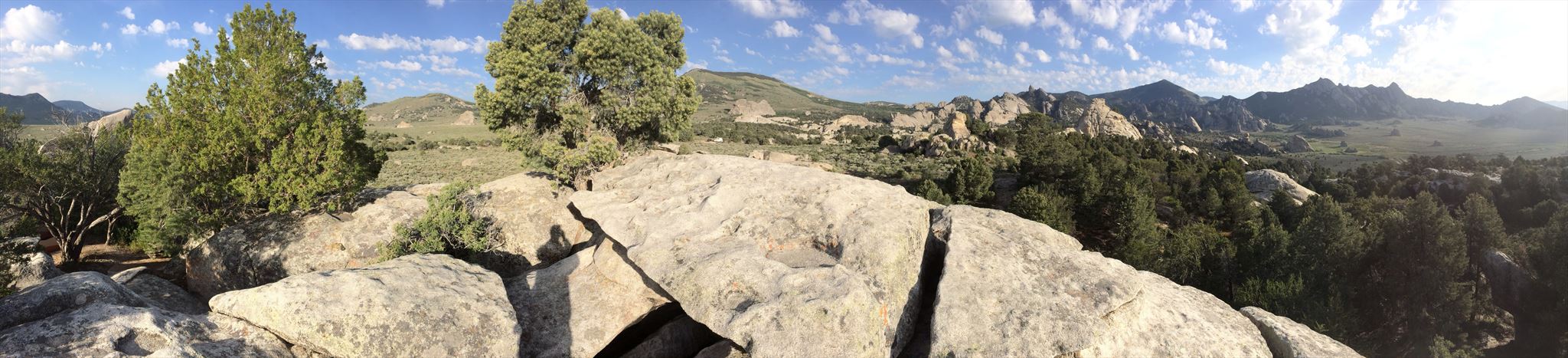
Tafoni are hollows, ranging in size of marble sized holes (sometimes referred to as honeycomb weathering), to room sized caves or rooms. Smaller cavities are sometimes referred to as alveoles, due to their resemblance to air sacs of the lungs.
Tafoni has been described in many types of rocks throughout the world, but they are more common in granite and sandstone rock located in arid to semiarid climates. The tafoni of the Reserve, typically have flat floors, covered by grus (looks decomposed granite). The entrance holes are typically smaller than the interior, owing to the presence of an overhanging lip or visor composed of case hardened exterior of host rock. The interior of these tafoni cavitations are typically coated with loosely bound crystals and thin flakes of rock that detach from the surface with the slightest touch.
The cavernous weathering process that creates tafoni begins on subaerially exposed overhanging rock surfaces that are rarely or never saturated with water. These conditions typically occur in joints and flared slopes, which are abundant in the Preserve. These surfaces promote the precipitation of salts derived from chemical weathering of the rock and externally from mist, fog, and wind born dust. These salts crystallize in microcracks within and between the mineral grains and wedge them apart, because of the insufficient water to flush the salts away from the rock surface. The disintegrating granite loses cohesion and falls from the roof of the overhang. exposing a fresh surface to attack. As this process continues, it self perpetuates itself, making larger and larger cavities, in a microclimate which is conducive to further weathering and erosion. The result is the many fascinating features that we see today in the Reserve, which ultimately results in windows and arches eventually.
Oddly enough, the salty climate which makes the tafoni's possible in this area, is, in large part, due to the salty air brought from the South, from the Great Salt Lake (approximately 30 miles away). The importance to this resource of salt can be demonstrated in features much closer to the Great Salt Lake, in an area called Devils Playground.
Tafoni which starts along suhorizontal joints and grows upward is called basal tafoni. This sort of formation can lead to skylights. Tafoni that begins along vertical or near vertical joints are called sidewall tafoni. Fin shaped spires can eventually be undermined to produce windows and arches in such a process.
Logging Requirement:
1. How deep is the tafoni, at it's deepest, on the feature in front of you?
2. Would you describe this as a basal or sidewall tafoni?
3. The trail continues around the rock, follow this to the other side. Is there tafoni formation on the other side? Why or why not?
References:
Etched In Stone: The Geology of City of Rocks National Reserve and Castle Rocks State Park, Idaho; Keven R. Pogue
Geologic Interpretive Trail, City of Rocks National Reserve; A self guided journey to discovering secrets in the rocks of City of Rocks, Prepared by Idaho Department of Parks and Recreation and the National Park Service.