The Tanana River is a 584-miles long and is a tributary of the Yukon River. According to William Bright, the name is from the Koyukon (Athabaskan), which literally means "trail river". The river's headwaters are located at the confluence of the Chisana and Nabesna rivers just north of Northway in eastern Alaska. In the marsh regions it is joined by several large tributaries, including the Nenana (near the city of Nenana) and the Kantishna. It empties into the Yukon approximately 70 miles downriver from the village of Manley Hot Springs, near the town of Tanana. Ice on the river begins to accumulate in October or November. Each winter the river has an average maximum thickness of 43 inches at Nenana. Over the years, the break-up date has varied from April 20 to May 20. (Alsaka)
From this point of view you will see the Tanana River and its many twists and turns which are geologically known as a meander. On a clear day you can see across to the other side and the mountain range on that side. Standing at the posted coordinates and looking out at 158.91 degrees you might be able to see the group of mountain ranges which has Mount Hess at 11,940 feet, Mount Skarland at 10,315 feet, Mount Giddings at 10,180 feet, Mount Geist at 10,720 feet, Mount Balchen at 11,140 feet, and so on, but that is 85.52 miles away. (Alaska)
Mount Hess and the others visable off in the far distance.

If you wanted to see Mount McKinley, sorry the view from here will not allow you to see it from here, you would have to look out from the posted coordinates at 217.38 degrees and be able to see for 147 miles.
Meander
A meander, in general, is a bend in a twisting watercourse or river. A meander is formed when the moving water in a stream erodes the outer banks and widens its valley and the inner part of the river has less energy and deposits what it is carrying. A stream of any volume may assume a meandering course, alternately eroding sediments from the outside of a bend and depositing them on the inside. The result is a snaking pattern as the stream meanders back and forth. When a meander gets cut off from the main stream, an oxbow lake is formed.
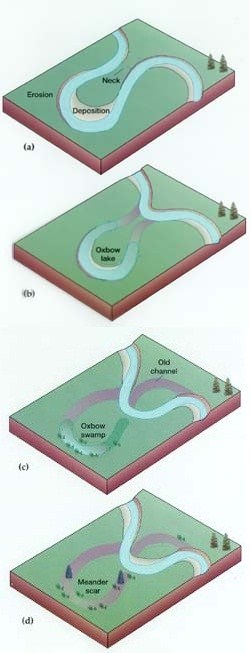
What is Erosion?
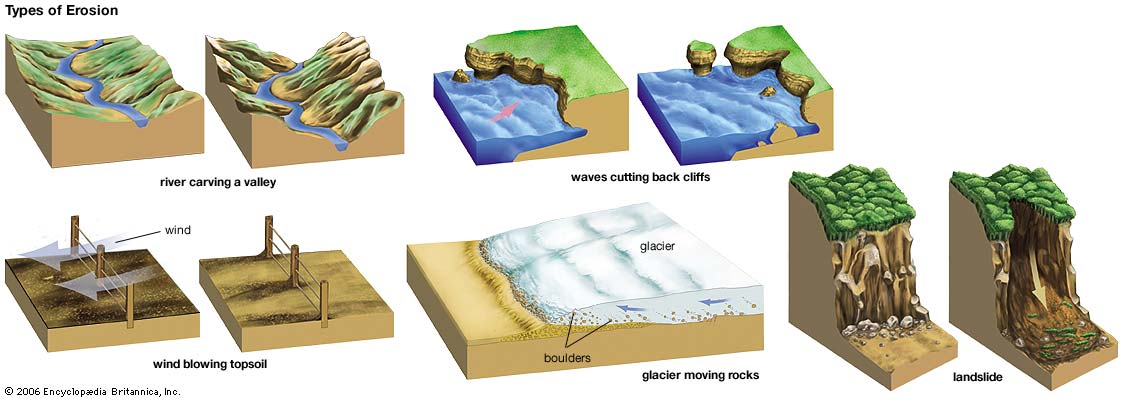
Erosion is the process by which soil and rock are removed from the Earth's surface by natural processes such as wind or water flow, and then transported and deposited in other locations.
Types of Erosion:
Splash Erosion: Small soil particles are detached and sent airborne through the impact of raindrops on soil.
Sheet Erosion: Raindrops break apart the soil structure and it's moved down-slope by water that flows overland as a sheet rather than definitive channels. This occurs frequently during cloud bursts.
Rill Erosion: This process develops small, short-lived, concentrated flow paths. These paths create a sediment source and delivery system for hill-slope erosion. Areas where precipitation rates exceed soil infiltration rates are more prone to this type of erosion.
Gully Erosion: Water flows in narrow channels during or directly following heavy rains or melting snow. The gullies can erode to considerable depths.
Valley or Stream Erosion: Continual water flow alongside land (along a linear feature) creates this type of erosion. It extends downward, deepening a valley, and head-ward, extending the valley into the hillside. This occurs most frequently in times of flooding.
Bank Erosion: Over time, banks of rivers and streams are naturally worn down.
Freezing and thawing: Cold weather causes water trapped in tiny rock cracks to freeze and expand, breaking the rock into several pieces.
Vandalism: Vandalism can cause erosion as well; paint chemicals and scratches in rock surfaces can leave lasting marks and erode away at the surface of the rocks leading to an accelerated rate of erosion that might not happen normally.
Urbanization: has major effects on erosion processes—first by denuding the land of vegetative cover, altering drainage patterns, and compacting the soil during construction; and next by covering the land in an impermeable layer of asphalt or concrete that increases the amount of surface runoff and increases surface wind speeds.
Source: (water)
**Logging requirements**
DO NOT POST ANSWERS IN YOUR LOG.
Send the following answers to me via email.
- The text "GC5D54M Tanana River Overlook" on the first line
- How many times do you see the river head almost directly south?
- How many meanders do you see from this view point?
- Are you able to see any points where the river has cut through to form an oxbow lake, or meander scar?
- What is the elevation here?
- What year was this boulder placed here and what kind of erosion do you see all OVER it?
| I have earned GSA's highest level: |
 |
Sources