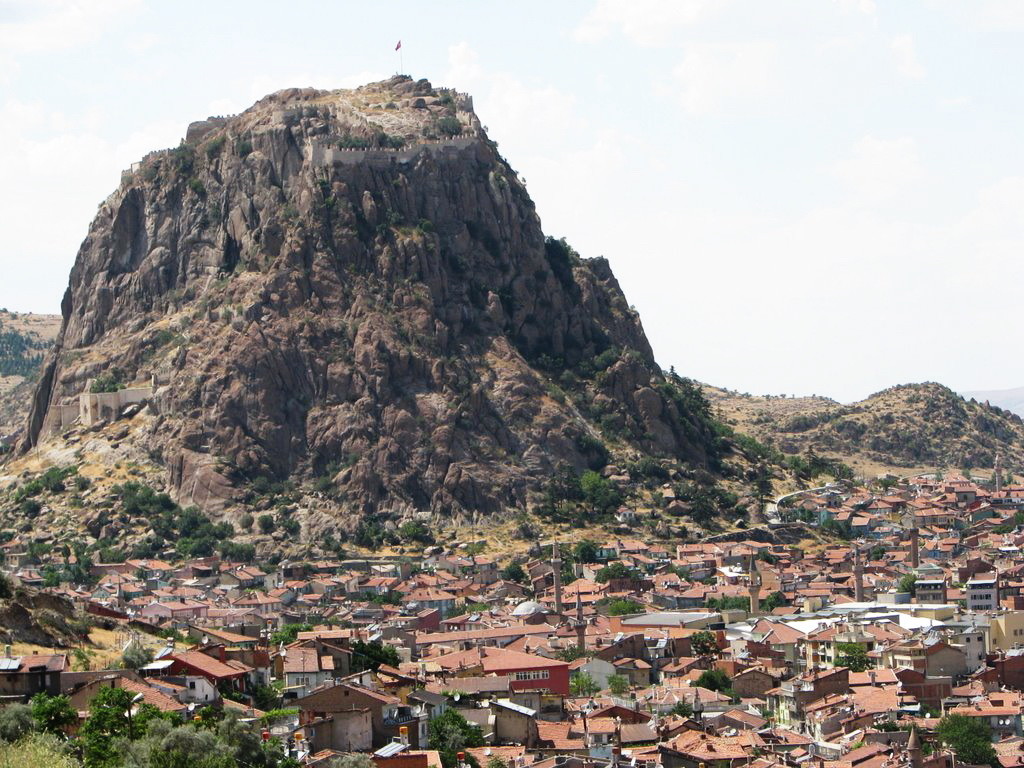
 Afyon Kalesi, şehirden 226 metre yükseklikte doğal bir anıt olarak yükselen kale, şehrin kaya kütlelerini oluşturan andezit bir kütledir. Bu özelliğinden dolayı şehirde binlerce yıldır ad oluşturmuştur. Hititler HAPUNAVA, Yunun, Roma ve Bizanslılar AKRONİUM, Selçuklu ve Osmanlılar KARAHİSAR olarak adlandırmıştır. Kale, Hititliler döneminden itibaren (M.Ö. 15.YY) Osmanlının son yıllarına kadar surlarla çevrili olarak aralıksız kullanılmıştır. Kale, sarp ve dik bir yapıda olup aşağı, orta ve yukarı olarak üç surla çevrilmiş ve savunma ağırlıklı bir yapıya kavuşmuştur. Frik tanrısı Kibele adına yapılmış tapınım yerleri Bizans Kilisesi, Selçuklu mescidi bulunan üst düzlük, tarih boyunca dinsel alan olarak kullanılmıştır. Alaattin Keykubat zamanında surlar onarılmış, kale içinde su sarnıçları ile aynı dönemde mimar Bedrettin Gevhertaş'a saray ve mescid yaptırmıştır. Surlar kısmen Osmanlılar zamanında, 1988 yılında Kültür Bakanlığı, 1999 yılından itibaren de Afyon Valisi Ahmet Özyurt tarafından İl Özel İdaresi bütçesinden onarılmıştır.
 The Castle of Afyon, is a volcanic mass which constitutes to main rock mass of city and rises as a natural monument 226 meters about city level. The city was given several names because of the castle for thousands of years, Hittites called the city HAPANOVA, Greek Roman and Byzantine called it AKRONIUM, Ottomans and Selcuks called it KARAHİSAR. The castle of Afyon had been used continuously from Hittities (B.C. 1500) until the end of the Ottoman Empire the castle which was built on a step rock is surrounded by three ramparts, lower, middle, upper one inside the other with the purpose of defending the city. Some parts such as the temple constructed in the name of the Phrygian goddess Kybele, a church of Byzantina and a small mosque from Selcuks located on upper the flat square had been used for religious purposes. There have also been deep water cisterns.During the rule of Alaaddin Keykubat 1. one of Selcuk sultans the architect Bedrettin Gevhertaş was assigned to construct mosque and a palace and repair the damaged parts of rampart of castle. The walls were partly fixed during the Ottoman period, by the culture minestry in 1988 and by the governor of Afyon Mr. Ahmet Özyurt by using the funds of Special District Administration in 1999.