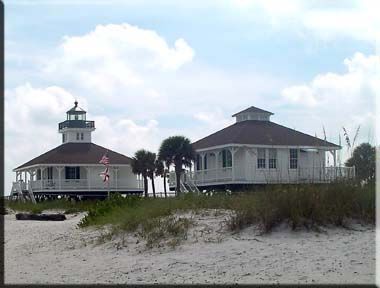
This Lighthouse was first lit on December 31, 1890. It is a two-story frame dwelling raised on iron screw-piles, with the lantern placed in a cupola at the peak of the roof. The keeper lived in the lighthouse. A similar house (without a lantern) built next to it was the assistant keeper's dwelling.
This Light originally served ships transporting cattle from ports on Charlotte Harbor to Cuba. Phosphate ore from the Peace River area became an important cargo in the 1890s, and the construction of the Charlotte Harbor and Northern Railway to Port Boca Grande in 1909 resulted in increased traffic. Ship traffic to Port Boca Grande peaked at more than 30 ships a day during World War II, when this port served as a safe harbor for shipping in the Gulf.
In 1988 the building and surrounding property were turned over to the State of Florida and became a State Park. In 1999 the Lighthouse and Museum opened to the public.
The light is considered an Aid to Navigation and the lamp room is maintained by the U.S. Coast Guard Station St. Petersburg Aids to Navigation Team.
Location: south tip of the Island, on the Boca Grande Pass
Year first lit: 1890
Automated: 1956
Deactivated: 1966, reactivated 1986
Foundation: iron screw piles
Construction: wood frame
Tower shape: octagonal lantern at roof peak of a square house
Height: 44 feet (13 m)
Original lens: three and a half order Fresnel lens
Characteristic: white light flashes every 20 seconds
In order to get the correct coordinates, please choose which lighthouse this is:
A) Dry Tortugas Lighthouse - N29° 21.568 W81° 47.186
B) Port Boca Grande Lighthouse - N29° 20.609 W81° 48.536
C) Cedar Key Lighthouse - N29° 22.068 W81° 47.086
To learn more about Florida Lighthouses, please visit the link below:
Lighthouse Friends, Florida Lighthouses: http://www.lighthousefriends.com/fl.html
Unless noted otherwise, all source material is from Wikipedia.