Local geology:
A Physiographic Region is a region of which all parts are similar in geologic structure and climate and which has consequently had a unified geomorphic history; a region whose patterns of relief features or landforms differs significantly from that of adjacent regions. This area is part of The High Plains which are a sub-region of the Great Plains mostly in the Western United States. Due to low moisture and high elevation, the High Plains commonly experiences wide ranges and extremes in temperature. The region is known for the steady, and sometimes intense, winds that prevail from the west. The winds add a considerable wind chill factor in the winter.
Confirmed by two different geologists this mesa has strata {Strata = is layers of sedimentary rock or soils with internally consistent characteristics that distinguish it from other layers.} from the Cretaceous period which is between 145–66 million years ago. (Cummins)
Mesa:
A mesa is the American English term for tableland, an elevated area of land with a flat top and sides that are usually steep cliffs. It takes its name from its characteristic table-top shape. It is a characteristic landform of arid environments, particularly the Western and Southwestern United States in badlands and mountainous regions. Mesas form by weathering and erosion of horizontally layered rocks that have been uplifted by tectonic activity. Variations in the ability of different types of rock to resist weathering and erosion cause the weaker types of rocks to be eroded away, leaving the more resistant types of rocks topographically higher than their surroundings. This process is called differential erosion. The most resistant rock types include sandstone, conglomerate, quartzite, basalt, chert, limestone, lava flows and sills. Differences in rock type also reflect on the sides of a mesa, as instead of smooth slopes, the sides are broken into a staircase pattern called "cliff-and-bench topography". The more resistant layers form the cliffs, or stair steps, while the less resistant layers form gentle slopes, or benches, between the cliffs. (Easterbrook)
Erosion
Erosion is the process by which soil and rock are removed from the Earth's surface by natural processes such as wind or water flow, and then transported and deposited in other locations. In this particular area at GZ, Water has caused most of the Erosion here.
Types of Erosion:
Splash Erosion: Small soil particles are detached and sent airborne through the impact of raindrops on soil.
Sheet Erosion: Raindrops break apart the soil structure and it's moved down-slope by water that flows overland as a sheet rather than definitive channels. This occurs frequently during cloud bursts.
Rill Erosion: This process develops small, short-lived, concentrated flow paths. These paths create a sediment source and delivery system for hill-slope erosion. Areas where precipitation rates exceed soil infiltration rates are more prone to this type of erosion.
Gully Erosion: Water flows in narrow channels during or directly following heavy rains or melting snow. The gullies can erode to considerable depths.
Valley or Stream Erosion: Continual water flow alongside land (along a linear feature) creates this type of erosion. It extends downward, deepening a valley, and head-ward, extending the valley into the hillside. This occurs most frequently in times of flooding.
Bank Erosion: Over time, banks of rivers and streams are naturally worn down.
Freezing and thawing: Cold weather causes water trapped in tiny rock cracks to freeze and expand, breaking the rock into several pieces.
Wind erosion is a major geomorphological force, especially in arid and semi-arid regions. Wind erosion is of two primary varieties: deflation, where the wind picks up and carries away loose particles; and abrasion, where surfaces are worn down as they are struck by airborne particles carried by wind.
Mass movement is the downward and outward movement of rock and sediments on a sloped surface, mainly due to the force of gravity. Mass movement is an important part of the erosional process, and is often the first stage in the breakdown and transport of weathered materials in mountainous areas. It moves material from higher elevations to lower elevations where other eroding agents such as streams and glaciers can then pick up the material and move it to even lower elevations. Mass-movement processes are always occurring continuously on all slopes; some mass-movement processes act very slowly; others occur very suddenly, often with disastrous results.
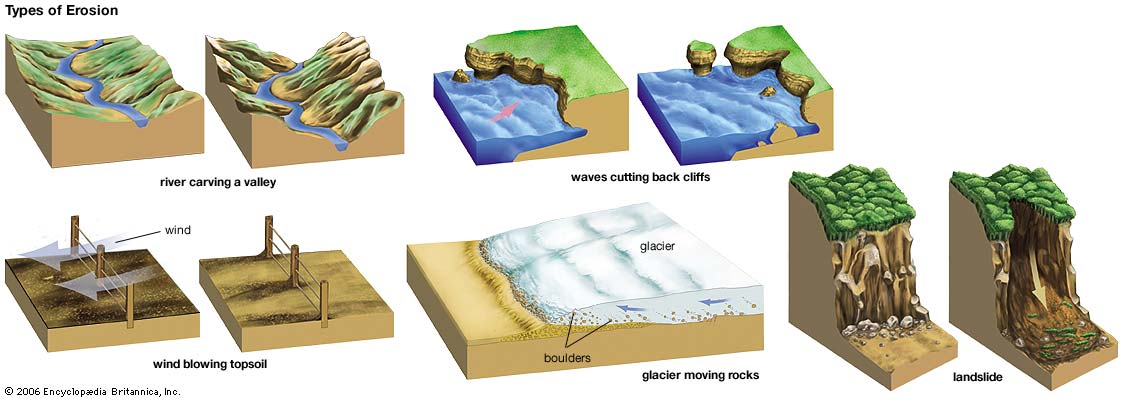
Source: (water)
Sources
**Logging requirements**
DO NOT POST ANSWERS IN YOUR LOG.
Send the following answers to me via email.
- The text "GC5F9E1 Mesa View" on the first line
- What river is listed and how do you think it helped in the formation of this mesa? (No photo's of this please)
At waypoint "Mesa View"
- What is the majority color of the mesa?
- What two primary colors are in the cliff on this side of the mesa?
- What does the mesa look like? (A = single pillar, B = two distinct levels)
| I have earned GSA's highest level: |
 |