Parasaurolophus
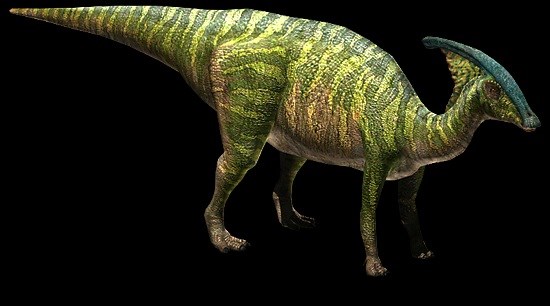
Parasaurolophus was an interesting-looking dinosaur. While it looked normal from the neck down, it looked almost as if it had a trombone on its head. And in a way, it did.
Parasaurolophus is one of many hadrosaurs from the Late Cretaceous of North America. Its name, which means "near crested lizard," refers to the resemblance of the crests of its close cousin Saurolophus. However, the crest of Saurolophus was solid bone and the crest of Parasaurolophus was hollow. The hollow space wiithin the crest of Parasaurolophus reached the nostrils and looped down to connect to the back of the throat. This crest was the animal's nasal cavity moved on top of its head.
This crest, seen also in other lambeosaurid hadrosaurs, has attracted much attention. At first, paleontologists thought this crest was used underwater, perhaps as a snorkel or a place to store extra air. Other suggestions included extra space to increase the animal's sense of smell or an an area used to cool its brain. The function of the crest is now thought to relate to hadrosaur social behavior. Because of their size and shape, crests could have been for display. They may have helped other members of its species identify the animal, and the crest may have shown how old the animal was and its gender.
Also, because it would have made a resonating chamber. Sounds would have been made by a vocal organ or voice box and "pushed" through the crest, making a deep honking call. In this way, the animal could have communicated. All lambeosaurines would have used their "voices" to announce themselves, to warn their hatchlings, and to challenge other animals that invaded their territory.
Brachiosaurus

Brachiosaurus is a large genus of Sauropod dinosaur from the Morrison Formation of Jurassic North America.
Description
As with all Sauropods, Brachiosaurus had four legs, a long neck, smal skull, long muscular tail, and thin columnar limbs. As with other Brachiosaurids, it had an arch of bone over the nasal openings in front of the eyes. It had longer front limbs than hind limbs, hence the name, "Arm Lizard." The longer front limbs caused the back to slope, making Brachiosaurus resemble the modern giraffe. It grew to over 85 feet in length, nearly 45 tonnes, and over 40 feet tall.
History
The genus Brachiosaurus, and type species B. altithorax, are based on a partial postcranial skeleton from Fruita, in the valley of the Colorado River of western Colorado. This specimen was collected from rocks of the Brushy Basin Member of the Morrison Formation in 1900 by Elmer S. Riggs and his crew from the Field Columbian Museum of Chicago. In 1899 Riggs had sent inquiries to rural locations in the western United States concerning fossil finds, and Bradbury, an amateur collector himself, reported that dinosaur bones had been collected in the area since 1885. It was Riggs' W. Menke who found the skeleton on July 4, 1900. Additional Brachiosaurus fossils are reported on Riggs Hill, but other fossil finds on the hill have been vandalized. Riggs published a short report in 1901, noting the unusual length of the humerus compared to the femur and the extreme overall size and the resulting giraffe-like proportions, as well as the lesser development of the tail, but did not publish a name for the new dinosaur. The titles of Riggs (1901) and (1903) suggested that the specimen was the largest known dinosaur. Riggs followed his 1903 publication that named Brachiosaurus altithorax with a more detailed description in a monograph in 1904. The Fruita skeleton was not the first discovery of Brachiosaurus bones, although it was the first to be recognized as belonging to a new and distinct animal. In 1883, a sauropod skull was found near Garden Park, Colorado, at Felch Quarry 1, and was sent to Othniel Charles Marsh. Marsh incorporated the skull into his skeletal restoration of "Brontosaurus" (now Apatosaurus). It eventually became part of the collections of the National Museum of Natural History. In the 1970s, when Jack McIntosh and David Berman were working on the issue of the true skull of Apatosaurus, they r eevaluated the Garden Park skull as more similar to Camarasaurus. It was described and recognized as a Brachiosaurus skull in 1998 by Kenneth Carpenter and Virginia Tidwell, intermediate in form between Camarasaurus and Giraffatitan brancai (then still considered to be Brachiosaurus brancai). Because there are no overlapping parts between this skull and the discovered in 1900, it cannot be confidently assigned to a species, so it is classified as Brachiosaurus.
Additional discoveries of Brachiosaurus material in North America have been uncommon and consist of a handful of bones. Material has been described from Colorado, Oklahoma, Utah, and Wyoming, and undescribed material has been mentioned from several other sites.
The Giraffatitan material(from Tengaduru in 1914) was considerated firstly as B. altithorax, but describing the "brachiosaurid" material, Janensch listed a number of differences and commonalities between them and B. altithorax. In three further publications in 1929, 1950 and 1961 Janensch compared the two species in more detail, listing 13 putative shared characters. Of these, however, only four appear to be valid, while six pertain to more inclusive groups than Brachiosauridae, and the rest are either difficult to assess or refer to material that is not Brachiosaurus.
In 1988, Gregory Paul published a new reconstruction of the skeleton of "B." brancai, highlighting a number of differences in proportion between it and B. altithorax. Chief among them is a difference in the way the trunk vertebrae vary: they are fairly uniform in B. altithorax, but vary widely in the African material. Paul believed that the limb and girdle elements of both species were very similar, and therefore suggested to separate them not at genus, but only at subgenus level. Giraffatitan was raised to genus level by Olshevsky without comment. A detailed study of all material, including the limb and girdle bones, by Michael Taylor in 2009 found that there are significant differences between Brachiosaurus altithorax and the Tendaguru material in all elements known from both species. Taylor found 26 distinct osteological (bone-based) characters, a larger difference than that between, for example, Diplodocus and Barosaurus, and therefore argued that the African material should be placed in its own genus, Giraffatitan, as G. brancai. An important difference between the two genera is the overall body shape, with Brachiosaurus having a 23% longer dorsal (trunk) vertebrate series and a 20 to 25% longer and also taller tail.
Paleoecology
With the removal of the East African Giraffatitan, Brachiosaurus is known only from the Morrison Formation of western North America. The Morrison Formation is interpreted as a semiarid environment with distinct wet and dry seasons, and flat floodplains. Vegetation varied from gallery forests (river–lining forests in otherwise treeless settings) of conifers, tree ferns, and ferns, to fern savannas with rare Araucaria-like trees. Several other sauropod genera were present in the Morrison Formation, with differing body proportions and feeding adaptations. Among these were Apatosaurus,Barosaurus, Camarasaurus, Diplodocus, Haplocanthosaurus, and Supersaurus. Brachiosaurus was one of the less abundant Morrison Formation sauropods. Brachiosaurus fossils are found only in the lower-middle part of the expansive Morrison Formation (stratigraphic zones 2-4), dated to about 154-153 million years ago, unlike many other types of sauropod which have been found throughout the formation.
Paleobiology
In contrast to most other sauropods, Brachiosauridae had an inclined back, due to their long forelimbs. Therefore, if the neck exited the body in a straight line, it already pointed upwards. The exact angle is influenced by how the pectoral girdle is reconstructed, that is how the shoulder blades are placed on the ribcage. The mobility of the neck was reconstructed as quite low by Stevens and Parrish, while other researchers like Paul and Christian and Dzemski argued for more flexible necks.
Brachiosaurus is thought to have been a high browser, feeding on foliage well above the ground. Even if it did not hold its neck near vertical, and instead had a straighter neck, its head height may still have been over 9 metres (30 ft) above the ground. It probably fed mostly on foliage above 5 metres (16 ft). This does not preclude the possibility that it also fed lower at times, between 3 to 5 metres (9.8 to 16 ft) up.
Its diet likely consisted of ginkgos, conifers, tree ferns, and large cycads, with intake estimated at 200 to 400 kilograms (440 to 880 lb) of plant matter daily. However, more recent studies estimate that ~240 kilograms (530 lb) of plant matter would have been sufficient to feed a 70 metric tons (77 short tons) sauropod, so Brachiosaurus may have required only about 120 kilograms (260 lb) of fodder a day. Brachiosaur feeding involved simple up–and–down jaw motion. The teeth were arranged to shear material as they closed, and were probably used to crop and/or nip vegetation.
It has repeatedly been suggested, for example, in the movie Jurassic Park, that Brachiosaurus could rear into a bipedal or tripodal (with tail support) pose to feed. However, a detailed physical modelling-based analysis of sauropod rearing capabilities by Heinrich Mallison showed that while many sauropods could rear, the unusual brachiosaurid body shape and limb length ratio made them exceptionally ill suited for rearing. The forward position of the center of mass would have led to problems with stability, and required unreasonably large forces in the hips to obtain an upright posture. Brachiosaurus would also have gained relatively little from rearing (only 33% more feeding height), compared to other sauropods, for which a bipedal pose may have tripled the feeding height.
Like all sauropods, Brachiosaurus was homeothermic (maintaining a stable internal temperature) and endothermic (controlling body temperature through internal means), meaning that it was able to actively control its body temperature, producing the necessary heat through a high basic metabolic rate of its cells. In the past, Brachiosaurus has been used an example of a dinosaur for which endothermy is unlikely, because of the combination of great size (leading to overheating) and great caloric needs to fuel endothermy. However, these calculations were based on incorrect assumptions about the available cooling surfaces (the large air sacs were not known), and a grossly inflated body mass. These inaccuracies resulted in overestimation of heat production and underestimation of heat loss. The large nasal arch has been postulated as an adaptation for cooling the brain, as a surface for evaporative cooling of the blood. Again, when this was proposed, cooling via the air sacs was not known, and thus not taken into account. Furthermore, other similar sized sauropods had no comparable structure. Additionally, in proportion to the entire animal, the nasal arch is very small, and would thus have made only an insignificant contribution to heat loss.
The nostrils of the Brachiosaurus (like other sauropods, for example the Giraffatitan), the huge corresponding nasal openings in its skull, were long thought to be located on the top of the head. In past decades, scientists theorized that the animal used its nostrils like a snorkel, spending most of its time submerged in water in order to support its great mass. The current consensus view, however, is that the Brachiosaurus was a fully terrestrial animal. Studies have demonstrated that water pressure would have prevented the animal from breathing effectively while submerged and that its feet were too narrow for efficient aquatic use. Furthermore, new studies by Lawrence Witmer (2001) show that, while the nasal openings in the skull were placed high above the eyes, the nostrils would still have been close to the tip of the snout (a study which also lends support to the idea that the tall "crests" of brachiosaurs supported some sort of fleshy resonating chamber).
Triceratops

Triceratops was a ceratopsian dinosaur and was one of the largest of its kind. It lived in the late Cretaceous Period. It was discovered by John Bell Hatcher and named by American paleontologist Othniel Charles Marsh in 1889.
In the United States, Triceratops is the official state fossil of South Dakota, and the official state dinosaur of Wyoming.
Although no complete skeleton has been found, Triceratops is well known from numerous specimens collected for over a century. Its four-legged horned appearance, somewhat reminiscent of an ancient rhinoceros, is one of the most famous and recognized of all dinosaurs.
Description
All species of this now-extinct genus lived on the North American continent. It was about 11 m (36 ft) long, and probably weighed around 10,909 kg (24,000 lb) at the biggest.
The distinctive skull of Triceratops had a single horn on the snout above the nostrils, and a pair of horns approximately 1 m (4 ft) long above the eyes. The rear of the skull consisted of a relatively short bony frill, and was the largest skull of any land animal, some growing over 9 ft (2.8 m) tall and 6 ft (1.8 m) wide.
Scientist think that the horns and the frill were used for several purposes: Defense against carnivores such as Tyrannosaurus rex. Communication between the herd members. Battling another Triceratops over female or territory. Courting females. A status symbol which reflects (or determines) the individual's status in the herd. Anchor points for the jaw muscles. Increasing body area to regulate temperature (thermoregulation).
Paleontologists deduce from the evidence of ichnites (fossil footprints) of dozens of individual animals, that Triceratops lived in herds, similar to those of modern-day buffalo.Triceratops were herbivores, and because of their low head, their primary food was probably low growth, although they may have been able to knock down taller plants with their horns, beak, and bulk . Behind the beak, Triceratops had a series of teeth arranged in a shearing mechanism. Triceratops possessed a sturdy build, with robust legs and hoofed toes. Triceratops teeth are among the most abundant fossils in the Late Cretaceous of Western North America (70-68 mya), suggesting that it was the dominant herbivore of the time. It often fought and sometimes was killed by Tyrannosaurus rex. It is estimated that Triceratops was able to run at around 24 km/h (15 mph), since its short legs meant it could not take long strides. It shared its landscape with the fearsome Tyrannosaurus, the armored dinosaur Ankylosaurus, and Edmontonia other ceratopsians, hadrosaurs like Edmontosaurus, and sauropods like Alamosaurus.
Recent Reasearch has suggested that Triceratops was partially covered in quills, probably along the back.
Apatosaurus

Apatosaurus is a genus of sauropod dinosaurs that lived about about 161-144 million years ago, during the Jurassic period. It was one of the large sauropods, about 4.5 meters (15 feet) tall at the hips, with a length of up to 75 ft and a mass up to 35 metric tonnes (39 tons).
Environment
It was once believed that Apatosaurus was too massive to support its own weight on dry land, so it was theorized that the sauropod must have lived partly submerged in water, perhaps in a swamp. Recent findings do not support this. In fact, like its relative Diplodocus, Apatosaurus was a grazing animal with a very long neck, and a long tail that served as a counterweight. Fossilized footprints indicate that it probably lived in herds. To aid in processing food, Apatosaurus may have swallowed gizzard stones (gastroliths) the same way many birds do today — its jaws alone were not sufficient to chew tough plant fibers.
Stegosaurus was up to 30 feet (9.1 meters) long. An average Stegosaurus was around 20 feet (6.1 meters) long, and weighed 2 tons. Stegosaurus had much longer hind legs than forelegs, and very strong muscles around its hips. So, although Stegosaurus walked on all fours, it is thought likely that the animal could have lifted its forelegs off the ground to eat from the branches of trees.
Classification and history
In 1877, Othniel Charles Marsh published notes on his discovery of the Apatosaurus, and then in 1879 described another, more complete dinosaur — the Brontosaurus. In 1903, it was discovered that the apatosaur was in fact a juvenile brontosaur, and the name Apatosaurus, having been published first, was deemed to have priority as the official name; Brontosaurus was relegated to being a synonym. The name was not formally removed from the records of paleontology until 1974. In 2015, the name Brontosaurus was assigned to its own genus.
Fossils of this animal have been found in Nine Mile Quarry and Bone Cabin Quarry in Wyoming, and at sites in Colorado, Oklahoma, Utah, USA.
Description
Apatosaurus was a large, long-necked quadrupedal animal with a long, whip-like tail. Its forelimbs were slightly shorter than its hindlimbs. One measurement places the total length of the species Apatosaurus louisae at 22 m (72 ft).
It was roughly the weight of four elephants. Estimates for A. louisae were 20,600 kg (45,000 lb)[3] and 22,407 kg (49,400 lb).Other estimates of the body mass of adult Apatosaurus species range from 18,000 kg (40,000 lb) to 35,000 kg (77,000 lb). A microscopic study of Apatosaurus bones concluded that the animals grew rapidly when young and reached near-adult sizes in about 10 years.
The skull was small in comparison with the size of the animal. The jaws were lined with spatulate teeth, which resembled chisels, suited to an herbivorous diet. Like other sauropods, the vertebrae of the neck were deeply bifurcated; that is, they carried paired spines, creating a wide and deep profile for the neck. The apparently massive neck was, however, filled with an extensive system of weight-saving air sacs. Apatosaurus, like its close relative Supersaurus, is notable for the incredibly tall spines on its vertebrae, which make up more than half the height of the individual bones. Also unusual among diplodocids is the shape of the tail, which is comparatively thin in breadth and short in height, a profile caused by the vertebral spines decreasing in height rapidly the farther they are from the hips. Apatosaurus also had very long ribs compared to most other diplodocids, giving it an unusually deep chest. The limb bones were also very robust.An article that appeared in the November 1997 issue of Discover Magazine reported research into the mechanics of Apatosaurus tails by Nathan Myhrvold, a computer scientist from Microsoft. Myhrvold carried out a computer simulation of the tail, which in diplodocids like Apatosaurus was a very long, tapering structure resembling a bullwhip. This computer modeling suggested that sauropods were capable of producing a whip-like cracking sound of over 200 decibels, comparable to the volume of a cannon firing.
Velociraptor

Velociraptor (Speedy Thief) was a small carnivorous dinosaur, well known thanks to Jurassic Park. It was one of the smallest dromaeosaurs, smaller than Utahraptor, Deinonychus and Dromaeosaurus
General Description
The most amazing find in Mongolia may be the discovery of the skeletons of the small theropod Velociraptor ("swift seizer") with its right arm clamped firmly in the beak of the small ceratopsian Protoceratops. Both skeletons are complete and picture a Late Cretaceous struggle to the death. In mid-battle a sand dune collapsed, killing the two dinosaurs and preserving them in their death pose until 1971, when they were unearthed. In 1922, the first specimen of Velociraptor was found by the American Museum of Natural History. Like the famous death-pose specimen, it was found in the Late triassic sandstones of the Djadokhta Formation in the Gobi Desert, and was also found lying alongside a skull of Protoceratops. Velociraptor was a small theropod, with a large sickle-shaped claw on the second toe of its foot, it had a long, narrow snout, which is different from the other members of its family. The jaws were lined with serrated teeth for tearing flesh, it swallowed its food in gulps instead of chewing, like most theropods. The arms were long and it had strong chest and arm muscles, for grasping onto prey. Since the death-pose specimen was found with a Protoceratops, it probably ate this small ceratopsian, but it may have hunted even larger prey. Its diet also included small animals, such as lizards. Another dromaeosaurid feature that can be clearly seen in the death-pose are the long pieces of bone along the sides of the bones of the tail to stiffen it. This allowed the tail to act as a balance when the animal walked and ran. The tail, however, was still flexible, expecially since it was attached to the hips. The complete "Struggle to the death" skeleton has not yet been described, but it will certainly reveal even more new and exciting facts about this fascinating genus.
Velociraptor was a small, dog-sized dinosaur that flourished in the mid-Cretaceous period. This dinosaur has become one of the most famous, due to its prominent role in the Jurassic Park movies.
Jurassic Park Velociraptor vs the actual Velociraptor
Velociraptor was closely related to the North American Deinonychus. Not massive like Tyrannosaurus or Tarbosaurus, this smaller dinosaur was a fierce predator, being quick and agile, as is portrayed in the movie 'Jurassic Park'. Unfortunately, the producers of 'Jurassic Park' felt compelled to make the movie Velociraptor 400% larger than the fossil record would indicate (standing 8–10 feet/2.43-3.048 meters tall and 4.25–6 meters long).
This would create the feeling that the characters where being chased constantly by something a little more scary and dangerous than a turkey sized dromaeosaur. The so called raptor in the movie is more similar to an Utahraptor in size.Velociraptor was roughly the size of a turkey. Also, Jurassic Park Velociraptors didn't have feathers.
For some reason, in the Jurassic Park series, Velociraptors lack feathers and are bigger; instead of feathers, they are given squamas on their backs. The reason for the differences may be the result of genetic splicing errors and the utilization of amphibian DNA to fill in the genetic code sequence gaps.
Food
Velociraptor was a carnivore who probably ate anything it could capture, since its size was no larger than a turkey, the most likely prey were small mammals and dinosaurs. Some of the Velociraptor skeletal remains have been found in close proximity of each other, what led scientists to believe that Velociraptor probably hunted in packs; however, they have also been interpreted as being congregations similar to scavenging komodo dragons, or nesting birds. They used their front claws to capture and hold their prey while they ate.
Birth and Offspring
We have no clear evidences that Velociraptor hatched from eggs. According to paleontologist David Burnie, it's quite possible that Velociraptor have given a birth to live young. His pelvis is very wide, what may be a proof for this theory. Despite this, fossilized skulls of Velociraptor young were recently found. Looking at them, we determined young Velociraptors had proportionally shorter snouts and bigger eyes than the adults, what's very usual for avian animals, such as Velociraptor. This indicates that the babies were fed and looked after by the adults for some period after hatching. However, some modern reptiles like turtles also have these skewed proportions, so they could equally be related to simply sense and ecology, with large eyes favouring nocturnal vision. Based on other deinonychosaurs, Velociraptor was probably precocial, meaning that, even if it had parental care, it was capable of moving around and finding it's own food very early on it's lifetime.
Senses
Velociraptor had fairly large brains, compared to other dinosaur species, which made them fairly intelligent compared to other non-avian theropods. However, their intelligence was still not above that of modern "basal" birds like ostriches and geese. The study of dinosaur skulls demonstrates that the Velociraptor had excellent hearing and binocular vision. All dinosaurs have a notch in their skull and middle ear bones where the tight ear drum stretched. Crocodiles and birds, both of which are related to the dinosaurs, have a keen sense of hearing, so it is not surprising that dinosaurs also had an acute sense of hearing. Nerve endings around the outside of the Velociraptor’s skull and the large olfactory lobes, suggests that the dinosaur's snout was highly sensitive to touch and smells. The Velociraptor like other predators had binocular vision, which allows them to see three dimensions while hunting and capturing prey.
Tyrannosaurus Rex

Tyrannosaurus meaning "king tyrant lizard" (Greek t yrannos = tyrant + sauros = lizard + rex = king), also known and simply as T. rex, was a large carnivorous theropod dinosaur that lived from 68-66 million years ago. Tyrannosaurus is the most-known- and famous dinosaur that has ever lived. Its fossil remains are relatively rare, as of 2012 only 44 specimens had been found, including three complete skulls. Tyrannosaurus rex measures from 37 to 43 feet (11–13 meters) long stands 13 feet (4 m) tall at hips, and weighs between 7 and 9 tons (14,000-18,000 lb), meaning this dinosaur was even bigger than the average African Elephant, and by far the largest carnivore ever in North America. What's more is it's speculated that dinosaurs grew their whole lives, so its possible we'll find even bigger specimens in the near future. It lived throughout what is now western North America, with a much wider range than most other tyrannosaurids, including the states of Wyoming, Montana, North and South Dakota, Colorado, Canada, and even Texas. It was among the last non-avian dinosaurs to exist prior to the Cretaceous–Tertiary Extinction Event. While Tyrannosaurus and its relatives ruled the north, abelisaurs such as Carnotaurus ruled the south. In fact, the tyrannosaurids were so successful, that whenever a tyrannosaur moved into an area anywhere within the northern hemisphere, all other large theropods were soon wiped out due to being in direct competition with them. So people have speculated about whether there may be more than one type of tyrannosaur in T.rex's environment.
Tyrannosaurus rex is one of the most most well-known dinosaurs, ranging from toys to television shows. Its name still brings fear even today, and it's also celebrated as the "King of the Dinosaurs". It has become the quintessential dinosaur/monster, and an icon in dinosaur culture. In 1892, Edward Cope described the first known Tyrannosaurus rex skeleton as Manospondylus gigas, but this is now considered a Nomen oblitum. Barnum Brown's 1902 discovery of "Dynamosaurus imperiosus," is also now called Tyrannosaurus rex, Tyrannosaurus' type species. He found two more specimens, in 1902 and 1905. Tarbosaurus was at one point considered to be a second Asian species of Tyrannosaurus, but, despite similarities between the two, Tarbosaurus is now usually referred to as it's own species, Tarbosaurus bataaryrannosaurus rex was not the undisputed biggest carnivorous dinosaur, however. Spinosaurus may have been the biggest carnivore ever discovered, with the largest estimates being 52 feet (16 m), long though its habits indicate a more aquatic than terrestrial lifestyle, similar to those of crocodilians, and it's only based on fragments for the time being, so its exact size isn't truly known, but Tyrannosaurus was by far the biggest carnivore ever in North America. Three carnosaurs called Mapusaurus, Giganotosaurus and Carcharodontosaurus also compete against T. rex for the title of largest carnivorous dinosaur, but recent study on body structure shows that due to excessive body mass, the tyrant lizard was likely heavier than either contenders.
Skin and feathers
In 2004, the scientific journal Nature published a report describing an early tyrannosauroid, Dilong paradoxus, from the famous Yixian Formation of China. As with many other theropods discovered in the Yixian, the fossil skeleton was preserved with a coat of filamentous structures which are commonly recognized as the precursors of feathers. It has also been proposed that Tyrannosaurus and other closely related tyrannosaurids had such protofeathers. However, skin impressions from large tyrannosaurid specimens show mosaic scales. While it is possible that protofeathers existed on parts of the body which have not been preserved, a lack of insulatory body covering is consistent with modern multi-ton mammals such as elephants, hippopotamus, and most species of rhinoceros. And in 2012, another feathered tyrannosaurid, Yutyrannus huali, was discovered.
As an object increases in size, its ability to retain heat increases due to its decreasing surface area-to-volume ratio. Therefore, as large animals evolve in or disperse into warm into warm climates, a coat of fur or feathers loses its selective advantage for thermal insulation and can instead become a disadvantage, as the insulation traps excess heat inside the body, possibly overheating the animal. Protofeathers may also have been secondarily lost during the evolution of large tyrannosaurids like Tyrannosaurus, especially in warm Cretaceous climates. If anything, the feathers would've been used to show off during courtship to attract mates in large tyrannosaurs. Even though the larger adult tyrannosaurs probably didn't have any feathers, the babies, which were much smaller and needed more warmth than the adults, probably hatched with a full coat of downy feathers and lost them as they grew.
Killer Instinct
There has been ongoing debate as to how Tyrannosaurus found its food. Most people believe it was a predator, hunting down and killing its food in the same way modern lions do. However, others believe it was a scavenger, as evidenced by its large olfactory bulbs (which indicate a phenomenal sense of smell). The best possible conclusion is that T. rex was both a part time hunter and scavenger, since no carnivore relies on just one of those things alone. Evidence has shown that T. rex was also cannibalistic when the sitiuation demanded it, or after killing its own kind for mating or territory. There's also evidence that Tyrannosaurus rex hunted in groups, from when Phil Currie found a large number of Tyrannosaurus' close, more primitive relative Albertosaurus in Canada that were all of different ages, and since Albertosaurus, which was more primitive and not as smart as its more famous cousin, hunted in groups, then why shouldn't T. rex have done the same?
The concept that makes Tyrannosaurus rex so deadly is that it had a huge 5 foot (1.5 metre) long skull that weighed well over 500 lbs (225 kg) in weight and great jaws that could dislocate like a snake to swallow large pieces of meat. It also had banana-sized teeth (12 in. or 30 cm), some of the largest in the animal kingdom, and could bite 500-600 lbs. (227–273 kg.) of meat off at a time and swallow it whole, sometimes breaking the teeth off when biting but growing them back repeatedly. Unlike most predators, T. rex would also eat basically the whole carcass, bones and all. We know because we've found Tyrannosaurus coprolites (fossilized dung) with ceratopsian and hadrosaur bones in it. The teeth made Tyrannosaurus different from most predators, because these teeth were blunter, stronger, and more suited to crush bone and penetrate armor instead of slice through flesh. Another discovery seems to show that T. rex also had a very infectious bite from the teeth, since the serrations in the them were much larger than other theropoods, and probably held pieces of rotten meat in them, which allowed harmful bacteria to grow and cause disease when the Rex bit down on prey items, so even if the T. rex didn't get the kill on the first bite, the prey would eventually die of infection and the T. rex would just track it down using its keen sense of smell and eat it after it'd died or became too weak to fight. It also seems as though T. rexes in the North fought against Triceratops, Ankylosaurus, Edmontosaurus, and Pachycephalosaurus, while ones in the South fought against all of those plus a large sauropod called Alamosaurus.
The average bite force of Tyrannosaurus rex astounded scientists when they used calculations from crocodile bite forces to find out that Tyrannosaurus rex had a bite force of 60,000 newtons (6.8 tons) of pressure and perhaps even more. Higher estimates were made by professor Mason B. Meers of the University of Tampa in 2003. In his study, Meers estimated a possible bite force of around 183000 to 235000 newtons or 18.3 to 23.5 metric tons; a bite force equivalent to that of the largest Megalodon shark specimens. Other studies say the neck could lift 5 tons. This tremendous amount of force is enough to easily crush bone and bite through a steel oil drum, and also is by far the most powerful bite force of any terrestrial animal that ever lived, surpassing any modern-day animal, such as sharks, crocodiles, or hippos. Tyrannosaurs could probably use hunting tactics which required lunging at prey from short distances, and then crushing them with its jaws. It also could break bones with it's tail, teeth, and could also do so by ramming into prey with its rock-hard head. T. rex was also the most muscularly built theropod ever, even its tiny arms were strong, being able to lift 500 lbs. (227 kg.) with each arm, crushing any Olympic record for weight-lifting. The exact use for its arms are unknown, but most scientists agree it was to grab onto struggling prey with those 2-inch (5-cm.) long, hook-like claws while its huge jaws finished it off with a bite to the neck. They also could've been used to grab on at first while mating or to help lift itself up off the ground. Most scientists agree that T. rex's arms got so small throughout evolution from its jaws becoming so big and powerful, so the arms were less needed, and if T. rex hadn't gone extinct, the arms might've completely disappeared all together.
Although it was the top predator, Tyrannosaurus rex had a very tough life, most not even living past their early 30's (even Sue died at 29), but T. rex has proven to also be a very resilient dinosaur. Nearly every adult Tyrannosaurus specimen found has wounds that it have been healed, but would've killed nearly any other animal.For instance, in one specimen named Sue, it had suffered and survived injuries such as broken ribs, infections in the vertebrae and legs, and also had arthritis. Other specimens have also been healed from Triceratops horns, Ankylosaurus clubs, and even bitemarks from other tyrannosaurs. In fact one specimen nicknamed Stan even had a piece of the back of his skull and brain case bitten out of and he still lived for several more years. Aside from fighting some of the toughest herbivores that nature's ever produced, like Triceratops and Ankylosaurus, they also fought amongst themselves frequently. Nearly every complete or mostly complete skull found has bite marks from the only large theropod around, another T. rex. They most likely fought over mates, territory, or food. Tyrannosaurus and its cousins were so successful that whenever a tyrannosaur moved into a territory, it drove out any other large predator, and were soon the only large predators in the area.
T. rex's speed has been a topic of discussion for a while. The scientists that believe T. rex was a scavenger say that it was a slow-moving, lumbering animal that could barely run 15 mph. However, some speculate, that since T. rex had some of the longest and most muscular legs of any bipedal dinosaur, it was a fast runner. In fact its legs and pelvis alone made up half of the tyrant lizard's body weight, and the tail alone weighed a full ton, designed to hold extra muscle mass and counter-balance its enormous head. Another study on the famous Tyrannosaurus specimen nicknamed Sue also shows how deep indentations on the leg bones where muscle once was, suggesting high concentration of the tissue. Also, unlike most other large theropods, T. rex had a longer shin bone than a femur bone, giving it an ostirich-like build and shows that T. rex possibly was fairly fast. Scientists that believe T. rex was a predator say that it could run 25-28 mph (40–45 km/h), faster than Olympic sprinters! Ao far it was confirmed that T.rex was a slow reptile, running up to 11 mph (18 kph). Even though T. rex wasn't that fast, it was still capable of taking down large prey. It also seems as though if T. rex was a predator, than it held its prey down with one of its feet, using the other one and its long tail for balance, and then taking a bite out if its prey's neck, severing the spine. T. rex also likely had specialized pads on the soles of its feet like elephants today to feel low frequencies in the ground to find and locate its prey like ceratopsians or ankylosaurs.
Another terrifying aspect about Tyrannosaurus rex was the size of its brain. It was the smartest of the large theropods, and its brain was about the size of a gorilla's or a coconut. Recent studies show that T. rex was probably about as smart as a lion, meaning this dinosaur could use strategic thinking to take down tough prey like Triceratops and Ankylosaurus. T. rex probably became so smart because unlike other large theropods, which hunted large, small-brained sauropods, it hunted tough animals that were about the same size, like Triceratops, so it would need to come up with a plan to kill it. That can also explain why the teeth were so much broader, thicker, and stronger than other carnivores, since there was more armor that needed to be bitten through. This brain size may also have led T. rex to be able to form a family pack, letting the juveniles chase after the prey items into the jaws of the adults, like lions do today. Hunting in packs or pairs could also be a factor in being able to take down tough prey. If T. rex hunted in a pack, most likely the juveniles would chase the prey towards the more powerful adults, where they would kill it. If it hunted in pairs, they probably attacked together on each side. If it was alone, then the tyrannosaur probably waited until it was ready to attack, and then would charge and repeatedly bite down until thge prey became weak and died. The large brain also helped T. rex take better care of its young, so the next generation of killers had a greater chance of surviving. The skull of T. rex also shows that it had large eyes that faced forward, giving it three-dimensional binocular vision, while most theropods had eyes that were on the sides of their heads. Considering how large its eyes were and how good of a sense of smell it had, there's also been debate as to whether Tyrannosuarus was a part-time nocturnal hunter.
Taxonomy
For a long time T. rex was considered part of the carnosaur genus, like Allosaurus, but a closer analysis a few years ago showed that it was actually part of its own genus; the tyrannosaurids, which descended from coelurosaurs like Velociraptor. While Tyrannosaurus was by far the biggest tyrannosaurid, it wasn't the only one. It had numerous relatives; Daspletosaurus, Albertosaurus, and Tarbosaurus are all part of the tyrannosaur family.
The earliest known tyrannosaurs were actually small hunters from the Jurassic Period, like Guanlong. Of all it's relatives, Daspletosaurus is believed to be the direct ancestor of T. rex, due to its very similar appearance. The skull of a small tyrannosaur, Nanotyrannus, found in South Dakota, was later thought to be from an adolescent T. rex but it is still possibly a separate species or genus. T. rex had a relatively short neck for such a large theropod, but was very well muscled and designed to withstand much more force from its powerul bite than other theropods were. Although Tyrannosaurus rex was the peak of tyrannosaur and carnivourous dinosaur evolution, it was an evolutionary dead end, with its closest descendants being birds, because of the K-T Extinction caused by a massive asteroid or comet.
Of the 31 specimens found, the most famous, most complete, and largest T. rex skeleton on display is Sue, a 42 foot (13 m) long Tyrannosaurus found in the badlands of South Dakota in 1990 by Susan Hendrickson. Sue's the most complete skeleton of any tyrannosaur, and was auctioned off in Washington D.C. for over $8,000,000. The skeleton is now on display in the Field Museum in Chicago, Illinois for everyone to see, but its skull is on a seperate case because it was too heavy to put on the actual skeleton, so they made a lighter replica and put it on the frame instead. Sue was named after the paleontologist who found it, but scientists aren't quite sure what its gender is. Not only is Sue the most complete and largest displayed T. rex, but it's also the oldest, dying at the age of 28. This seems to suggest tyrannosaurs grew continuously as they aged. Sue has given the most information of any T. rex skeleton yet, and is one of only a few Tyrannosaurus with a complete skull and forelimb. Despite being so large and ferocious, Sue's bones have shown just how tough its life was. It has healed rib fractures, healed infected broken leg bones, bites taken out of its vertebrae by other tyrannosaurs, and even arthritis. Another significant specimen found by Dr. Jack Horner, curator of the Museum of the Rockies in Bozeman, Montana, shows medullary tissue in the bone sctructure, tissue only found in modern-day pregnant birds. This is a very significant find because it's the first dinosaur ever discovered to show that dinosaurs (or at least coelurosaurs) had a birth cycle much closer to birds than previously thought, and also shows the first proven male or female Tyrannosaurus. Some other famous T. rex specimens are Stan, Thomas, Samson, and Jane.