This earthcache can be grabbed without ever leaving your vehicle, or even slowing down along the I-5! It may help to have a passenger in the car with you to do the observing so the driver doesn't have to take their eyes off the road at all. You assume all risks while attempting this earthcache. This earthcache, me (1962penny), geocaching.com, and Groundspeak are not liable for an accident if caused by the observations for this earthcache and the lack of awareness by the driver. Paying attention to the road is the sole priority of the driver, and this earthcache should NOT be attempted if there is no passenger in the car to make observations for the driver.


Unconformities
The concept of an unconformity arises from two of the oldest principles of geology.
The Law of Original Horizontality: Layers of sedimentary rock (strata) are originally laid down flat, parallel to the Earth's surface. That's the law of original horizontality.
The Law of Superposition: Younger strata always overlie older strata, except where the rocks have been overturned. That's the law of superposition.
So in an ideal sequence of rocks, all the strata would stack up like the pages in a book in a "conformable" relationship. Where they don't, the plane between the mismatched strata—representing some sort of gap—is an unconformity. There are four main kinds of unconformity.
The Angular Unconformity
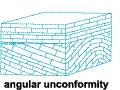
The most famous and obvious kind of unconformity is the angular unconformity. Rocks below the unconformity are tilted and sheared off, and rocks above it are level. The angular unconformity tells a clear story:
First a set of rocks was laid down.
Then these rocks were tilted, then eroded down to a level surface.
Then a younger set of rocks was laid down on top.
The Disconformity
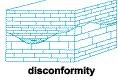
Now, omit the second step: strata are laid down, then a period of erosion happens, then more strata are laid down. The result is a disconformity or parallel unconformity. All the strata line up, but there is still a clear discontinuity in the sequence—maybe a soil layer developed on top of the older rocks, or a rugged surface where they were eroded.
The Paraconformity
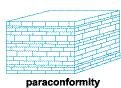
If the discontinuity is not visible, it is called a paraconformity. These are harder to detect, as you might imagine. A sandstone in which trilobite fossils suddenly give way to oyster fossils would be a clear example.
The Nonconformity
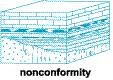
There is a body of rock that is not sedimentary, upon which strata are laid down. Because we aren't comparing two bodies of strata, the notion of them being conformable doesn't apply. This kind of junction between two different major rock types is a nonconformity.
Logging as a find:
Please send me a note with the following:
•The name of this earthcache : GC5H93R 70 mph Geology!
•How many people in your car
1) What kind of unconformity do you see in the ridge to the west?
Sources:
-http://www.geocaching.com/geocache/GC543MV_crystal-cove-a-gap-in-time?guid=be199379-a7c1-4834-8b05-6b90c3570d4a
-http://geology.about.com/od/geoprocesses/a/unconformities.htm