A simple earthcache describing how the landscape you are in, formed and a particular feature.
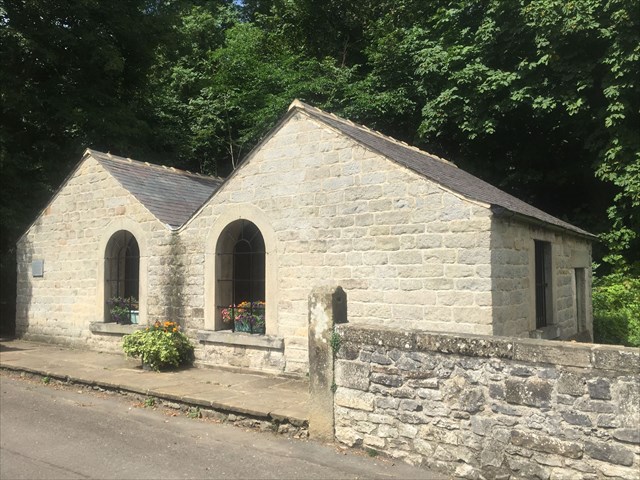
You are standing in front of the reconstruced bath house of Stony Middleton. It is built over a thermal spring. There is no actual evidence that the Romans bathed here. However given the archeological evidence and the local mineral deposits that they mined, it is reasonable to suppose that they did. Springs and wells always had a resonance with earlier cultures. Healing has often been associated with hot springs and there are some Spa towns close by; Buxton and Matlock to name two.The local church is dedicated to St Martin, the patron saint of cripples and soldiers. Maybe this spring is the reason for that.
Stony Middleton lies in the White Peak area of the Derbyshire Dales National Park. The village lies in the Middleton Dale which is a deep limestone gorge. The limestone was deposited 350 to 310 millian years ago during the Carboniferous period. This is a time when Stoney Middleton basked in tropical sunshine near the equator. Limestone is formed from the shells and skeletons of sea creatures that died and settled on the sea bed. Over time (millions of years) the accumulation of untold billions of creatures can form layers thousands of feet in thickness. Over the intervening millions of years the landmass slowly drifted northwards to the present latitude. It's been subjected to lifting and folding to raise it to the current height and to give it a pronounced dome shape.
This gorge was formed the successive floodwaters of four previouse Ice Ages. Fast flowing meltwaters from the receding ice sheets carved out and deepened the gorge forming the steep sided dale you are standing in.
Limestone is, naturally, rich in calcium, think of all those skeletons, in the form of calcium carbonate, CaCO3.
Rain water is slightly acidic. It picks up tiny traces of carbon dioxide from the atmosphere as it passes through the air. The CO2 dissolves in the rain to form weak carbolic acid. This acid is sufficiently strong enough, though, to react with the calium carbonate in the limestone and to slowly dissolve the limestone away. Over time, this chemical process eats away at weaknesses in the rock, creating fissures. Water penetrates underground and creates a subterranean drainage network of channels and caves. Where acidic water carves out limestone the landscape is referred to as 'karst'.
Groundwater seeps down in the manner described but sometimes it meets an impermeable barrier. Typical barriers could be marine clays laid down in deeper seas, before the limestone was formed. This barrier will prevent the water seeping lower so it has to flow laterally. When the water eventually emerges it can do so as a spring, as here.
Thermal springs can get their heat from a number of different sources. By going deep underground, closer to the earth's Mantle, the water will become hotter, which is termed 'geothermally'. Alternatively, water can be heated by volcanic magma, closer to the surface of the Earth. In volcanic areas the water can become super-heated and scalding hot.
To claim this EarthCache you need to visit the site and answer the following questions. A bit of internet searching will give you the rest. While it would be nice to have a photograph it is not compulsory. Please do not reveal any of the answers in your log.
Questions:-
1. What other features can develop in a "karstic" landscapes?
2. How do you think the spring water is heated?
3. In what year was the first prize awarded?