Bristleback (DotA #16 – Calcudoku) Mystery Cache
Bristleback (DotA #16 – Calcudoku)
Please note Use of geocaching.com services is subject to the terms and conditions
in our disclaimer.
Dags för calcudoku och promenad!
Time for a calcudoku and a stroll!
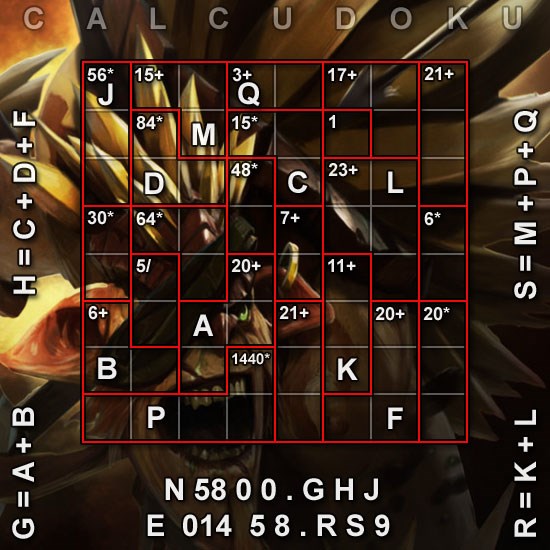
Cachen finns inte vid kartmarkören, utan högst 3 kilometer från denna, utmed lugna och promenadvänliga småvägar på landsbygden söder om Tranås. Du får fram dess koordinater genom att lösa calcudokun på bilden nedan.
En calcudoku är ett sifferpussel som skiljer sig från en vanlig sudoku, då siffrorna ska placeras ut så att matematiska uttryck inom inringade områden blir korrekta.
Alla rader och alla kolumner ska, precis som i en vanlig sudoku, även innehålla alla siffrorna från 1 till calcudokuns storlek exakt en gång vardera (t.ex. siffrorna 1-4 om det är en 4x4-calcudoku eller 1-6 om det är en 6x6-calcudoku).
Calcudokun är indelad i områden (röda kantlinjer på bilden). I varje område står ett värde (t.ex. 4) och en aritmetisk operator (+ = plus, - = minus, * = gånger eller / = delat). Detta innebär att de siffror som man sätter in i områdets rutor (i någon inbördes ordning), med denna operator emellan, ska ge detta värde om det beräknas.
Om det exempelvis står ”4+” i ett två rutor stort område, så måste siffrorna i dessa två rutor vara antingen 3 och 1 eller 1 och 3, då 3 + 1 = 4 och 1 + 3 = 4. De kan inte vara 2 och 2, för två tvåor kan inte placeras bredvid varandra eftersom varje rad samt kolumn bara får innehålla en tvåa.
Om det står ”6*” i ett två rutor stort område, så är möjliga kombinationer som kan stå i de båda rutorna 2 och 3, 3 och 2, 1 och 6 samt 6 och 1, då samtliga av dessa blir 6 om man multiplicerar dem (2 * 3 = 6, 3 * 2 = 6, 1 * 6 = 6 och 6 * 1 = 6).
Om området består av en ensam ruta där det t.ex. står ”5” (utan operator), så fyller man helt enkelt i en 5:a i denna ruta.
I svårare calcudokun kan fler operatorer förekomma, även subtraktion och division. För dessa två operatorer, så är den inbördes ordningen mellan siffrorna valfri när uttrycket ska beräknas.
Om det i en 7x7-calcudoku exempelvis står ”3/” i ett två rutor stort område, så är möjliga siffror i de båda rutorna därför antingen 1 och 3, 3 och 1, 2 och 6 eller 6 och 2, då 3 / 1 = 3 och 6 / 2 = 3.
Till skillnad från i en vanlig sudoku, så får man i en calcudoku inga siffror från början. En bra idé är dock att börja med att fylla i de områden som bara är en enda ruta, och därefter försöka avgöra vilka siffror övriga områden eller rutor måste innehålla, respektive inte kan innehålla.
Uteslut omöjligheter, precis som i en vanlig sudoku, för att lösa den bit för bit.
Det finns bara en enda möjlig lösning på varje calcudoku, vilken du har fått fram när du har fyllt i siffror i alla rutor, så att alla rader och kolumner innehåller siffrorna 1-calcudokuns storlek exakt en gång vardera, samtidigt som de matematiska uttrycken i varje område stämmer (med valfri ordning mellan de ingående siffrorna i de områden där multiplikation eller division används).
När calcudokun är löst, så kommer du att ha siffror i rutorna med bokstäver. Sätt in dessa siffror på bokstävernas plats i koordinatformeln eller ekvationerna, så får du cachens koordinater.
---
The cache is not at the map marker, but as most 3 kilometers away from it, along calm roads and paths that are great to walk on, on the countryside south of Tranås. You get the coordinates by solving the calcudoku on the picture below.
A calcudoku is a number puzzle which differs from an ordinary sudoku, where the numbers should be placed in a way such that mathematical expressions will become correct.
All rows and all columns should, just like in an ordinary sudoku, contain the numbers from 1 to the calcudoku’s size exactly one time each (for example the numbers 1-4 if it is a 4x4-calcudoku or 1-6 if it is a 6x6-calcudoku).
The calcudoku is divided into areas (red borders on the picture). Each area has a value written in it (for example 4) and an arithmetic operator (+ = addition, - = subtraction, * = multiplication or / = division). This means that the numbers that you insert into the boxes in the area (in some internal order), with this operator between, should give that value if calculated.
For example, if it says “4+” in a two boxes big area, the numbers in those boxes will have to be either 3 and 1 or 1 and 3, since 3 + 1 = 4 and 1 + 3 = 4. They can’t be 2 and 2, because two twos can’t be placed next to each other since every row and every column can only contain the number 2 once.
If it says “6*” in a two boxes big area, possible combinations of numbers in these boxes are 2 and 3, 3 and 2, 1 and 6 or 6 and 1, since all of these combinations will be 6 if you multiply them (2 * 3 = 6, 3 * 2 = 6, 1 * 6 = 6 and 6 * 1 = 6).
If the area is a lonely box where it for example just says “5” (without an operator), you just write a 5 in that box.
In harder calcudokus, more operators may be used, including subtraction and division. For these two operators, the internal order between the numbers can be chosen when the expression is calculated.
For example, in a 7x7 calcudoku, if it says ”3/” in an area which is two boxes big, possible numbers in the two boxes are either 1 and 3, 3 and 1, 2 and 6 or 6 and 2, since 3 / 1 = 3 and 6 / 2 = 3.
Unlike a normal sudoku, you won’t get any numbers from the start in a calcudoku. Therefore, a good idea is to start with the areas which are just one box big, and after that try to determine which numbers other areas or boxes have to contain, or can’t possibly contain.
Remove impossibilities, just like in an ordinary sudoku, to solve it a little bit at the time.
There is only one possible solution to each calcudoku, and you will find it when you have written numbers in all the boxes, such that all rows and all columns contain the numbers 1-the calcudoku’s size exactly one time each, at the same time as the mathematical expressions in all areas are correct (with some internal order for the numbers in the expression, if multiplication or division is used).
When the calcudoku has been solved, you will have numbers in the boxes with letters in them on the picture. Insert these numbers on the spots of the letters in the coordinate formula or equations, and you will get the cache coordinates.
Om du vill, så kan du använda GeoCheck för att kontrollera att dina koordinatsiffror är korrekta.
If you want to, you can use GeoCheck to make sure that your coordinates are correct.
Additional Hints
(Decrypt)
V geäqrg. Qh fxn VAGR xyäggen hcc, Fjrexre, zra qh yäfre iäy vagr yrqgeåqra söeeäa qh erqna äe hccr v geäqgbccra, fbz inayvtg! / Va gur gerr. Lbh fubhyq ABG pyvzo hc, Fjrexre, ohg V thrff lbh jba'g ernq gur pyhr hagvy lbh'er nyernql va gur gerrgbc, nf hfhny!
Treasures
You'll collect a digital Treasure from one of these collections when you find and log this geocache:

Loading Treasures