This is the second attempt at placing a cache close to what is now left of the derelict northern annexe of St Andrew's Hospital, formerly the Norfolk County Asylum.
At time of placing the original cache some demolition works had commenced to the far west wing, these continued over the whole annexe save for the central section and bell tower. It is understood the site will be redeveloped into office buildings..
Parking is available in Northside and Central Avenue, but will be difficult during office hours. Beware of parking illegally - I work nearby and have seen cars being towed!
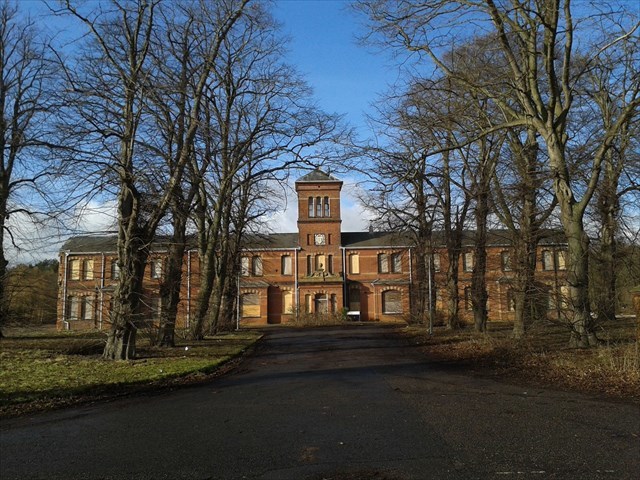
History of St Andrew's Hospital (by Evelyn Simak, from Geograph website:
Problems created by the 'furiously and dangerously mad' were recognised by the 'Vagrancy Acts' of 1714 and 1744, which allowed justices of the peace to order their detention. 18th-century law held such persons responsible for any criminal acts, and prisons or bridewells (houses of correction) were the main destinations for their secure accommodation. Philanthropic efforts had already produced some care homes but the 1808 'Act for the better Care and Maintenance of Lunatics, being Paupers or Criminals in England' resulted in the construction of a number of large asylums ranging in capacity from 40 to 3,500 inmates. County Asylums were placed throughout the Country, usually (but not always) within the County they served and sites deemed suitable would commonly be large isolated tracts of land, often served by minor roads and branch railways, the qualities of such sites providing the ideal curative sources for good light, fresh clean air and a nice views across farmland and woodland. Locally they provided a sustainable source of employment for generations and developed their own communities to serve them. Further afield they were often viewed with suspicion or fear - a distant place where disturbed local people or relatives would be 'removed' to, and often surrounded with much folklore.
The Norfolk Lunatic Asylum was situated in Yarmouth Road, Thorpe St Andrew near Norwich. The architects were Francis Stone and John Brown (Norfolk County Surveyors) and Robinson Cornish and Gaymer of North Walsham. The County Asylum was intended specifically for pauper lunatics and was only the second institution of its kind when completed in early 1814. The buildings were originally designed for the reception of 40 male patients in April 1814, followed by female patients in June of the same year. Roughly 70 patients were present on average in the early years. Extensions in 1831 and 1840 allowed this number to double and more substantial additions in the late 1850s as well as the construction of an auxiliary asylum, which was completed in 1881, some 700 inpatients could be accommodated. The auxiliary asylum or annexe is situated to the north of the main buildings, on the other side of Yarmouth Road, connected by a lane that was carried over the main road by a bridge. In April 1889 the institution was re-titled the Norfolk County Asylum, and after its modernisation into 'a hospital for mental disorders' (with reorganisation into distinct male and female asylums) there was room for more than 1,000 patients.
Patient care was disrupted by the outbreak of WWI, with most of the patients being evacuated to other institutions across eastern England. In 1915 the Norfolk County Asylum became the Norfolk War Hospital for military casualties and when the asylum was re-converted in 1920 it was named Norfolk Mental Hospital although the local use of the alternative, St Andrew's Hospital, was officially recognised from January 1924 onwards. In the period between the two wars the hospital housed more than 1,100 patients. During WWII the hospital was used as a multi-purpose hospital, providing the additional functions of an Emergency Section hospital such as receiving refugees, evacuees and civilian casualties in cleared wards whilst maintaining its complement of mental patients.
From the 1950s onwards - with improved therapies and new medications, the changing perceptions of patients' rights, and increasingly critical assessment of the psychiatric hospital as as an appropriate setting - St Andrew's spent most of its years as an NHS hospital under threat of closure, a long drawn-out process that was ultimately resolved with the securing in 1994 of a separate NHS Trust for mental health care services in Norfolk. The hospital was eventually closed in April 1998. The original grade II listed hospital buildings from 1814, situated to the south of Yarmouth Road, have since been converted into private housing. The complex incorporates a church (in Francis Stone Court), also converted for domestic use. There is no trace of the nearby cemetery which was presumably built over when the hospital became disused (it is still marked on OS maps).
In January 2011 the auxiliary asylum - St Andrew’s House and its 13-acre site - situated north of Yarmouth Road, on the edge of St Andrew’s Business Park that has sprung up around it, has been put on the market by NHS Norfolk, touted as a prime site for development. It was most recently used as offices by the Norfolk Primary Care Trust, now NHS Norfolk, which left in 2007 for more modern premises.
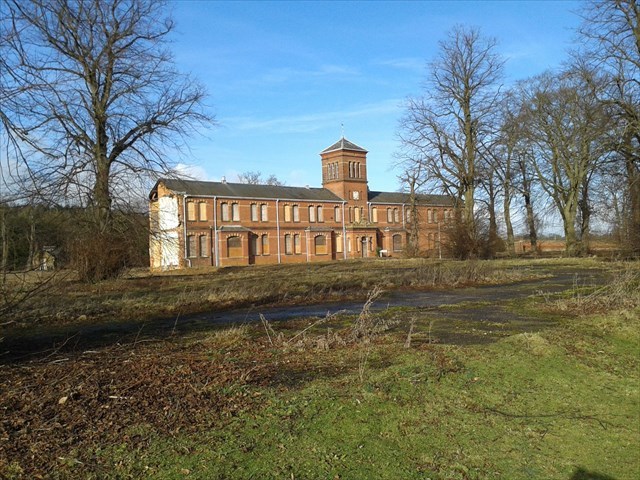
Remaining central section of the hospital, February 2015
Personally I have once been inside the hospital - in the mid-1990's I had a days job from a temp agency assisting clearing an office in the complex; I have vague memories of typical hospital type rooms and corridors. If you search for 'St Andrews Hospital' or Urban Exploration online you will turn up photos taken by people who enter these derelict buildings for a hobby, and show it in all it's majestic run down Victorian splendour!