|
Introduction :
Sandstone is a detrital rock that formed about 370 million years ago during the primary era in the Devonian period on the Famennian stage.
Sandstone's formation :
A detrital rock is a rock formed by the accumulation of sediments, so sandstone comes from the accumulation of sand banks deposited at the bottom of the sea that undergo the phenomenon of sedimentation: under their own weight, these deposits are packed and gradually sunk (phenomenon of subsidence).
By diagenesis (all chemical and mechanical processes that affect a sedimentary deposit), the sand grains are cemented by precipitation and crystallization of dissolved salts in the pore water.
If the degree of cementation is weak, the rock is so friable as if it's high, the rock is hard and consistent.
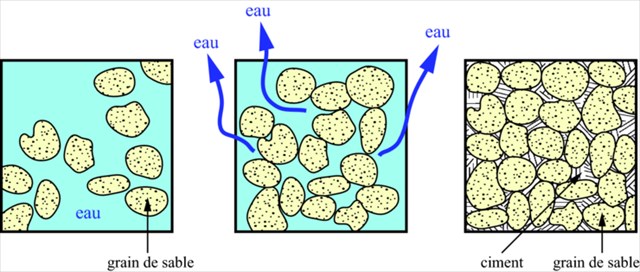
Sandstone is then, a sedimentary rock composed of grains of sand (quartz or silica) connected by a variable nature of cement (siliceous, calcareous or ferruginous) which the quality and color of the sandstone depends on: clear or yellowish white to grayish, the sandstone can also be colored in yellow, red or green by iron oxides.
The sandstone can sometimes be hillock: its surface has bumps.
Reminder on "Earthcaches": There is no container or logbook on the given coordinates. Just visit the site and answer the questions by e-mail.There is no need to wait for my reply, feel free to log immediately after. If the answers are incorrect, I will let you know. Happy caching!
To validate your visit:
This EarthCache initially lead you to the belfry of Bethune, a monument built largely of sandstone. (N 50 ° 31,860 E 002 ° 38,350)
1-. Does the belfry was built with sandstone of different colors or not? If yes, give me the colours that you see and the colour that is majority. Then deduce the oxidation level of the iron during the formation of the sandstone.
2-. After this general observation, move closer to the belfry, touch the stone and try to find answers to the following questions: What do you feel? Is it smooth, grainy, soft, rough? How can you connect your comments with the sandstone formation process?
Then go to the theater of Bethune (N 50 ° 31,813 E 002 ° 38,559)
3-. How many blocks of sandstone can you seen all around the theater? Do you think that these blocks were formed in the same conditions or not? (help: compare the block of the coordinates above with the rest of the blocks)
Go now to the bastion St. Pry, where you will find the remains of ancient walls of the city of Bethune (N 50 ° 31,720 E 002 ° 38.110)
4-. There is an information board, complete the following sentence: It was found that the masonry had been built with ............... ......... ...............
5-. Finally, cross the road in the direction of N 50 ° 31,710 E 002 ° 38,180 you will find the last remains of the defensive wall of Vauban,sandstone and other rocks were utilised to build it, what are these other rocks and from what were they formed?
You can contact me in: English, French or Spanish.
|