
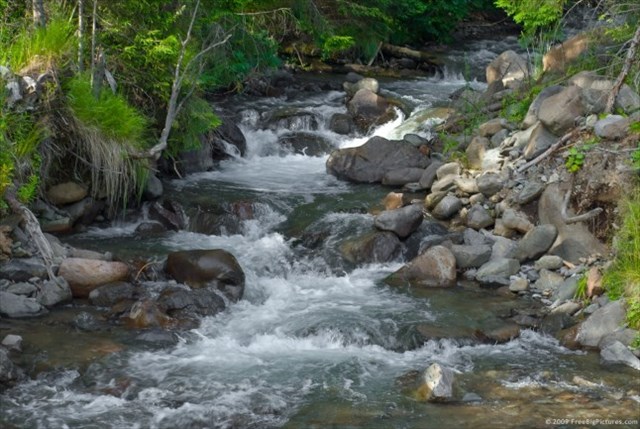
A river is a natural flowing watercourse, usually freshwater, flowing towards an ocean, a lake, a sea, or another river. In some rare cases a river could flow into the ground and dry up completely at the end of its course, without reaching another body of water. Small rivers may be called by several other names, including stream, creek, brook, rivulet, andrill. There are no official definitions for generic terms, such as river, as applied to geographic features, although in some countries or communities a stream may be defined by its size. Many names for small rivers are specific to geographic location; examples are "run" in some parts of the United States, "burn" in Scotland and northeast England, and "beck" in northern England. Sometimes a river is defined as being larger than a creek, but not always: the language is vague.
Rivers are part of the hydrological cycle. Water generally collects in a river from precipitation through a drainage basin from surface runoff and other sources such asgroundwater recharge, springs, and the release of stored water in natural ice and snowpacks (e.g. from glaciers). Potamology is the scientific study of rivers while limnology is the study of inland waters in general.
At the given co-ordinates a small tributory stream joins the main Euchan Water, please e mail me the answers to the following questions.
1. The Euchan Water makes a dramatic change in direction here, in you own words what causes this.
2. Estimate the difference in height between the Euchan Water and the tributory.
3. In your own words what causes the difference in levels.