|
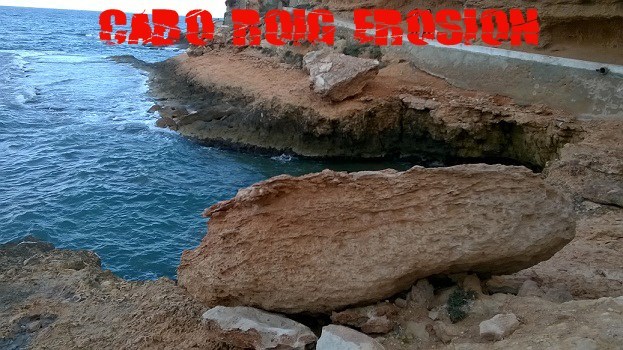
 Version en castellano más abajo Version en castellano más abajo
The four main types of coastal erosion are Abrasion, Hydraulic action, Corrosion and Attrition.
Abrasion - Where sand and shingle are picked up by waves and scrap along the coastline.
Hydraulic Action - The pounding affect of water on the coastline during storms. Also water and air is compressed into joints and cracks and weakens the rock.
Corrosion - When certain types of cliff erodes by the weak acids in the sea.
Attrition - When the waves causes rocks and pebbles to bump into each other and break.
CLIFF COLLAPSE
 Cliffs collapse for a number of reasons, including the rate and type of weathering acting upon the front edge of the cliff or the cliff face, and the rate and type of erosion occurring at the cliff base. These 2 processes are dependent upon various factors including: The size and power of the waves attacking the coastline The material that makes up the coastline - sandstones and weak clays will collapse quicker than more solid Granite The structure of the rock, rocks with vertical faults and horizontal bedding planes are more susceptible to erosion. The climate of the area - warm humid climates favour more chemical weathering. Where the waves strike the cliff face. Cliffs can collapse in a number of different movements, called mass movements. Cliffs collapse for a number of reasons, including the rate and type of weathering acting upon the front edge of the cliff or the cliff face, and the rate and type of erosion occurring at the cliff base. These 2 processes are dependent upon various factors including: The size and power of the waves attacking the coastline The material that makes up the coastline - sandstones and weak clays will collapse quicker than more solid Granite The structure of the rock, rocks with vertical faults and horizontal bedding planes are more susceptible to erosion. The climate of the area - warm humid climates favour more chemical weathering. Where the waves strike the cliff face. Cliffs can collapse in a number of different movements, called mass movements.
Slumping/Rotational slips
Here the water from the sea or rainfall, can build up in soils and add weight to it. The material moves down slope along a curved surface, leaving behind an exposed scarp face below the head of the slump, and producing a hummocky toe at the foot.
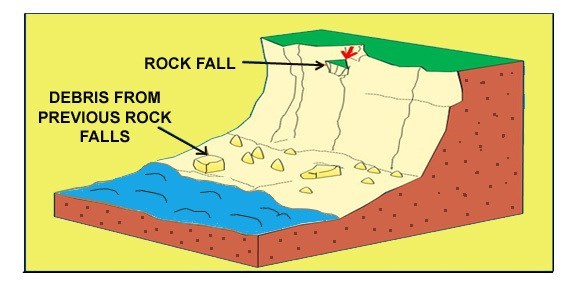
Rock falls
Here, large and small fragments of rock are continually weathered and eroded until they separate and fall from the cliff as whole parts. In cold weather lands this is often due to freeze thaw weathering.
Land slides
Where rocks are laid down in beds that slope (dip) down towards the sea whole layers can slide down slope along a slide plane.
Mudflow
This is where saturated soil and weak rock flows down a slope and produces a lobe - sometimes called a solifluction lobe.
The earthcache
Tasks to validate this Earthcache:
1) In the specified coordinates, from the sea promenade, stroke the cliff wall and explain what type of material you think is: sand, clay, granite, limestone ...
2) Describe how it is the hand touch: rough, smooth, sharp-pointed, hard, easily crumbles ...
3) What type of coastal erosion do you think that most influence has on the cliff and why?
5) Voluntarily a photo of you in the area will be welcome, as well as photos about geological details on site.
Once you get the answers please email me through my profile. You don't need my confirmation about the correct answers to log. Please log your visit directly, including your voluntary photo and if there is some problem about the matter I'll contact with you.
Logs that include the answers will be deleted without notice.
TIPS
If you walk out of the promenade beware, there may be potentially dangerous places at risk of falling.
PLEASE BE CAREFUL!

Los cuatro tipos principales de erosion costera son Abrasion, Acción hidráulica, Corrosion y Desgaste.
Abrasion - Cuando la arena y las piedras son recogidos por las olas y se rompen a lo largo de la costa.
Accion Hidraúlica - El efecto de la erosion ocasionado por el agua de lluvia durante las tormentas. Tambien el agua y el aire se comprimen en juntas y grietas debilitando las rocas.
Corrosion - Cuando ciertos tipos de acantilados son erosionados por sustancias ácidas disueltas en el agua de mar.
Desgaste - Cuando las olas hacen que las rocas y los guijarros choquen entre sí y se rompan.
DERRUMBE DE ACANTILADOS
 Los acantilados se derrumban por varias razones, fundamentalmente debido la intensidad y el tipo de meteorización que actúa sobre la pared y en la base del acantilado. Estos dos procesos dependen de varios factores: El tamaño y la fuerza de las olas que rompen en la costa El material del que se compone la costa, las arcillas débiles o areniscas provocaran derrumbes más fácilmente que por ejemplo el granito que es más sólido. La estructura de las rocas, las rocas con fallas verticales y horizontales son más susceptibles a la erosión. El clima de la zona los climas cálidos y húmedos favorecen más la meteorización química. Los acantilados pueden derrumbarse por una serie de diferentes movimientos, llamados "movimientos de masas": Los acantilados se derrumban por varias razones, fundamentalmente debido la intensidad y el tipo de meteorización que actúa sobre la pared y en la base del acantilado. Estos dos procesos dependen de varios factores: El tamaño y la fuerza de las olas que rompen en la costa El material del que se compone la costa, las arcillas débiles o areniscas provocaran derrumbes más fácilmente que por ejemplo el granito que es más sólido. La estructura de las rocas, las rocas con fallas verticales y horizontales son más susceptibles a la erosión. El clima de la zona los climas cálidos y húmedos favorecen más la meteorización química. Los acantilados pueden derrumbarse por una serie de diferentes movimientos, llamados "movimientos de masas":
Hundimientos / corrimientos rotatorios
Aquí el agua, procedente del propio mar o de las lluvias, puede acumularse en el suelo y añade peso a la misma. El material se mueve hacia abajo por la pendiente, dejando tras de sí una cara escarpada por debajo del hundimiento, dejando restos acumulados del desprendimiento en forma de rocas en la base de dicho acantilado.
Caída de rocas
Grandes y pequeños fragmentos del terreno son desgastados continuamente y erosionados hasta que se separan y caen al acantilado en forma de rocas. En algunos lugares de clima frío esto ocurre en los deshielos, debido a la meteorización por congelación.
Deslizamientos de tierras
Cuando las rocas se disponen en láminas en pendiente hacia abajo, algunas capas de material rocoso pueden deslizarse por dicha pendiente con dirección al mar.
Flujo de lodo
Este fenomeno se produce cuando el suelo saturado y la roca débil fluyen por una pendiente y produce un lóbulo llamado de solifluxión.

El earthcache
Tareas para validar este Earthcache:
1) En las coordenadas especificadas, desde el paseo marítimo, toca la pared del acantilado y explica el tipo de material del cual crees que se trata: arenoso, arcilloso, granítico, calizo…
2) Describe cómo es al tacto: áspero, suave, puntiagudo, duro, se desmorona fácilmente…
3) ¿Qué tipo de erosión costera piensas que influye más en la pared del acantilado y por qué?
4) Voluntariamente una foto vuestra en las inmediaciones del acantilado será bienvenida, así como fotos sobre detalles geológicos de dicho terreno.
Una vez que tengáis las respuestas por favor enviarme un correo electrónico a través de mi perfil. No necesitáis mi confirmación a las respuestas correctas para loguear el erthcache. Por favor loguear vuestra visita directamente, incluyendo vuestra foto voluntaria y si hay algún problema al respecto me pondré en contacto con vosotros.
Los registros que incluyan las respuestas serán borrados sin previo aviso.
CONSEJOS
Si os salís del paseo marítimo procurar tener cuidado, ya que hay lugares potencialmente peligrosos con riesgo de caída.
¡POR FAVOR SER PRUDENTES!


|