Please be aware for your own safety and don't go up to the top of the ridge on your own! It is not safe! There was an incident on the top of the ridge in October 2017 - see this link for the details.
The GSSA sign has not survived the elements too well and along with the graffiti it is almost unreadable. Here is a much better version.
Terms to understand:
Conglomerate: A sedimentary rock consisting of larger gravel like rocks and pebbles cemented together by finer grained material.
Sandstone: A sedimentary rock formed when sand is compacted into layers.
Quartzite: A metamorphic rock formed when sandstone is subjected to severe heat and pressure.
Johannesburg consists of rocks belonging to the Witwatersrand Supergroup - various sedimentary rocks that have accumulated in layers.
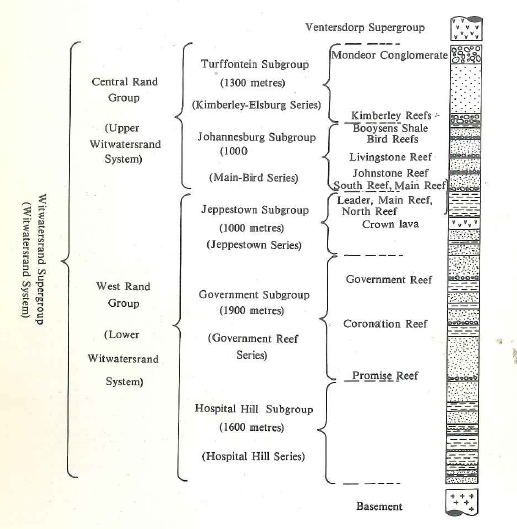
Composition of the Witwatersrand Supergroup.
These rocks are subdivided into two groups. The Central Rand group encompasses the upper rocks and consists of mainly quartzites and conglomerates. The Lower West Rand Group consists of mainly shales and quartzites.
Above GZ around the base of the stairs, you will find rock belonging to the Turffontein Subgroup - Mondeor Conglomerate. But from the above image, you can see that this rock is not on the top and is instead older than the Ventersdorp Lava on top of it. So how did it end up on the surface? After the sedimentary rock was capped by lava, severe faulting and folding occurred which had a profound effect on the local geology. Because of all this movement of the Earth's crust, these rocks, normally only exposed in the southern suburb of Mondeor, are exposed right here in Kensington!
The rocks you see here are quartzite and conglomerate, consisting of pebbles within quartzite rock. 2400 million years ago rivers flowed in this area. The conglomerate formed over a very long time when sediment accumulated in these rivers with pebbles being imbedded into layers of sand. With heat and pressure, the sandstone changed into quartzite and formed this conglomerate rock. After this, lava covered Johannesburg and then there was significant tectonic activity and older rocks were displaced and ended up on the surface. This really muddled up the sedimentary sequence and puzzled geologists for quite some time!
LOGGING REQUIREMENTS
In order to substantiate your visit, please submit your answers to the following questions to me via the Message centre or an email. In your message/email please mention the Earthcache which you are sending answers for. Any logs not accompanied by answers within 7 days will be deleted.
1) Describe the colour, composition and texture of the quartzite and conglomerate rock. How did you distinguish between the two?
2) Since rivers helped form the conglomerate rock, do you think this rock formed upstream or downstream?
3) Please justify your answer to 2).
4) Where do you think the material which makes up these rocks came from?
OPTIONAL: Any non-spoiler photos and/or a photo of you with your GPS by the GSSA sign will be appreciated.
|
References:
1) Mendelsohn, F. and Potgieter, C.T., Guidebook to Sites of Geological and Mining Interest on the Central Witwatersrand, The Geological Society of South Africa, 1986.
2) McCarthy, T.S., Cadle, A.B. and Horrocks, P., Thrust faulting in Witwatersrand rocks at Langerman's Kop, Johannesburg, Transactions of the Geological Society of South Africa, 85, 189-201, 1982.