Just outside Pillsbury Hall there is a pile of rocks. There are several ways rocks can be transported to a location; they can form there naturally by various processes of erosion, they can be carried there by the force of water in a river or by the power of a glacier as erratics or they can simply fall from a bluff by gravity. The rocks here however were all transported by man. There is no natural reason that so many diverse rock types should all have ended up in the same location except that this is the home to many geologists. As you look around you will see sedimentary rocks, including some conglomerates with large rounded rocks embedded within them and some fossil shells. There are also many metamorphic rocks where these igneous or sedimentary rocks have been transformed by heat and pressure into different structures. Feel free to examine them and see if you can find at least one of each of the three major rock types; Igneous, Sedimentary and Metamorphic.

The largest rock in the garden is a tall greenish cylinder that was drilled from a mineshaft near Ely. It is called Ely Greenstone, and it has been sitting outside Pillsbury hall for several decades. That may seem like a long time, but this is an OLD rock garden. This piece of Ely Greenstone (and all the rest of Greenstone formation from which it was extracted) is very, very, very old. It was formed billions (with a B) of years ago and is one of the oldest rocks in the continental US.
It was originally formed on an ocean floor as magma erupted from below the sea floor in a volcanic event, and formed pillow lava. As the lava erupts on the ocean floor the outside solidifies, and the pressure of the erupting lava inside freshly-solidified rock builds up until the solidified outer coat splits and fresh lava emerges, creating a characteristic pillow structure. Because the outside of the pillows cooled very quickly on contact with the sea water it has a slightly different structure from the interior of the pillow which cooled more slowly and was protected from the seawater. If you look carefully at the cylinder you can see the outline of the lava pillows as a darker green / grey color of the Greenstone at the boundary of the pillows.
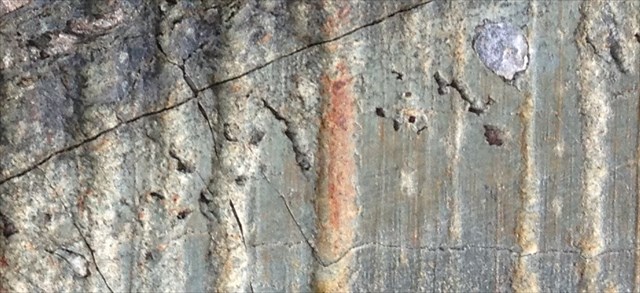
If you look closely at some of the darker pillow edges you will see some very small holes called vesicles in the rock. This is probably where there was steam or other gases in the molten lava that were trapped when it solidified so quickly on contact with the sea water. The extent of the vesicles is an indication of how fast the surface of the lava pillow cooled. In between the lava pillows you will see trapped areas of white rock that set off the Greenstone very nicely, especially when it is polished up and used as a decorative masonry item such as the serpentine pillars in Walter Library entrance hall.
The fresh lava pillows are examples of igneous rock, however over the time between when they were formed and now, they have been transformed by heat and pressure into metamorphic serpentine rock. If this rock, from one of the oldest outcrops in the country, could tell us its story, what a story it would have to tell.
Over its lifetime continents have formed, moved around the surface of the globe and been torn apart. The tectonic plates on which they sit have collided together, creating mountains where one plate rides over another and ocean trenches where the plate edges are pushed down. The mountains have gradually been worn down by the forces of erosion, creating sedimentary rocks, and these mountain-building and erosion cycles have been repeated many times. It is difficult to imagine continents moving, and indeed they do so only very slowly - perhaps only a few mm per year - but over the course of billions of years even that slow continental drift is enough to re-shape the surface of the earth several times over. Here are some highlights of the itinerary of the Ely Greenstone as it moved around the surface of the earth as part of the Laurentian shield:
- Around 2.5 billion years ago, Arctica formed as an independent continent.
- Around 2.45 billion years ago, Arctica was part of the supercontinent Kenorland.
- Around 2.1 billion years ago, Kenorland shattered.
- Around 1.8 billion years ago, Laurentia was part of the supercontinent Columbia.
- Around 1.5 billion years ago, Laurentia was an independent continent.
- Around 1.1 billion years ago, Laurentia was part of the supercontinent Rodinia.
- Around 750 million years ago, Laurentia nearly rifted apart.
- Cambrian (542 to 488 million years ago), Laurentia was an independent continent.
- Devonian (416 to 359 million years ago), Laurentia collided against Baltica, forming the supercontinent Euramerica.
- Permian (299 to 251 million years ago), all major continents collide against each other forming the supercontinent Pangaea.
- Jurassic (199 to 145 million years ago), Pangaea rifted into two supercontinents: Laurasia and Gondwana. Laurentia was part of the minor supercontinent Laurasia.
- Cretaceous (145 to 66 million years ago), Laurentia was an independent continent called North America.
- Neogene (23 million years ago until today), Laurentia, in the form of North America, crashed into South America, forming the supercontinent America.
Like most bedrock the Ely Greenstone will have been covered by layers of material; sedimentary rocks, and the products of erosion and weathering that go to make up the outer layers of soil that we usually see around us. The fact that the Ely Greenstone is accessible so close to the surface is due in part to the glacial river warren that scourged a huge valley over much of Minnesota as the waters of Lake Agassiz that were formed from the melting glaciers broke through the debris that contained them and headed downhill to the present day Gulf of Mexico. The immense amount of water rushing downhill scraped away the overlying rock strata leaving the underlying bedrock exposed, particularly at Ely.
Once this piece of Ely Greenstone was exposed at the surface it was excavated with one of the first core-drills larger than a few inches in diameter used in mining. The drill used steel pellets as abrasives to cut out a core five and a half feet (about 1.68 m) in diameter, and when the shaft had been driven down for several feet, the core was broken off and removed from the shaft. The rock you see here is one part of that core. With a density of about 180 lbs/ft3 (2900 kg/m3 ) the Ely Greenstone is quite dense.
This Ely Greenstone has witnessed a lot of history, and has a story to tell – only some of which you see here. Each of the other rocks you see in the rock garden has its own story to tell of how it was created, what has happened to it over time, and what it has been witness to. Please feel free to examine these other rocks and think about what their stories might be, but do leave them all in place for future visitors.
To log this earthcache please e-mail me the answers to the following questions. Do not put the answers in your log.
1. Based on the image on the information board, how many years has this Ely Greenstone stood here?
2. How old is the Ely Greenstone from which this cylinder is composed?
3. How wide is the region at the edge of the lava pillows visible on the Ely Greenstone that contains the vesicles?
4. What is the oldest rock in this rock garden and how old is it?
5. Estimate the volume of the Ely Greenstone, and using the density given above, calculate its approximate weight.
References
https://en.wikipedia.org/wiki/Igneous_rock
https://en.wikipedia.org/wiki/Laurentia
https://www.esci.umn.edu/sites/www.esci.umn.edu/files/Historic%20Campus%20Geology%20Exploration%20F14.pdf