Fossil Ammonite
Este ejemplar de Ammonite fue un Cefalópodo, ahora ya extinto, de la subclase de moluscos; lo que viene a ser un calamar con concha para nosotros, jeje. Existió entre el Devónico y Cretácico y este se puede ver en el Arrabal de Santiago en una de las piedras.
Es bien sabido por l@s jerezan@S que Jerez hubo un día en el que tenía su propia playa, en la Época del Plioceno de la Era Cenozoica, justo cuando los primeros primates estaban en plena evolución, las laderas de Vallesequillo, toda la Hoyanca, cerrofrutos y San Telmo estaban cubiertas de agua. Todo eso fue hace relativamente poco tiempo.
El Fósil encontrado en la iglesia es bastante anterior, entre Los Periodos Devónico y Cretácico que pertenecen a dos Eras diferentes, el Devónico a la Era Paleozoica y el Cretácico que coincide con la extinción de los dinosaurios a la Era Cenozoica.
Existió por toda Andalucia y parte de la Península un mar llamado Thetis, fue lo que surgió en el momento en el que la Pangea se separo en dos grandes super continentes, llamados Laurasia al norte y Gondwana al sur, es por eso que en Andalucía no tenemos huellas de dinosaurios, aunque creo que en Jaén si que se ha llegado a encontrar algo y hay algún yacimiento.
La tierra emergida en la península llegaba hasta Sierra Morena, toda la "depresión del Guadalquivir" y Andalucía entera estaba bajo el agua, lo que también se conocía como fosa Bética.

This was a copy of Ammonite Cephalopod, now extinct, molluscs subclass; what it comes to be a squid with shell for us, hehe. It existed between the Devonian and Cretaceous and this can be seen in the suburb of Santiago in one of the stones.
It is well known by the people of Jerez in Jerez was a day that had its own beach in the Pliocene epoch of the Cenozoic Era, just as the first primates were evolving, the slopes of Vallesequillo, all Hoyanca, cerrofrutos San Telmo and were covered with water. All that was relatively recently.
Fossil found in the church is much earlier, between Devonian and Cretaceous Periods belonging to two different eras, the Devonian to Cretaceous and Paleozoic Era which coincides with the extinction of the dinosaurs to the Cenozoic Era.
Andalucia existed throughout the peninsula and part of a sea called Thetis, was what appeared at the time where the Pangaea separated into two large super-continent called Gondwana Laurasia to the north and south, that is why no Andalusia We have dinosaur footprints, although I think in Jaen if it has come to find something and there is a reservoir.
The landmass on the peninsula came to Sierra Morena, all "Guadalquivir depression" and whole Andalusia was under water, which is also known as Bética grave.
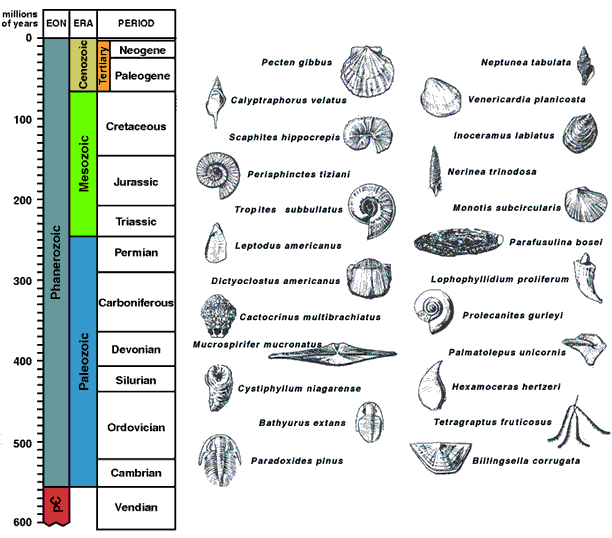
Ammonites, nombre común de un grupo de cefalópodos extinguidos que solían tener un caparazón en espiral enrollado sobre sí mismo. Estos animales, parecidos a los calamares, aparecieron durante el devónico, hace unos 380 millones de años, y desaparecieron junto a los dinosaurios al final del cretácico, hace 65 millones de años. El caparazón de los ammonites tenía cámaras, igual que la de su pariente vivo el nautilo. El animal podía moverse hacia arriba y abajo bombeando el agua hacia dentro o fuera de las cámaras, y vivía en la última y mayor. Sin embargo, algunos tipos de ammonites no tenían un caparazón enrollado; Baculites, por ejemplo, lo tenía recto. Se parecen a los actuales Nautilus.
Los ammonites abundaron en medios marinos de aguas poco profundas en los márgenes de los continentes, aunque fueron unos nadadores bastante lentos y evitaban las aguas de las orillas, dominadas por las olas. También se desarrollaron en los mares continentales, como los que cubrían el interior de Norteamérica durante el periodo cretácico superior, y el antiguo mar Tetis, que una vez ocupó el sur de Europa, el norte de África y partes de Asia.
Los ammonites experimentaron distintos cambios reconocibles fácilmente a lo largo del tiempo, y por tanto, son muy útiles como indicadores de la edad de los hábitats marinos. La comparación de los tipos fósiles de ammonites en las distintas capas de rocas indica la edad relativa de éstas.
Ammonites, common name for a group of extinct cephalopods they used to have a shell spiral wound on itself. These animals, like the calamari, appeared during the Devonian, about 380 million years ago and disappeared along with the dinosaurs at the end of the Cretaceous, 65 million years ago. The shells of ammonites had cameras, like your living relative the nautilus. The animal could move up and down pumping water into or out of the chambers, and lived in the latest and greatest. However, some types of ammonites had no shell wrapped; Baculites, for example, had it right. They resemble the current Nautilus.
The ammonites abounded in the marine shallow water at the edge of the continent, although some were quite slow swimmers and water avoided the banks, dominated by the waves. They were also developed in the continental such as covering the interior of North America during the Late Cretaceous period, and the ancient Tethys Sea, once occupied southern Europe, North Africa and parts of Asia seas.
The ammonites underwent various changes easily recognizable over time, and therefore are useful as indicators of the age of marine habitats. Comparing fossil ammonites types in the different layers of rock indicates the relative age of these.


Para registrar este EarthCaché como encontrado, tiene que visitar el lugar de las coordenadas publicadas, Usted necesita una regla o una cinta métrica.
Una vez tenga las medidas y soluciones a las demás cuestiones debe enviar un email al propietario del EarthCaché con las respuestas correctas.
No es necesario tener la confirmación del propietario para logear como encontrado el cache, puede logear inmediatamente este cache pero debe mandar las respuestas.
El propietario borrará cualquier log found que tenga imagenes del fósil en concreto, también borrará logs que no envien las respuestas o sean incorrectas.
Muchas gracias por la visita a este cache earth en el centro de la ciudad. *****FELIZ GEOCACHING*****
PREGUNTAS
1.- Cuál es el diámetro del ammonite?
2.- A que altura está del suelo?
3.- A que periodo pertenece?
4.- Cuándo desaparecen?
To register this EarthCache as found, has to visit the place of the published coordinates, you need a ruler or tape measure.
Once you have the measures and solutions to other issues must send an email to the owner of EarthCache with the correct answers.
You do not need confirmation from the owner to log in as found the cache, the cache can immediately logear but must send the answers.
The owner found erase any log that has images of the fossil in particular, also delete logs that do not send the answers or be incorrect.
Thank you very much for the visit to this earth cache in the city center. GEOCACHING HAPPY ***** *****
QUESTIONS
1. What is the diameter of the ammonite?
2. How high is the floor?
3. To that period belong?
4. When they disappear?
