Tawhai
Common name: Silver beech
Botanical name: Nothofagus menziesii
The tawhai is a tall forest tree that grows up to 30 metres tall, with a trunk up to 2 metre across. In the forest the tree tends to have its spreading branches arranged more or less in tiers, but if it grows in the open it forms a broad dome shaped tree with its lower branches arching down towards the ground. The tree is found from sea level to 900m from Thames southwards, but does not grow around Mt. Taranaki. In the high mountains of the South Island the tree can even be found in harsh climates growing only a metre or two high, sometimes growing just as a shrub, above the normal bush line.
The timber is red-coloured and has an even straight grain. In the past it has been used for wharf and bridge construction, railway sleepers and house building. More recently it has been used for furniture and decorative work.
I reckon that early Maori came across the tawhai, and named it, before encountering the related tawhairaunui (literally ‘tawhai big leaves’), the name given to the Red beech and visually similar Hard beech, or tawhairauriki (literally ‘tawhai more leaves’), which was the name given to the Black beech and visually similar Mountain beech (both of which already have their own caches in this series). In both cases the Maori names admirably describe the most easily distinguished difference between those species and the ‘plain’ old tawhai.
Bark
The bark is silvery-white on younger trees, but grey and flakey on very old trees. As with other forms of beech they can develop buttresses around the base of the tree. One distinguishing feature of the bark is the horizontal banding around the trunk, which does not occur with the other types of New Zealand beech. On very old trees with flaking bark this banding tends to disappear, but it is clearly visible on the tree at GZ and on some younger tawhai in the vicinity.

Bark showing colour and banding from tree at GZ
Leaves
The leaves are 6-15mm long and the same in width and are arranged alternately along the branchlets. They are thick and leathery, with small serrations on their margins.

Tawhai foliage showing alternate leaf arrangement
Flowers
Tawhai trees bear male and female flowers on the same tree, with female flowers being further out along the branchlets than the male. The flowers are very small, with male flowers being only 3 to 4 mms across and female flowers are much smaller, only about 1 mm, so there is no chance of spotting them from the ground on a mature tree unless you have some good binoculars. Flowering is very irregular from year to year. Flowers are followed by very small nuts.
Flowers are produced at about the same time as the new season’s leaves in October and November, as shown in the photo below (from a tree in CO’s garden). The leaves at this stage are a brighter green than normal and only about half normal size and the male flowers are still green: they take on a slightly reddish colour when they mature and open to release their pollen. I have arrowed the male flowers and female flowers in the photo, with female flowers being particularly hard to spot unless you know what you are looking for and where you are looking for them.

The end of a branch on a tawhai in CO’s garden, showing male and female flowers
After a few months the fertilised female flowers have transformed into tiny seed cupules that are spiky like a lot of tiny green hedgehogs. As these ripen and turn brown they split open to release their seeds. In the photo below you can see a few cupules have started to do that (taken at the beginning of March in CO's garden).
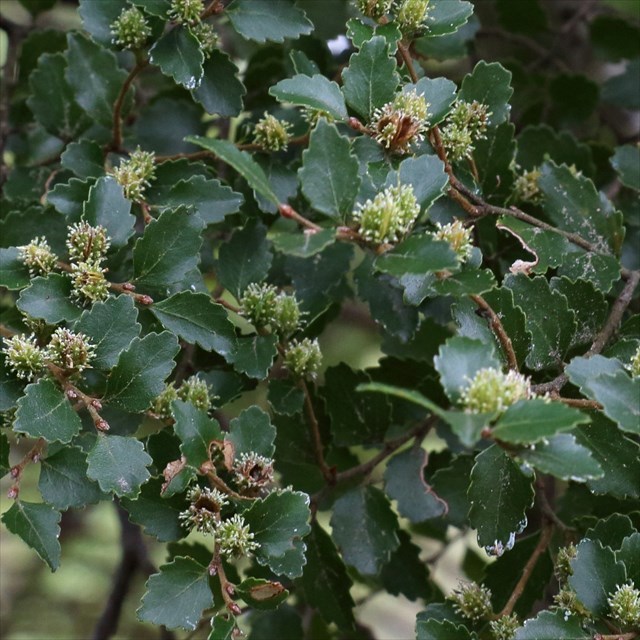
Seed cupules near the tips of the branches, early autumn
The tawhai at GZ
The tree at GZ is probably middle-aged, nowhere near as old or as big as tawhai can get, but still exhibits signs of its maturity. When you are climbing the Kaitoke Ridge Track from the Rivendell end it should virtually leap out at you because for some time on your journey here the trees you pass have pretty much been kamahi, kamahi, kamahi, tawhairaunui, kamahi, kamahi, tahwairaunui, kamahi…you get the picture. I was ecstatic when I saw it: at last, another species of tree for the series!

A nice change from all that kamahi
The cache
The cache is an M&M container (surprise!) and at time of placement contained a log sheet only. Please make sure you bring your own writing implement to sign the log. Online logs that are found not to have a matching entry in the paper log will be deleted. Please rehide carefully to make sure after replacing it that the cache cannot be glimpsed from the track in either direction as it is NOT a camo’d container.