CHARAKTERYSTYKA DZIELNICY MOKRE
POŁOŻENIE
Mimo, że w Toruniu nie wydzielono administracyjnych dzielnic „dzielnica” Mokre zakorzeniła się w głowach mieszkańców tego miasta. Znajduje się ona w północno-wschodniej części Torunia. Od północy graniczy z Katarzynką, na południu od śródmieścia oddziela ją pas przymiejski. Od zachodu dzielnica graniczy z Chełmińskim, a od południowego-wschodu z Jakubskim Przedmieściem i Rubinkowem . Cechy położenia topograficznego sprzyjają dalszej rozbudowie terytorialnej i funkcjonalnej „dzielnicy”. W przeszłości rozwój hamowały tereny podmokłe, które zadecydowały o nazwie wsi, później przekształconej w część Torunia.
HISTORIA
Nazwa Mokre pojawiła się po raz pierwszy w 1258 r. jako miano lasu. Na tym terenie, leżącym poza obszarem patrymonium miasta, powstała wieś Mokre. Założona przez mieszczan toruńskich na prawie chełmińskim, była związana z miastem jedynie ekonomicznie, a nie administracyjnie. Miała ona własną ławę sądową.
Mokre ukształtowało się i rozwinęło przy skrzyżowaniu dwóch szlaków komunikacyjnych: drogi gdańskiej (obecna ul. Grudziądzka) i drogi kowalewskiej (obecna ul. Kościuszki).
Od początku XIX w., w związku z wielkim napływem robotników zatrudnionych przy budowie fortyfikacji, Mokre przekształciło się w typową podmiejską osadę robotniczą.
W 1906 r. Mokre, o obszarze 913,79 ha i liczące ponad 10 tys. mieszkańców, przyłączono do administracji miejskiej Torunia. Wówczas była to dzielnica o bardzo chaotycznej, głównie niskiej zabudowie. Liczne odnogi bocznic kolejowych, prowadzące do licznych obiektów przemysłowych i składowych, przecinały obszary upraw ogrodniczych. W okresie międzywojennym Mokre było dzielnicą zaniedbaną, na peryferiach egzystowały osiedla biedy: Kozackie Góry i Dębowa Góra, składające się z lepianek i szałasów.
Choć po drugiej wojnie światowej powstało wiele nowych osiedli mieszkaniowych, Mokre nadal pełni głównie funkcje dzielnicy przemysłowo-składowej.
Plac Zwycięstwa
Miejsce to zwane jest często placem Artylerzysty ze względu na znajdujący się tutaj pomnik. Tradycje artyleryjskie w Toruniu sięgają początków II Rzeczypospolitej, od tego czasu miasto nazywane było stolicą polskiej artylerii. Po raz pierwszy inicjatywę budowy pomnika Artylerzysty podjęto już w 1937 i wracano do niej wielokrotnie. Powstał dopiero w 1980 roku. W roku 1993 dołączono do niego tablicę upamiętniającą 70 lat istnienia w Toruniu Oficerskiej Szkoły Artylerii. Przed pomnikiem odbywały się promocje oficerskie jej absolwentów oraz inne uroczystości wojskowe. Pomnik symbolizuje artylerię od najdawniejszych czasów. Płaskorzeźby cokołu ujmują wszystkie rodzaje dział polskich biorących udział w II wojnie światowej oraz starszych dział. W górnej części pomnika przedstawiono grupę artylerzystów. Znicz zaprojektowano w kształcie odłamka pocisku artyleryjskiego. Życie dopisało zupełnie niespodziewany finał. Już po wysłaniu skrytek do recenzji przyjechała ekipa budowlana i .... przeniosła pomnik w inne miejsce.
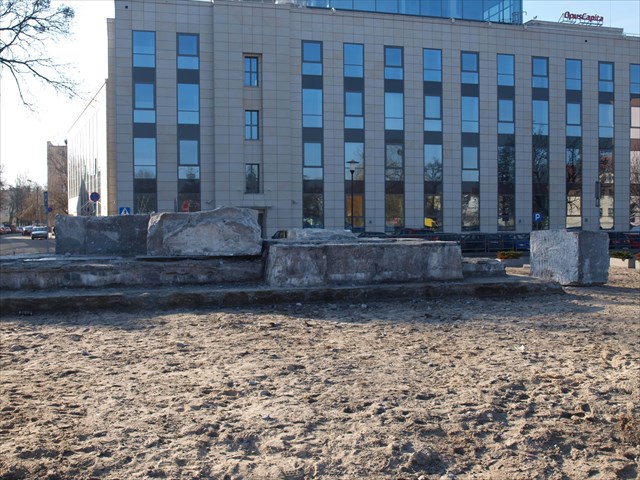
Miejmy nadzieję, że nie ruszą skrytki. A nowe miejsce pobytu pomnika pewnie doczeka się niedługo nowego kesza.
O keszu
Mikro pojemnik w poblizu resztek pomnika. Bardzo proszę o delikatne obchodzenie się z maskowaniem. Nie zapomnij spisać kodu do finału. Weź coś do pisania. Kordy +/- 5 metrów
ENGLISH VERSION
CHARACTERISTICS OF THE MOKRE DISTRICT
LOCATION
Although the city of Toruń is not officially divided into districts, the “district” of Mokre is well established among its inhabitants. Mokre lies in the north-eastern part of Toruń. In the north it borders Katarzynka, in the south it is separated from the city centre with a suburban area. In the west Mokre borders Chełmiński, and in the south-east it borders the districts of Jakubskie Przedmieście and Rubinkowo. The topographical features of the district are conducive to further functional and spatial development. In the past the development of the district was hindered by wetlands (hence the name, meaning “wet”). The village of Mokre was later annexed to Toruń..
HISTORY
The name “Mokre” appeared for the first time in 1258; it was the name of a forest then. On this area, located outside the city’s patrimony, the village of Mokre has been incorporated by the townsmen of Toruń under the Kulm law. The village was connected to the city only by means of economy, and not administration. The village had its own court of assessors.
Mokre was formed and developed where two communication routes: the Gdańsk route (nowadays Grudziądzka street) and Kowalew route (nowadays Kościuszki street) crossed.
From the beginning of the 19th century, in connection with a large inflow of labourers employed on the construction of the city’s fortifications, Mokre became a typical suburban workers’ settlement.
In 1906 Mokre (with 913.79 ha and over 10 thousand inhabitants) was incorporated in the administration of Toruń. At that time it was a district with mainly low-rise buildings, arranged in an extremely chaotic manner. The gardening areas were crossed by numerous railway sidings leading to various industrial buildings and depots. In the Interwar Period Mokre was neglected, with poverty ghettos: Kozackie Góry and Dębowa Góra, consisting of mud huts and shanties, on the outskirts.
Although after the World War II many new housing estates were built there, Mokre is still mainly an industrial and depot district.
Victory Square
It is also called the Artilleryman Square because of the memorial that stands here. The tradition of artillery in Toruń reaches back to the beginnings of the Second Republic of Poland; since then the city has been called the capital of Polish artillery. The idea of the Artilleryman Memorial was first suggested as early as in 1937, and since then it has been brought forward many times. The Memorial, however, was not erected until 1980. In 1993 a plaque was erected next to the Memorial, commemorating 70 years of the Artillery’s Officer School in Toruń. The Memorial was the site for the commissions of the school graduates as well as other military ceremonies. The Memorial symbolizes artillery right from its beginnings: bas-reliefs on the plinth depict all kinds of Polish cannons taking part in Word War II as well as older kinds of cannons. In the upper part of the Memorial there is a sculpture of a group of artillerymen. The torch has been designed in the form of a fragment of an artillery shell. However, the life itself added an unexpected punch line. After the caches had been sent for review, a construction team showed up and... moved the Memorial to another site. Let’s hope the cache remains intact. As for the new site of the Memorial, it will probably get its own cache soon.
About the cache
Microcontainer in one of the “flowerpots” at the back of the Memorial. Please handle the camouflage with care. Don’t forget to write down the code you will need for the final. Take something to write with. Coordinates: +/- 5 meters.