Skip to content

Lima Coastline EarthCache

Hidden : 12/12/2015
Difficulty:
1.5 out of 5
Terrain:
1.5 out of 5

Size: Size:   other (other)

Join now to view geocache location details. It's free!

Watch

How Geocaching Works

Please note Use of geocaching.com services is subject to the terms and conditions in our disclaimer.

Geocache Description:


ENGLISH

What is conglomerate?

"Conglomerate is a clastic sedimentary rock that contains large (greater than two millimeters in diameter) rounded clasts. The space between the clasts is generally filled with smaller particles and/or a chemical cement that binds the rock together. Conglomerate can have a variety of compositions. As a clastic sedimentary rock it can contain clasts of any rock material or weathering product that is washed downstream or down current. The rounded clasts of conglomerate can be mineral particles such as quartz or they can be sedimentary, metamorphic or igneous rock fragments. The matrix that binds the large clasts together can be a mixture of sand, mud and chemical cement.

Conglomerate forms where a sediment of rounded clasts at least two millimeters in diameter accumulates. It takes a strong water current to transport and shape particles this large. So the environment of deposition might be along a swiftly flowing stream or a beach with strong waves. There must also be a source of large-size sediment particles somewhere up current. The rounded shape of the clasts reveal that they were tumbled by running water or moving waves. Conglomerates often begins by being deposited as a sediment consisting mainly of pebble and cobble-size clasts. The finer-size sand and clay which fill the spaces between the larger clasts is often deposited later on top of the large clasts and then sifts down between them to fill the interstitial spaces. The deposition of a chemical cement then binds the sediment into a rock.

Conglomerate has very few commercial uses. Its inability to break cleanly makes it a poor candidate for dimension stone and its variable composition makes it a rock of unreliable physical strength and durability. Conglomerate can be crushed to make a fine aggregate that can be used where a low-performance material is suitable. Many conglomerates are colorful and attractive rocks that are rarely used as an ornamental stone for interior use. Analysis of conglomerate can sometimes be used as a prospecting tool. For example: most diamond deposits are hosted in kimberlite. If a conglomerate contains clasts of kimberlite then the source of that kimberlite must be somewhere upstream."

Source:
link


How did form Lima Coastline?

The Rímac and Chillón Rivers eroded deep valleys on the Lima coastal plain during the Late Miocene (~5.3 million years ago), due to at least 485 m of uplift produced by the Nazca Ridge, combined with a sea level low stand of around -50 m. The main paleo-Rímac channel along the southeastern boundary of the alluvial cone was apparently deflected by the Lima Anticline and reached the sea in the vicinity of Morro Solar, whereas the paleo-Chillón ran largely parallel to the anticline, breaching it to enter the Pacific at present-day Magdalena. These valleys were filled by fine-grained sediments, possibly during marine transgression at 1.7 million years ago, which was followed by uplift and regression to below present sea level. Meltwater surges from the Andean Cordillera during subsequent interglacial stades caused an accumulation of coarse, reworked glacial moraine in the Rímac and Chillón fans, forming the Lima Conglomerate and drowning the Lima Anticline. The Rímac and Chillón Rivers subsequently migrated north and westward, possibly in response to tectonic tilting of the landscape, causing silt and mud to accumulate in abandoned channels along the southeastern boundary.


The pebbles are well exposed along the coast side in the cliffs that can be up to 80 m high. The Cordillera is the supplier of the pebbles and gravels that can be encountered here. Conglomerate casts can be up to 80cm large at the coast. The Rimac river has a steep gradient of 1:25 and, according to my sources, thus is largely providing bed load transport. Casts are mostly granites, diorites, gab bros and mesozoic to Cenozoic volcanic rocks. The Lima Conglomerate has a thickness of up to 86m. It is interrupted in parts by lenticular sand- and siltstone lenses that likely represent incursions caused by sea-level variations.

The pebbles of the Lima Conglomerate get washed out and form the beach. The beach is only pebbles but it makes a great and amazing sound when the waves are washing over them and the water flows back: "clak-clak-clak..."

To log this earthcache, send me an email with the answers to the following questions:

1. How do appear Conglomerate rocks? In your opinion what characteristic identifies the Lima Conglomerates?
2. What color are these rocks?
3. You are right now in front of the conglomerate cliff ! How high is this wall (in meters)?
4. OPTIONAL! Post a picture with you or your GPS with Lima Coastline in your background!


ESPAÑOL

¿Cuál es el conglomerado?

Conglomerado es una roca sedimentaria clástica que contiene grandes (más de dos milímetros de diámetro) redondea clastos. El espacio entre la clase generalmente se llena con partículas más pequeñas y / o un adhesivo químico que se une la roca juntos. Conglomerado puede tener una variedad de composiciones. Como una roca sedimentaria clástica puede contener clastos de cualquier material rocoso o producto a la intemperie que está lavado, aguas abajo o hacia abajo actual. Los clastos redondeados de conglomerado pueden ser partículas minerales, tales como el cuarzo o pueden ser fragmentos de rocas sedimentarias, metamórficas o ígneas. La matriz que une a los grandes clastos juntos puede ser una mezcla de arena, barro y cemento química.
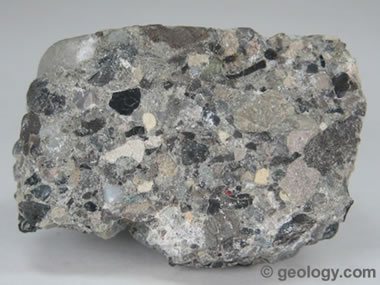
Formas conglomeradas en un sedimento de clastos redondeados al menos dos milímetros de diámetro se acumula. Se necesita una corriente de agua fuerte para transportar y partículas de forma tan grande. Así que el ambiente de deposición puede ser a lo largo de un arroyo que fluye rápidamente o una playa con olas fuertes. También debe haber una fuente de partículas de sedimento de gran tamaño en algún lugar actual. La forma redondeada de la clase revelan que se cayeron por el agua corriente o las ondas en movimiento. Conglomerados menudo comienza al ser depositado como un sedimento que consiste principalmente de guijarros y cantos rodados de tamaño clastos. La arena más fina de tamaño y arcilla que llenan los espacios entre los clastos más grandes a menudo se depositan después en la parte superior de las grandes clastos y luego se desplaza hacia abajo entre ellos para llenar los espacios intersticiales. La deposición de un adhesivo químico se une entonces el sedimento en una roca.

Conglomerado tiene muy pocos usos comerciales. Su incapacidad para romper limpiamente lo convierte en un mal candidato para la piedra dimensión y su composición variable hace que sea una roca de la fuerza física no confiable y durabilidad. Conglomerado puede triturarse para hacer un agregado fino que se puede utilizar en un material de bajo rendimiento es adecuado. Muchos conglomerados son rocas coloridas y atractivas que rara vez se utilizan como piedra ornamental para uso interior. Análisis de conglomerado a veces puede ser utilizado como una herramienta de prospección. Por ejemplo: la mayoría de los yacimientos de diamantes se alojan en kimberlita. Si un conglomerado contiene clastos de kimberlita entonces la fuente de esa kimberlita debe estar en algún lugar aguas arriba.

Fuente:
link


¿Cómo se formaron Lima Litoral?

Los ríos Rímac y Chillón erosionado profundos valles en la planicie costera de Lima durante el Mioceno tardío (~ Hace 5,3 millones de años), debido a al menos 485 m de elevación producida por la Dorsal de Nazca, combinado con un bajo soporte el nivel del mar de alrededor de -50 metro. El principal canal de paleo-Rímac lo largo del límite sureste del cono aluvial aparentemente fue desviado por el Lima anticlinal y alcanzó el mar en las proximidades del Morro Solar, mientras que el paleo-Chillón corrió gran parte paralelo al anticlinal, violar a entrar en el Pacífico en la actual Magdalena. Estos valles fueron ocupados por los sedimentos de grano fino, posiblemente durante transgresión marina en 1,7 millones de años atrás, que fue seguido por el levantamiento y la regresión por debajo de su nivel actual del mar. Meltwater surge de la Cordillera de los Andes durante los estados interglaciares posteriores causaron una acumulación de gruesos, reelaborados morrena glacial en los aficionados Rímac y Chillón, que forman el conglomerado Lima y ahogando el anticlinal de Lima. El Rímac y Chillón Ríos posteriormente migraron hacia el norte y hacia el oeste, posiblemente en respuesta a la inclinación tectónica del paisaje, haciendo que el cieno y el barro que se acumulan en los canales abandonados a lo largo de la frontera.


Las piedras están bien expuestos a lo largo del lado de la costa en los acantilados que puede ser de hasta 80 m de altura. La Cordillera es el proveedor de los guijarros y gravas que se pueden encontrar aquí. Yesos Conglomerado pueden ser de hasta 80cm grande en la costa. El río Rímac tiene una pendiente de 1:25 y, según mis fuentes, por lo tanto está proporcionando gran parte del transporte de carga cama. Los yesos son en su mayoría granitos, Doritos, gabros y mesozoico al Cenozoico rocas volcánicas. El Conglomerado Lima tiene un espesor de hasta 86m. Se interrumpió en partes en arena y siltstone lentes lenticulares que probablemente representan incursiones causadas por las variaciones del nivel del mar.

Los guijarros del Conglomerado Lima se lavan y forman la playa. La playa está a sólo guijarros pero hace una gran y sorprendente sonido cuando las olas están lavando sobre ellos y el agua fluye de nuevo: "clak-clak-clak..."

Para registrar este Earthcache, me envía un correo electrónico con las respuestas a las siguientes preguntas:

1. ¿Cómo no se origina rocas conglomeradas? En su opinión, ¿qué característica identifica los conglomerados Lima?
2. ¿De qué color son las rocas?
3. Usted está ahora delante del acantilado conglomerado! ¿Qué tan alto es este muro (en metros)?
4. ¡OPCIONAL! Publica una foto con usted o su GPS con Lima Costa costa en el fondo!

Additional Hints (No hints available.)