The posted co-ordinates will take you to a point on the beach where you can observe this first hand.PLEASE DO NOT PROGRESS NEAR THE CLIFFS OR UP THE BEACH AS SOME OF THIS IS NOW PRIVATE PROPERTY. Up to ten houses here may be demolished as coastal erosion continues. South Wairarapa District Council is monitoring the houses and recently issued dangerous building notices to two homeowners. A number of houses here have been demolished since 2006 when the issue came to the attention of the council. Parts of other houses have fallen into the sea. Many of these homes have been in the family for more than a generation therefore it must be distressing to see them threatened by erosion.
Here is a link to an article in Stuff April 2016 Couple Heartbroken
And another in the Wairarapa Times Age Feb 2017 Deserted baches, public danger
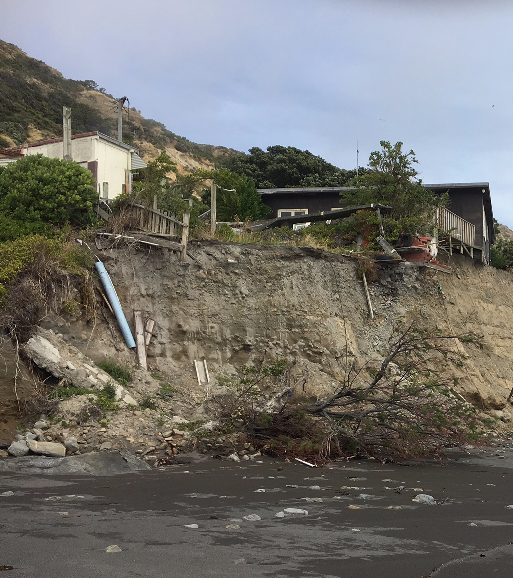
Whatarangi, Cape Palliser Rd
What is coastal erosion? This is the wearing away of land and the removal of beach or dune sediments by wave action, tidal currents, wave currents, drainage or high winds. Waves, generated by storms, wind, or fast moving motor craft, cause coastal erosion, which may take the form of long-term losses of sediment and rocks, or merely the temporary redistribution of coastal sediments.
On non-rocky coasts, coastal erosion may result in dramatic rock formations in areas where the coastline contains rock layers or fracture zones with varying resistance to erosion. Softer areas become eroded much faster than harder ones, which typically result in landforms such as tunnels, bridges, columns, and pillars. Also abrasion commonly happens in areas where there are strong winds, loose sand, and soft rocks. The blowing of millions of sharp sand grains creates a sandblasting effect. This effect helps to erode, smooth and polish rocks.
THE FIVE TYPES OF WAVE ACTION
1. Hydraulic
Hydraulic action occurs when waves striking a cliff face compress air in cracks on the cliff face. This exerts pressure on the surrounding rock, and can progressively splinter and remove pieces. Over time, the cracks can grow, sometimes forming a cave. The splinters fall to the sea bed where they are subjected to further wave action.
2.Attrition
Attrition occurs when waves cause loose pieces of rock debris (scree) to collide with each other, grinding and chipping each other, progressively becoming smaller, smoother and rounder. Scree also collides with the base of the cliff face, chipping small pieces of rock from the cliff or having a corrasion (abrasion) effect, similar to sandpapering.
3.Corrasion (Abrasion)
Corrasion or otherwise known as abrasion occurs when waves break on cliff faces and slowly erode it. As the sea pounds cliff faces it also uses the scree from other wave actions to batter and break off pieces of rock from higher up the cliff face which can be used for this same wave action and attrition.
4. Corrosion
Corrosion occurs when the sea's pH (anything below pH 7.0) corrodes rocks on a cliff face. Limestone cliff faces, which have a moderately high pH, are particularly affected in this way.
5.Solution
Acids contained in sea water will dissolve some types of rock such as chalk or limestone.
FACTORS THAT INFLUENCE EROSION RATES
Primary Factors
The ability of waves to cause erosion of the cliff face depends on many factors.
The hardness (or inversely, the erodibility) of sea-facing rocks is controlled by the rock strength and the presence of fissures, fractures, and beds of non-cohesive materials such as silt and fine sand.
The rate at which cliff fall debris is removed from the foreshore depends on the power of the waves crossing the beach. This energy must reach a critical level to remove material from the debris lobe. Debris lobes can be very persistent and can take many years to completely disappear.
Beaches dissipate wave energy on the foreshore and provide a measure of protection to the adjoining land.
Once stable, the foreshore should widen and become more effective at dissipating the wave energy, so that fewer and less powerful waves reach beyond it. The provision of updrift material coming onto the foreshore beneath the cliff helps to ensure a stable beach.
The adjacent configuration of the seafloor, controls the wave energy arriving at the coast, and can have an important influence on the rate of cliff erosion. Shoals and bars offer protection from wave erosion by causing storm waves to break and dissipate their energy before reaching the shore.
Given the dynamic nature of the seafloor here, changes in the location of shoals and bars may cause the locus of beach or cliff erosion to change position along the shore.
Coastal erosion has been greatly affected by the rising sea levels globally.
Secondary Factors • Weathering and transport slope processes • Slope hydrology • Vegetation • Cliff foot erosion • Cliff foot sediment accumulation • Resistance of cliff foot sediment to attrition and transport • Human Activity
Tertiary Factors • Resource extraction• Coastal management
COASTAL EROSION CONTROL STRATEGIES
There are three common forms of coastal erosion control methods. These three include: soft-erosion controls, hard-erosion controls, and relocation.
1. Hard-erosion controls
Hard-erosion control methods provide a more permanent solution than soft-erosion control methods. Seawalls and groynes serve as semi-permanent infrastructure. These structures are not immune from normal wear-and-tear and will have to be refurbished or rebuilt. It is estimated the average life span of a seawall is 50–100 years and the average for a groyne is 30–40 years. Because of their relative permanence, it is assumed that these structures can be a final solution to erosion. Seawalls can also deprive public access to the beach and drastically alter the natural state of the beach. Groynes also drastically alter the natural state of the beach. Natural forms of hard-erosion control include planting or maintaining native vegetation, such as mangrove forests and coral reefs.
2. Soft-erosion controls
Soft erosion strategies refer to temporary options of slowing the effects of erosion. These options, including Sandbag and beach nourishment, are not intended to be long term solutions or permanent solutions. Another method, beach scraping or beach bulldozing allows for the creation of an artificial dune in front of a building or as means of preserving a building foundation.
3. Relocation
Under this response, humans move from the coast and surrender the coast to the natural processes of both absolute and relative sea level rise and erosion. This solution is eco-centric meaning that the focus is on forcing humans to adapt to the natural processes rather than the opposite. By removing structures along the oceanfront, the beach is surrendered to the natural forces of the ocean. In this case, property owners and coastal communities are essentially “retreating” from the sea. Typically, there has been low public support for “retreating. However, this would be most effective in reducing the impacts of erosion on human society.
Once you complete the EarthCache requirements you can post your find without delay, as per the EarthCache guidelines. You will also need to verify your find by sending us a message and provide your answers to these questions:
1. Use the text "Coastal Erosion - GC6AA2Q" in your email.
2. Describe the wave action type that best fits the erosion occurring here.
3. Which secondary factors are predominantly the cause of the erosion here.
4. Describe the coastal erosion strategies that are evidently being employed here.
Please DO NOT post answers with your log.