When the glaciers retreated from Cape Cod 15,000 years ago, they left behind bare, scoured land. Streams of meltwater flowed over the flat outwash plains depositing layers of sandy material. The first vegetation to start growing were grasses. Forests developed further from the sea, but the coastal terrain remained sandplain grasslands and shrublands (the pine barrens of Cape Cod's characteristic scrub oaks and pitch pine). Taller white pines and deciduous trees were prevented from growing by periodic wildfires across the drought-prone sands. Over time, sandplain grasslands have become rare in Massachusetts, with the Crane Wildlife Management Area being the prime example. In 2014-16, MassWildlife restored the "critically imperiled" habitat here and will maintain it through prescribed burns.
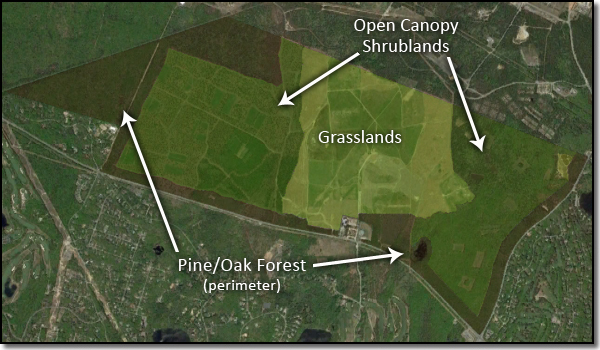
This land also serves a conservation role for sandplain grasslands birds. These birds thrived from the late 1700's to early 1900's while Massachusetts forests were converted to agricultural fields. During the past century, abandoned farms have again become forests, and the birds’ habitat now comprises landfills, airports and power line rights-of-way. Those parcels are often too small for ground-nesting species that require large open meadows for cover and food supply. In addition, pesticide use and aggressive mowing contribute to nest failure.
Of particular concern are the Upland Sandpiper and Grasshopper Sparrow, listed as Endangered and Threatened respectively under the Massachusetts Endangered Species Act (MESA). Both are "area-sensitive," meaning they need 100+ acres with unbroken sightlines for successful breeding. Following the recent restoration work, sandplain grasslands habitat now extends across 400 contiguous acres at Crane WMA. Habitat restoration will also benefit other grasslands birds in decline including the American Kestrel, Bobolink and Eastern Meadowlark.
Now for the puzzle: Imagine that you are a birder assisting researchers with a seasonal bird count. Your assigned station is at the posted coordinates. You pop up a chair and get comfy with your sun hat, binos and thermos of tea. You are given a checklist in the usual order, and you record all the birds you see and hear throughout the morning. If that statement is true, you have the solution.
Submit your report
About the Cape Cod Mini Star series