The Five Pagoda Temple(Chinese 五塔寺), formally known as the "Temple of the Great Righteous Awakening(Chinese 大真觉寺)or "Zhenjue Temple" (Chinese 真觉寺), is a Ming dynasty Buddhist temple located in Haidian District, Beijing, China.
Architecture
The temple has a square foundation, the "diamond throne", that stands 7.7 metres (25 ft) tall. The foundation can be accessed through a spiral staircase and supports five pagodas and a glazed pavilion. Each of the pagodas has a rectangular floor plan. Four of the pagodas are positioned on the corners of the foundation (one pagoda on each corner), the fifth pagoda stands in the center. The five pagodas are associated with the Five Dhyani Buddhas. The corner pagodas have 11 layers of eaves, whereas the slightly taller central pagoda has 13 layers. The total height of the structure from its base to the tip of the central pagoda is 17 metres (56 ft). The building is constructed from brick and white marble, but the building has taken a rusty color due to theoxidation iron traces in the stone. All four walls of the foundations are decorated with carving of the one thousand sagacious Buddhas arranged in rows as well as Buddhist symbols (such as dharma wheels), animals (elephants and peacocks) and floral designs (bodhi trees ), as well as Sūtra texts.
Among the decorations is a pair of footprints that symbolizes the spread of Buddhism all over the world. Traces of red pigments remain from the previous painting of the pedestal. Its Diamond Throne Tower's architectural style is that of a "diamond (Vajra) throne pagoda", which is inspired by the Mahabodhi Temple in Bodh Gaya, India that marks the place where Buddha is said to have attained enlightenment (bodhi). However, the design of the Diamond Throne Pagoda in the Zhenjue Temple differs from that of the Mahabodhi Temple in the proportions of the structure: The pedestal of the Mahabodhi Temple is much lower compared to the overall height than the pedestal in the Zhenjue Temple. Furthermore, the central pagoda in the Mahabodhi Temple is much taller than the corner pagodas, whereas in the Zhenjue Temple, the central pagoda is only slightly higher than the other pagodas. Besides the proportions, the two buildings also differ in the decorations, which have a distinct Chinese style in case of the Zhenjue Temple, e.g., they had glazed-tile roofs.
History
It is not clear how the architectural style of the "Diamond Throne Pagoda" of the Mahabodhi Temple was introduced to China. According to one tradition. the design was presented to the imperial court by the high-ranking Indian monk Pandida during the reign of the Yongle Emperor in the early 15th century. Besides the designs for the diamond throne pagoda, the monk is said to have brought with him five golden Buddha statues. According to the legend, these statues are buried in the temple, one under each pagoda. However, references to such design can be found in much older Chinese art and architecture, for example in a mural painting in the Dunhuang Grottoes that has been dated to theNorthern dynasties, about 1000 years older than the Zhenjue Temple.
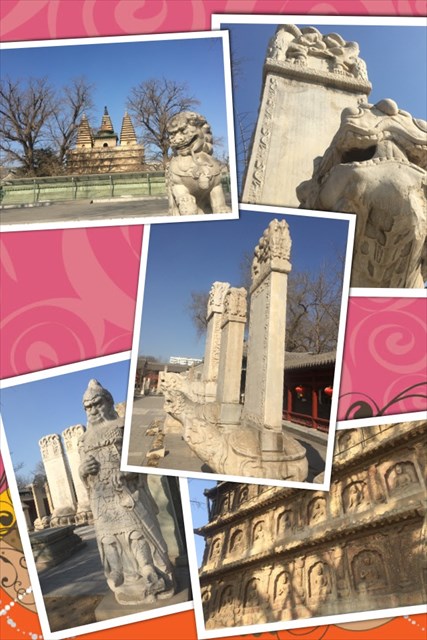 Using the style of the diamond throne pagoda, the temple was constructed later during the reign of the Chenghua Emperor in 1473. Besides the marble construction of the diamond throne pagoda, the temple complex also contained a number wooden buildings; at least six halls were present during the times of the Ming dynasty. The complex underwent renovation during the time of the Qing dynasty in 1761 when the halls were tiled in yellow. The temple complex was damaged by fire in 1860, during the Second Opium War and again in 1900 by the Eight-Nation Alliance that put down the Boxer Rebellion. Only the stone structure of the five pagoda building proper survived the destruction, the wooden halls perished, but the pedestal that once supported the "Big Treasure Hall" remains on the site. At present, the temple houses the Beijing Art Museum of Stone Carvings (Chinese: 北京石刻艺术博物馆 ). The Zhenjue Temple has been listed as a national monument since 1961 (resolution 1-75).
The above content comes from Wikipedia。
五塔寺原名“真觉寺”,位于北京市海淀区西直门外白石桥以东长河北岸,创建于明代永乐年(1403-1424年),寺内高石台上有五座小型石塔,五塔寺金刚宝座塔是印度佛陀伽耶精舍(释迦牟尼得道处迦耶山寺所建的纪念塔)形式的佛塔。
五塔寺约建成于明成化九年(1473年),名为“真觉寺金刚宝座塔”。据史书记载,明永乐初年,印度僧人班迪达自西域来京,向明成祖朱棣呈献了五尊金佛和印度式“佛陀伽耶塔”即金刚宝座的规式。明成祖与他谈经论法十分投机,封他为大国师,授予金印,并赐地于西关(今西直门)外长河(今高梁河)北岸,为之建寺,寺名“真觉”。后又根据这位高僧提供的规式建成了金刚宝座塔,并重修了寺院。
清王朝建立后,乾隆为给其母做寿曾两次重修五塔寺。乾隆十六年第一次重修后为避雍正皇帝“胤禛”名讳,改名为“大正觉寺”。乾隆二十六年是当朝皇太后七十大寿,五塔寺作为祝寿的主要场所之一又进行了全面修葺,并请来一千名喇嘛念经,各国使臣都进贡了寿礼,头戴红顶花翎的大臣们奔波于殿前塔后……当时热闹繁华的情景被绘制在一幅彩图中。图画再现了五塔寺当年的全貌:南临长河,南北向中轴线上依次排列着牌楼、山门、天王殿、大雄宝殿、金刚宝座、毗卢殿、后大殿,东西分别列钟豉褛、廊庑配殿等大小二百馀间旁屋。寺内主要建筑屋顶全部换上黄色琉璃瓦,在阳光照耀下闪闪发光,金碧辉煌,显示出皇家寺院的威严气势。
艺术上,五塔寺金刚宝座塔是印度佛陀伽耶精舍(释迦牟尼得道处迦耶山寺所建的纪念塔)形式的佛塔。 在佛教中宝座和五塔各有由来和讲究。按佛经上说,金刚有五方五界:佛部(中)、金刚部(东)、宝部(南)、莲花部(西)、羯摩部(北)。每部有五方主佛:中为毗卢遮那佛,东为阿闲佛,南为宝生佛,西为阿弥陀佛,北为不空成就佛。佛又有五方宝座,即动物坐骑:大曰狮了座、阿閦象座、宝生马座、阿弥陀孔雀座、不空成就迦楼罗金翅鸟王座,所以五塔寺金刚宝塔宝座和五塔的须弥座四周都有狮子、象、马、孔雀、金翅鸟王等五种动物形象的雕刻。宝座和五塔的须弥座上密布着佛足迹、佛像、五佛宝座、八宝金刚杵、菩提树、法轮、花瓶、天王、罗汉、梵文、卷草等。这些内容大多属藏传佛教题材,对佛学研究有重大参考价值。金刚宝座塔虽然是以印度的“佛陀迦耶塔”为蓝本,但还是融合了我国传统的建筑和雕刻艺术,是中外文化交流的实证。正是由于在历史、艺术、科学上具有的特殊价值,五塔寺金刚宝座塔被列为第一批全国重点文物保护单位。
以上内容来自百度百科“五塔寺”条目。